
Author

admin

Browsing

Graphene is often heralded as the “wonder material” of the 21st century, and investing in graphene companies offers investors exposure to a growing number of graphene applications across a diverse set of industries.

In terms of size, Grand View Research is forecasting that the global graphene market will grow at a compound annual growth rate of 35.1 percent between 2024 and 2030 to reach US$1.61 billion. The firm says that revenue for electronics industry applications will be a major contributor to the growth in demand for graphene.

Demand for graphene coatings and composites will come from the energy storage, aerospace and automotive industries industries, among others. Graphene coatings are used in batteries, conductors and generators to improve energy efficiency and performance, while lightweight graphene composites are being used in aircraft and automobiles.

According to Fortune Business Insights, the graphene market is mainly being driven by demand from the Asia-Pacific region, due in large part to favorable government policies, academic researching and increasing graphene investment. Rising demand from the automotive, marine, aerospace and defense industries in this region are also important factors.

For those interested in how to invest in graphene, here’s a look at seven publicly traded graphene companies making moves in the market today, based on research gleaned from intelligence firms Grand View Research and Fortune Business Insights.

These top graphene stocks are listed in alphabetical order, and all data was accurate as of March 12, 2025.

1. Black Swan Graphene (TSXV:SWAN)

Press ReleasesCompany Profile

Market cap: C$33.19 million

Black Swan Graphene describes itself as an emerging powerhouse in the bulk graphene business. UK-based global chemicals manufacturer Thomas Swan & Co. holds a 15 percent interest in Black Swan and brings a portfolio of patents and intellectual property related to graphene production. Through this partnership, Black Swan is building out a fully integrated supply chain from mine to graphene products.

Black Swan launched a number of new graphene products in 2024, such as its GraphCore 01 family of graphene nanoplatelets products, which includes powders and polymer-ready masterbatches designed for the polymer industry.

In June 2024, the company announced a commercial partnership with advanced materials engineering company Graphene Composites that will see Black Swan’s graphene used in the fabrication of GC Shield, a patented ballistic protection technology.

The following month, the company secured a distribution and sales agreement with UK-based manufacturer of plastic materials Broadway Colours. Under the agreement, Broadway will incorporate Black Swan’s graphene nanoplatelets in the manufacture of graphene enhanced masterbatches for plastic manufacturing.

Black Swan closed on a C$6 million equity financing in February 2025 which will help to fund its capacity expansion and global commercialization plans for 2025.

2. CVD Equipment (NASDAQ:CVV)

Company Profile

Market cap: US$20.65 million

CVD Equipment produces chemical vapor deposition, gas control and other types of equipment and process solutions for developing and creating materials and coatings for a range of industrial applications, including aerospace engine components, medical implants, semiconductors, battery nanomaterials and solar cells.

CVD’s processing can be used to produce graphene and nanomaterials such as carbon nanotubes and silicon nanowires. Its PVT200 system is designed to grow silicon carbide crystals for the manufacture of 200 millimeter wafers. The company’s first nine months of 2024 saw orders worth US$21 million, up from US$19.9 million in the same period in 2023.

In November 2024, CVD reported a US$3.5 million follow on order for a production chemical vapor infiltration system to produce advanced, energy efficient materials for use within gas turbine engines.

3. Directa Plus (LSE:DCTA)

Company Profile

Market cap:GBP 6.9 million

Leading graphene nanoplatelet producer Directa Plus makes products designed for commercial applications such as textiles and composites. The Italy-based firm has developed a patented graphene material named G+ Graphene Plus, which is both portable and scalable. Directa Plus casts a wide net, even using its graphene for golf balls with the aim of improving users’ control and swings using elasticity.

Directa Plus inked in December 2023 what it called a ‘landmark agreement’ to acquire a proprietary system for preparing graphene compounds for market-ready battery and polymer applications, opening up two more potential markets for Directa Plus products.

In April 2024, the company announced the installation of its GiPave high-tech asphalt at the Imola Circuit for the Emilia-Romagna Grand Prix held in May 2024 as part of the Formula 1 World Championship. GiPave uses graphene and recycled plastics to create a cleaner, more sustainable asphalt product.

4. First Graphene (ASX:FGR,OTCQB:FGPHF)

Company Profile

Market cap: AU$27.44 million

First Graphene is an advanced materials company that has developed an environmentally sound method of converting ultra-high-grade graphite into the competitively priced, high-quality graphene in bulk quantities.

The firm is working with three Australian universities on developing graphene products and associated intellectual properties, including PureGRAPH, its graphene powder. First Graphene is vertically integrated, and applications for its products extend to fire retardancy, energy storage and concrete, among others.

In May 2024, the company secured a distribution agreement for the Australia and New Zealand markets, with the potential for additional markets. The five-year contract represents a significant milestone for the commercialization of First Graphene’s PureGRAPH material, according to the press release.

First Graphene joined a nine-member consortium in July 2024 to develop and commercialize lightweight impermeable cryogenic all-composite tanks for the safe storage and transport of liquid hydrogen. The next month, the company secured funding for a collaborative research project aimed at commercializing its Kainos technology for the production of ‘high-quality, battery-grade synthetic graphite and pristine graphene from petroleum feedstock using a scalable hydrodynamic cavitation manufacturing process.’

First Graphene kicked off the new year in 2025 with the announcement that its Kainos technology had secured patents from the Australian and South Korean governments. The following month, the company completed a AU$2.4 million private placement to help fund the acceleration of its global commercial pipeline.

5. Haydale Graphene Industries (LSE:HAYD,OTC Pink:HDGHF)

Company Profile

Market cap: GBP 4.13 million

Through its subsidiaries, Haydale Graphene Industries designs, develops and commercializes advanced materials. The company is focused on commercializing its proprietary heating ink-based technology and integrating graphene and other nanomaterials into next-generation industrial applications.

Haydale has a partnership with the University of Manchester’s Graphene Engineering Innovation Centre (GEIC), through which it is researching and developing graphene-based innovations such as conductive ink heating applications for the automotive and future homes sectors.

In July 2024, Haydale announced that a feasibility study has shown initial indications that Haydale’s plasma-functionalized graphene can capture carbon dioxide.

In March 2025, the company announced it had secured new commercial contracts for its new heating systems from Affordable Warmth Solutions to develop a further graphene heater ink product, and with the national gas grid, National Gas Transmission, for the use of its technology in upgrading the gas network.

6. NanoXplore (TSXV:GRA,OTCQX:NNXPF)

Company Profile

Market cap: C$411.17 million

Established in 2011, NanoXplore is able to produce high volumes of graphene at affordable prices due to its unique and environmentally friendly production process. The company’s GrapheneBlack graphene powder can be used in plastic products to greatly increase their reusability and recyclability.

NanoXplore is also targeting lithium-ion batteries with its patented SiliconGraphene battery anode material solution, which employs GrapheneBlack as a coating agent around silicon to make a safer, more reliable cell. NanoXplore’s graphene products are also being used in internal combustion engine vehicles.

In early 2024, as part of its five year strategic plan, NanoXplore increased the production capacity at its plant in Québec, Canada. The capacity expansion will enable the company to meet increased demand from an existing customer for its graphene-enhanced composite products. The customer assumed a significant portion of the expansion costs.

In its fiscal Q2 2025 financials for the quarter ended December 31, 2024, the company reported Q2 total revenues of C$33.12 million, up 14 percent from the same quarter in the previous year.

7. Talga Group (ASX:TLG,OTC Pink:TLGRF)

Company Profile

Market cap: AU$180.377 million

Talga Group is a vertically integrated battery anode and materials company, mining its own graphite and producing anodes. It has operations in Sweden, Japan, Australia, Germany and the UK. The company also produces graphene additives for use by materials manufacturers in applications such as concrete, coatings, plastics and energy storage.

Talga has the Talphite and Talphene lines of graphene products, which include conductive additives for battery cathode and anode products, solid-state anodes and graphite recycling.

In January 2025, the company announced that the Swedish government gave the greenlight to its detailed plan for the Nunasvaara South natural graphite mine in Northern Sweden. The Kiruna municipality had previously halted planning work, and the federal government instructed it to adopt the plan by May 16 of this year.

Private graphene companies

The graphene stocks listed above are by no means the only graphene-focused companies. Investors interested in graphene would also do well to learn more about the private companies focused on graphene technology, including ACS Material, Advanced Graphene Products, Graphene Platform, Graphenea, Grafoid and Universal Matter.

FAQs for graphene

What is graphene?

Graphene is a single layer of carbon atoms arranged in a hexagonal lattice. First produced in 2004, when professors at England’s University of Manchester used Scotch tape to peel flakes of graphene off of graphite, the material is 200 times stronger than steel and thinner than a single sheet of paper. Graphene has many possible applications in various fields, such as batteries, sensors, solar panels, electronics, medical equipment and sports gear.

What are some good properties of graphene?

Graphene’s outstanding properties include high thermal and electrical conductivity, high elasticity and flexibility, high hardness and resistance, transparency and the ability to generate electricity via exposure to sunlight.

What is the difference between graphene and graphite?

Graphene and graphite are both allotropes of carbon, meaning they are structurally different forms of the same element. A key difference between them is that graphene is a single layer of graphite.

Securities Disclosure: I, Melissa Pistilli, hold no direct investment interest in any company mentioned in this article.

This post appeared first on investingnews.com

Natural gas is a vital source of energy for the global economy, representing about one quarter of electricity generation worldwide.

Natural gas is the largest source of electricity generation in the US, beating out coal as the top power fuel. One of the advantages of investing in natural gas is the important role it plays in the energy transition. For example, natural-gas-fired electricity plants can be quickly turned on and off to serve as a back-up energy supply for intermittent wind and solar power. Even so, global demand can be volatile as it is very much dependent on the weather.

For some investors, natural gas investment remains an exciting frontier and a potentially lucrative portfolio addition. Read on for a more in-depth look at why natural gas investing can be compelling and some of the best natural gas stocks to invest in when the time is right.

In this article

What is natural gas and LNG?
What is driving natural gas prices?
How to invest in natural gas
How to invest in natural gas stocks
How to invest in natural gas ETFs
How to invest in natural gas futures

What is natural gas and LNG?

Natural gas is a hydrocarbon gas mixture that is primarily composed of methane and is found by itself or with oil. Although it’s a carbon-based fuel, natural gas is considered a cleaner form of energy than oil and coal.

LNG, or liquefied natural gas, is a form of natural gas that’s been cooled to a liquid state to reduce transport risk and allow for easier storage.

Natural gas is used as a fuel in home heating and in transportation. It’s also used to manufacture chemicals and materials such as propane, ethane, lubricants, household cleaners, carpet fibers and plastics.

What is driving natural gas prices?

Volatility in natural gas demand often leads to big spikes and declines in natural gas prices. As a fuel for home heating as well as an energy source for air conditioning, the natural gas market is highly attuned to seasonal temperature changes and extreme weather events. Other factors that can influence natural gas prices include production, import and storage inventory levels, according to the US Energy Information Administration (EIA). Geopolitical events are also a major factor.

Natural gas prices reached a 10-year high of US$9.25 per million British thermal units in September 2022 as an energy crisis took hold in Europe following Russia’s invasion of Ukraine. Global supply uncertainty and delivery disruptions were the main culprit.

However, reduced demand from a mild winter demand coinciding with a period of record high production in the United States led to an oversupplied market. This pushed prices for natural gas down below US$3 in the first few weeks of 2023 and prices remained below US$4 for the next two years as the supply overhang remained.

In 2025, a much colder winter and rising geopolitical tensions have sent natural gas prices on an upward trend. The growing threat of war in Europe and the US-Canada trade war are both having an impact on natural gas prices.

The United States is the largest natural gas producer in the world by far. According to the most recent data from the Energy Institute, US natural gas production in 2023 totaled 1.35 trillion cubic meters. That figure represents nearly a quarter of global natural gas production for that year.

The country’s output has grown exponentially over the last decade due to the transition away from coal, and advancements in extraction technology such as horizontal drilling and hydraulic fracturing, also known as fracking. The United States is also the biggest consumer of the fuel, primarily for home heating and generating electricity.

In 2022, in response to Russia’s invasion of Ukraine, the US became the world’s largest exporter of LNG as European nations sought to wean themselves from Russian natural gas.

As for the other top natural gas producing countries, Russia is the second largest natural gas producer and exporter, with 586.4 billion cubic meters of output in 2023. The country also holds the world’s biggest-known natural gas reserves. Up until the end of January 2025, Europe accounted for 49 percent of Russia’s LNG exports, followed by China at 22 percent and Japan at 18 percent. On January 1, 2025, Ukraine let its Russian gas transit agreement expire, which could potentially disrupt natural gas supply chains and jeopardize energy security in Europe.

Iran ranks third in largest natural gas production and second in largest reserves. The Middle Eastern nation produced 251.7 billion cubic meters of the commodity in 2023. Iran plans to increase capacity with an US$80 billion investment in its gas fields and a long-term natural gas supply deal with Russia’s Gazprom for 109 billion cubic meters of gas supplied annually for domestic use and re-export.

China is not far behind Iran, producing a record 234.3 billion cubic meters of natural gas in 2023. Despite this, the Asian nation still relies on imports to meet about half of its demand. The majority of China’s natural gas imports come from Australia, Turkmenistan, the US, Malaysia, Russia and Qatar. In response to the 10 percent tariff imposed on Chinese products to the US imposed under the Trump Administration, China slapped a 15 percent tariff on US LNG imports in mid-February 2025.

Canada rounds out the top five natural gas producers country, with an output of 190.3 billion cubic meters of natural gas in 2023. Canada is also a top natural gas exporter; however, the US is its only trading partner. As of late-February 2025, the LNG Canada project and the Coastal GasLink pipeline is nearly complete with first shipments to the Asian Pacific markets of Japan and South Korea scheduled for mid-2025.

Canada’s natural gas exports to long-time partner the US are currently in question as Trump threatens 25 percent tariffs on Canada, with a lower 10 percent tariff on imports of Canadian natural gas and other energy. Trade negotiators on both sides are trying to work out potential exemptions.

Other trends to watch in this sector, according to the International Energy Agency (IEA), are fast-growing natural gas demand in the Asia Pacific region and the transition from oil to natural gas as the primary energy source in the Middle East.

All of the uncertainty in the markets may be daunting, but investors interested in the potential for natural gas investments should not necessarily be discouraged — after all, while prices for the fuel can reach incredible lows, they can also climb to incredible highs, which no doubt supports companies in the sector.

How to invest in natural gas

Those who decide to invest in natural gas have plenty of ways to gain exposure to the fuel, including natural gas stocks, natural gas ETFs and natural gas futures. Take a look at each of those three best ways to invest in natural gas below. All data and information was current as of March 12, 2025.

How to invest in natural gas stocks

Investors can opt to look at some of the best natural gas companies to invest in this market. Many companies that are exploring for or producing natural gas are also focused on oil, and it can be difficult to find stocks that are aimed purely at natural gas. That said, some of the large-cap NYSE and NASDAQ-listed oil and gas stocks listed below are heavily involved in natural gas.

This list of US natural gas companies is arranged in alphabetical order and all stocks had market caps above US$2 billion when data was gathered.

Antero Resources (NYSE:AR)
Antero Resources is a natural gas and liquids company with operations in the United States’ Appalachian Basin. The company is one of the largest US-based suppliers of natural gas and liquified petroleum gas (LPG) to the global natural gas export market.

Civitas Resources (NYSE:CIVI)
Civitas Resources produces crude oil and liquids-rich natural gas from its assets in the DJ Basin in Colorado and the Permian Basin in Texas and New Mexico. Natural gas and natural gas liquids comprise 32 percent and 30 percent, respectively, of the company’s total proved reserves.

Comstock Resources (NYSE:CRK)
Comstock Resources is a natural gas producer with operations in the Haynesville Shale in North Louisiana and East Texas. This natural gas basin has direct access to Gulf Coast markets and the LNG corridor.

ConocoPhillips (NYSE:COP)
ConocoPhillips is headquartered in Houston, Texas, with operations and exploration activities in 14 countries. In addition to oil and bitumen, its products include natural gas, natural gas liquids and is a leading pioneer in the LNG market.

Coterra Energy (NYSE:CTRA)
Coterra Energy is a Houston, Texas-based energy company with a multi-basin portfolio of operations and deep inventories in the Permian Basin, Marcellus Shale and the Anadarko Basin. Natural gas and natural gas liquids account for 50 percent of the company’s revenues.

Diamondback Energy (NASDAQ:FANG)
Diamondback Energy is a Texas-based oil and gas company operating unconventional, onshore oil and natural gas reserves assets in the Permian Basin. Half of its hydrocarbon reserves are natural gas and natural gas liquids.

Devon Energy (NYSE:DVN)
Devon Energy, based in Oklahoma City, has oil and natural gas exploration and production operations in key US energy resource plays including the Delaware Basin, Eagle Ford, Anadarko Basin, Powder River Basin and Williston Basin. Natural gas production is a focal point of Devon’s growth strategy for 2025.

EOG Resources (NYSE:EOG)
EOG Resources is one the largest US oil and gas producers with significant operations across the US, including in the Barnett Shale, Northeastern Utah’s Uinta Basin and South Texas. The company has a long-term LNG supply contract with major energy trading company Vitol.

Northern Oil & Gas (NYSE:NOG)
Northern Oil & Gas is a non-operator model company with a large portfolio of upstream oil and natural gas assets in the United States. As a non-operator, NOG does not drill or operate rigs, but rather acquires a fractional working interest in drilling operations. This allows the company to benefit from market upside while mitigating costs and downside risks. The company’s properties are primarily in the Williston, Uinta, Permian and Appalachian basins.

Range Resources (NYSE:RRC)
Range Resources is a Fort Worth, Texas-based natural gas exploration and production company. It operates in the Appalachian Basin and is the largest land owner in the Marcellus Formation.

How to invest in natural gas ETFs

Exchange-traded funds (ETFs) are another option for oil and gas investors. Below are a few natural gas-focused ETFs and broader oil and gas ETFs to get you started.

iShares U.S. Oil & Gas Exploration & Production ETF (BATS:IEO)
The iShares U.S. Oil & Gas Exploration & Production ETF offers investors exposure to the US oil and gas industry. While not a good pick for a long-term portfolio, ETF Database says “it can be very useful for more active traders seeking to establish a tilt towards domestic energy companies.” The fund’s top holdings include many of the stocks on this list. The fund’s one-year and three-year returns are -8.14 percent and 6.48 percent, respectively.

SPDR S&P Oil & Gas Exploration & Production ETF (ARCA:XOP)
The SPDR S&P Oil & Gas Exploration & Production ETF is another fund focused on the US energy markets, specifically companies discovering and exploiting new oil and gas deposits. As with IEO, the XOP is not ideal for a long-term investment approach. However, it does offer a more balanced exposure to the same stocks and lower costs than IEO, ‘making it the most attractive option for those seeking to bet on this corner of the U.S. energy market,” ETF Database states. The fund’s one-year and three-year returns are -12.37 percent and 1.18 percent, respectively.

ProShares Ultra Bloomberg Natural Gas ETF (ARCA:BOIL)
The ProShares Ultra Bloomberg Natural Gas ETF offers twice daily leveraged exposure to natural gas. An important caveat is that the volatile nature of the natural gas market makes this ETF for more seasoned investors, ETF Database advises. Taking a look at the fund’s one-year and three-year returns of 37.2 percent and -70.49 percent, respectively, proves this out.

United States Natural Gas Fund (ARCA:UNG)
The United States Natural Gas Fund offers exposure to US natural gas. It can potentially act as an inflation hedge, ETF Database states, although “UNG often suffers from severe contango making the product more appropriate for short-term traders.” The fund’s one-year and three-year returns are 48.37 percent and -29.09 percent, respectively.

United States 12 Month Natural Gas Fund LP (ARCA:UNL)
The United States 12 Month Natural Gas Fund LP differs from UNG in that it “diversifies across multiple maturities, potentially mitigating the adverse impact of contango,” ETF Database explains. The fund’s one-year and three-year returns are 37.17 percent and -10.53 percent, respectively.

How to invest in natural gas futures

Some of the top natural gas futures contracts include Henry Hub Natural Gas Futures, E-mini Natural Gas Futures and Delivered Natural Gas Futures sold through the Chicago Mercantile Exchange Group (CME Group). Futures prices of natural gas are set in contract units of 10,000 MMBtu.

Investors considering investing in natural gas futures should be aware that these contracts are very liquid and extremely active throughout the week.

As for when natural gas futures trade, these futures trade nearly 24 hours a day from Sunday to Friday, with a 60-minute break each day beginning at 5:00 p.m. Eastern Time. Trading in natural gas futures is generally heaviest on Thursdays, when the US Department of Energy releases its weekly natural gas storage report.

Securities Disclosure: I, Melissa Pistilli, hold no direct investment interest in any company mentioned in this article.

This post appeared first on investingnews.com

Perth, Australia (ABN Newswire) – On 20 January 2025, BPH Energy Limited (ASX:BPH) and Bounty Oil & Gas NL (ASX:BUY) as the PEP 11 Joint Venture announced that they had been given notice by the National Offshore Petroleum Titles Administrator (NOPTA) that the Joint Authority had refused the Joint Venture Applications made on 23 January 2020 (First Application) and 17 March 2021 (Second Application) (the Decision).

On 12 February 2025 BPH advised that investee Advent Energy Limited’s (BPH 36.1% direct interest) 100% subsidiary Asset Energy Pty Ltd had applied to the Federal Court for an Originating Application for judicial review pursuant to s 5 of the Administrative Decisions (Judicial Review) Act 1977 (Cth) and s 39B of the Judiciary Act 1903 (Cth) to review a Decision of the Commonwealth-New South Wales Offshore Petroleum Joint Authority, constituted under section 56 of the Offshore Petroleum and Greenhouse Gas Storage Act 2006 (Cth).

The Originating Application seeks:

1. An order quashing or setting aside the Decision;

2. A declaration that the Decision is void and of no effect; and

3. An order remitting the First Application and Second Application to the Joint Authority for reconsideration according to law.

The Federal Court of Australia made orders today by consent including the following:

– By Wednesday 30 April 2025, the first respondent must file and serve one copy of a bundle of documents that was before the Hon Ed Husic MP as the Responsible Commonwealth Minister of the Commonwealth-New South Wales Offshore Petroleum Joint Authority in making the decision that is the subject of this application, subject to any claim to privilege.

– Other than the bundle of material, all evidence relied upon by the parties must be presented by way of affidavit.

– By Wednesday 21 May 2025, the applicant must file and serve any further affidavits upon which it intends to rely at the hearing of the matter.

– By 25 June 2025, the first respondent must file and serve any affidavits upon which it intends to rely at the hearing of the matter.

– By 16 July 2025, the applicant must file and serve any affidavits upon which it intends to rely at the hearing of the matter by way of reply.

– The application be listed for a 2-day hearing at 10.15 am AWST on 16 September 2025 and 17 September 2025.

– The applicant must file and serve an outline of submissions in chief and a list of authorities by 4.00 pm AWST not less than 42 days before the hearing.

– The first respondent must file and serve an outline of submissions in response and a list of authorities by 4.00 pm AWST not less than 14 days before the hearing.

– The applicant must file and serve an outline of submissions in reply and a list of authorities by 4.00 pm AWST not less than 7 days before the hearing.

– The first case management hearing listed for 10.00 am AWST on 19 March 2025 is adjourned to 9.30 am AWST on 23 July 2025.

– Liberty to apply on 3 days’ notice to the other party.

– Pursuant to subsection 15(1)(a) of the Administrative Decisions (Judicial Review) Act 1977 (Cth), the operation of the decision of the Commonwealth-New South Wales Offshore Petroleum Joint Authority comprised of the first respondent and the second respondent made on 16 January 2025 is suspended with effect from 16 January 2025, until further order of this Court.

Asset Energy Pty Ltd is a 100% owned subsidiary of Advent Energy Ltd and lodged the Originating Application as Operator for and on behalf of the PEP11 Joint Venture Partners, Bounty Oil and Gas NL (ASX:BUY) and Asset Energy Pty Ltd.

About BPH Energy Limited:  

BPH Energy Limited (ASX:BPH) is an Australian Securities Exchange listed company developing biomedical research and technologies within Australian Universities and Hospital Institutes.

The company provides early stage funding, project management and commercialisation strategies for a direct collaboration, a spin out company or to secure a license.

BPH provides funding for commercial strategies for proof of concept, research and product development, whilst the institutional partner provides infrastructure and the core scientific expertise.

BPH currently partners with several academic institutions including The Harry Perkins Institute for Medical Research and Swinburne University of Technology (SUT).

Source:
BPH Energy Limited

Contact:
David Breeze
admin@bphenergy.com.au
www.bphenergy.com.au
T: +61 8 9328 8366

News Provided by ABN Newswire via QuoteMedia

This post appeared first on investingnews.com

Flagging global sales and Elon Musk’s increasingly outspoken political activities are combining to rock the value of Tesla.

Shares in the once-trillion-dollar company saw their worst day in five years this week. Year to date, Tesla’s stock has plunged 41% — though it is still up by about 36% over the past 12 months.

On Monday, the stock was down another 5%.

For Musk, Tesla’s shares remain his primary source of paper wealth, though he has also turned his stake in SpaceX into a personal lending tool. But it was proceeds from selling Tesla shares that helped Musk complete his acquisition of Twitter, now known as X.

Musk’s wealth also allowed him to help vault Donald Trump into a second presidential term. Even as Musk’s net worth has diminished as a result of Tesla’s recent share-price declines, data suggests he is in no danger of losing his title as the world’s wealthiest person.

Musk has said on X that he is not concerned about Tesla’s recent drop in value. Still, evidence suggests the company is entering a period of transition.

A spokesperson for Tesla did not respond to a request for comment.

Musk’s wealth has propelled him to a global presence that lacks precedent — and has polarized world opinion about the tech entrepreneur in the process. Any weakening of his financial position, therefore, could undercut his influence in the political and tech spaces where he now commands outsize attention.According to Bank of America, Tesla’s European sales plummeted by about 50% in January compared with the same month a year prior.

Some say this is attributable to a growing distaste for Musk, who has begun dabbling in the continent’s politics in the wake of his successful support of Trump’s candidacy last year.

Others note Tesla’s European market is facing increased competition from the Chinese electric-vehicle maker BYD, which has telegraphed ambitious plans for expansion on the continent.  

A more decisive blow to Tesla’s near-term fortunes may be emanating from China itself. There, Tesla’s shipments plunged 49% in February from a year earlier, to just 30,688 vehicles, according to official data cited by Bloomberg News. That’s the lowest monthly figure registered since July 2022 — amid the throes of Covid-19 — when it shipped just 28,217 EVs, Bloomberg said.

This post appeared first on NBC NEWS

Over a double cheeseburger and fries, Robert F. Kennedy Jr. told Fox News host Sean Hannity earlier this month of his plans to improve the country’s health by incentivizing companies to step away from processed foods.

From across the red high-top table of a Florida Steak ’n Shake, the health and human services secretary went on to praise the Indianapolis-based fast-food chain as a shining example of change since it began cooking its shoestring fries in beef tallow instead of one of the many seed oils that have become targets of Kennedy’s health agenda.

“Steak ’n Shake has been great,” Kennedy said. “We’re very grateful to them for RFK’ing the french fries.”

The nationally televised praise marked the latest conservative endorsement for Steak ’n Shake, a 91-year-old company with 450 locations nationwide that has become one of the most high-profile businesses to support Kennedy’s “Make America Healthy Again” agenda — a move that has been boosted by Republican politicians and MAGA influencers including Rep. Anna Paulina Luna, Charlie Kirk, Laura Loomer, Kari Lake, Tony Shaffer and Benny Johnson.

“I just had a cheeseburger and fries cooked in beef tallow today for lunch! Delicious!!” Rep. Marjorie Taylor Greene, R-Ga., wrote on X.

At a time when many companies might be looking to avoid politics, Steak ’n Shake is opting to publicly align itself with Kennedy and other high-profile conservatives. On social media, the brand has transformed its feed from the usual steam of burgers and shakes into a near nonstop stream of Trump-adjacent iconography: Elon Musk, Teslas, Fox News clips and even a red hat emblazoned with the words “Make Frying Oil Tallow Again,” a version of which is available for purchase on Kennedy’s MAHA merchandise website.

The company has not publicly embraced Trump or any of his policies but has been full-throated in its embrace of Kennedy.

“We support MAHA,” Steak ’n Shake Chief Operations Officer Dan Edwards told NBC News last week. “Restaurant chains like ours would like to meet customer demand for better quality.”

Edwards said support for the company is “across the political spectrum” and that “there is nothing political about great-tasting fries.” He did not answer specifically whether the company had any fears about alienating customers who do not support Kennedy’s MAHA agenda or Trump.

“We are grateful to Secretary Kennedy for his leadership and for raising awareness about beef tallow,” he added.

It’s a bold move for a company that has weathered a rocky financial situation that forced the reported closure of 200 locations since 2018. While there is a wide array of relatively new and small brands that have sought to capitalize on the strength and passion of the MAGA movement, few, if any, established companies have shifted their public identity so quickly.

Politics aside, Steak ’n Shake’s choice to focus on seed oils comes with its own controversy.

The MAHA agenda, helmed by Kennedy, features several health-focused concerns of questionable veracity, including skepticism of the food and drug industry, fluoride in water and vaccines. Seed oils have also long been a target of unfounded theories about negative health impacts, some of which Kenney has touted, calling them “one of the most unhealthy ingredients we have in foods.”

Health experts have sought to counter those claims, noting that replacing seed oils with saturated fats offers little to no dietary benefit and can end up doing harm.

Maya Vadiveloo, an associate professor at the University of Rhode Island who specializes in nutrition, said it is “well established that saturated fats are linked to an increased risk of heart disease, while vegetable oils, including oils from seeds, protect heart health.”

Edwards said that while the burger brand supports Kennedy’s MAHA movement, Steak ’n Shake CEO Sardar Biglari, who acquired the company in 2008, has been trying to move to beef tallow for some time.

“My boss asked, ‘Why should Europeans have better fries than Americans?’” Edwards said. “My boss said one day that we need to RFK the fries. So, a verb was invented.”

As for the company’s sudden shift on social media, Edwards said the posts “sometimes are aspirational,” noting that “sometimes we refer to space or Mars.”

“NASA and Musk/SpaceX are the only two viable players in the area. We have referred to both,” Edwards said. “Regardless of politics, we admire Musk’s accomplishments.”

In February, Tesla wrote on X that it had signed a deal to build charging stations at several Steak ’n Shake locations after the fast food joint responded to Musk’s compliment on its fries. Edwards said discussions with Tesla and Steak ’n Shake started more than 18 months ago.

Steak ’n Shake’s shift hasn’t been entirely smooth. The Bulwark reported that the chain’s move inspired some in the MAHA world to look deeper at the company’s food practices, finding that its fries were precooked in seed oils. The company later acknowledged on its website that some of its foods arrived at locations prefried, and that the initial frying had been in seed oils.

However, Edwards said, because Kennedy has advocated for the removal of seed oils “completely,” the company is making a commitment to do so. And while he did not provide details as to how Hannity’s interview with Kennedy came about, he did say that when the Fox News host “calls, we answer.”

“Sean Hannity is the best. He knows the restaurant business,” he said. “We are honored Sean Hannity and Secretary Kennedy visited Steak ’n Shake.”

This post appeared first on NBC NEWS

PepsiCo said Monday that it is buying prebiotic soda brand Poppi for nearly $2 billion.

While soda consumption has broadly fallen over the last two decades in the U.S., prebiotic sodas, fueled by industry newcomers Poppi and Olipop, have won over health-conscious consumers over the last five years. The category’s growth makes it attractive for Pepsi and its rival, Coca-Cola, which recently launched its own prebiotic soda brand, Simply Pop.

Pepsi said it plans to acquire the upstart Poppi for $1.95 billion. The deal includes $300 million of anticipated cash tax benefits, making the net purchase price $1.65 billion.

Pepsi will also have to make additional payments if Poppi achieves certain performance milestones within a set time frame after the acquisition closes.

Pepsi did not say when the deal is expected to close, pending regulatory approval.

Poppi’s founders Allison and Stephen Ellsworth launched the brand back in 2018, the same year that Olipop was founded. Poppi’s formula includes apple cider vinegar, prebiotics and just five grams of sugar.

The company recently made its second straight Super Bowl appearance with an ad during the big game, demonstrating both its deep pockets and a desire to reach an even wider audience.

But as Poppi’s sales have grown, it has also attracted backlash for its health claims. The company is currently in talks to settle a lawsuit that argued Poppi’s drinks are not as healthy as the company claims, according to court filings.

For its part, rival Olipop was valued at $1.85 billion during its latest funding round, which was announced in February. In 2023, Olipop founder and CEO Ben Goodwin told CNBC that soda giants PepsiCo and Coca-Cola had already come knocking about a potential sale.

This post appeared first on NBC NEWS

In this exclusive video, legendary trader Larry Williams breaks down why the stock market is primed for a rally, using technical analysis, fundamental signals, and seasonal trends. He explains how tariffs, crude oil, and cyclical patterns could fuel the next big market surge, plus stocks to watch during this potential upswing. Don’t miss these key insights from a market expert!

This video originally premiered on March 14, 2025. Watch on StockCharts’ dedicated Larry Williams page!

Previously recorded videos from Larry are available at this link.

Five Below, Inc. (FIVE) has had a rough year, to say the least. The stock is trading near its 52-week lows and 65% below its 52-week highs. The company’s CEO resigned last July and, since then, shares have struggled to rebound.

The discount retailer that caters to low-income shoppers rallied 10% after last quarter’s results and quickly gave back all those gains. It’s hoping to follow in the footsteps of its peer, Dollar General (DG), which guided higher than expectations and rallied last week.

Technically, shares are in a long-term downtrend that has accelerated headed into this week’s numbers. Every rally has been an opportunity to sell, as shares have consistently trended below its downward-sloping 200-day simple moving average (SMA).

Shares are oversold based on their relative strength index (RSI), but the stock has remained oversold for weeks. It appears closer to a tradable near-term bottom, where there is support for a bigger sell-off to around $65.

As a result of this, risk/reward favors the bulls. Look for shares to rally back into the downtrend channel on a near-term rally. That would take shares into the $78 to $85 area. Sadly, each rally has been a great opportunity to sell. There is much resistance to get through any upswing to signal that this is a good long-term buy, but, for the swing trader, a rally may be in order.

Nike, Inc. (NKE) shares have been mired in a two-year slump. Shares have fallen after the last five quarterly reports with an average loss of -9%. They have traded lower after seven of the last 8 releases. Shareholders are hoping that the second full quarter under CEO Elliot Hill’s leadership will start the much-needed turnaround for investors.

The sneaker giant expects slower sales and a decline in numbers thanks to markdowns to clear out unpopular inventory. However, hope springs eternal. Have new shoe models grown in popularity? Has Mr. Hill started to stem the tide of weaker growth? We shall find out when they report after the close on Thursday.

Technically, since breaking below the 200-day moving average in December 2023, shares have consistently stayed below this key moving average. There was hope that a recent announcement with Kim Kardashian’s Skims could lead to the breakout. It did lift for a couple of days, but couldn’t sustain upward momentum, so the bears won out again. 

There is a small silver lining in the chart above, though. When shares hit a recent low, the RSI reading had a bullish divergence. This means price made a new low, but the momentum indicator made a higher low. This could be a change demonstrating that the worst may be over.

To the upside, expect a test with that pesky 200-day moving average again. Look for a break above there and a run to recent highs at $82.62. If it fails at that level, you want to see old resistance in the 200-day act as support. Then the bulls may be able to take control. To the downside, you do not want to see any new lows, Look for support at the $68 to $70 level. The risk/reward set-up favors the bulls taking a shot here and keeping sell stops nearby if it fails. 

Micron Technology, Inc. (MU) has experienced some rather large moves after reporting earnings over the last four quarters. Last Q, it dropped -16.2%; before that, it gained +14.7%, lost -7.1%, and rallied +14.1%. So it’s not surprising to see that a move of +/-10.4% is expected when it reports after the close on Thursday.

Investors will focus on a few fundamental stories. Projected gross margins might decline according to their guidance. That could be a headwind. Data center revenue has been a strength; let’s see if it continues. Then, of course, there’s the all-important guidance—will they mention demand metrics and address potential tariff concerns?

Technically, shares continue to be mired in a neutral, yet very tradable, range. Going back to its August lows, shares have found a solid level of support around $85. Shares have tested that level multiple times and held. On the first three occasions, shares rallied back to $110. Recently, they have struggled to get that high, and the downward sloping 200-day now acts as resistance.

If shares were to gap higher, watch two strong levels of resistance. The first is the 200-day at $105.20, while the second, and most important, is just above $110 to $114. It may take a miraculous guide to break and stay above these key resistance levels.

As to the downside, we have seen $85 stand the test of time again and again. The more often it is tested, the more likely it is to fail. So there are clear lines in the sand of this rectangular formation. The measured move from this pattern is for a move of +/- $25. That would give upside and downside targets of $135 and $60, respectively. Clearly, it’s a coin flip at the moment from a risk/reward perspective. We will need more information to see how this resolves. For now, keep trading the channel.


Disclaimer: This blog is for educational purposes only and should not be construed as financial advice. The ideas and strategies should never be used without first assessing your own personal and financial situation, or without consulting a financial professional.

Even with an impressive run of relative performance thus far in 2025, some investors still remain skeptical of gold’s uptrend. Let’s look at the performance of gold through three different angles, all using the best practices of technical analysis.

Gold Has Dramatically Outperformed in 2025

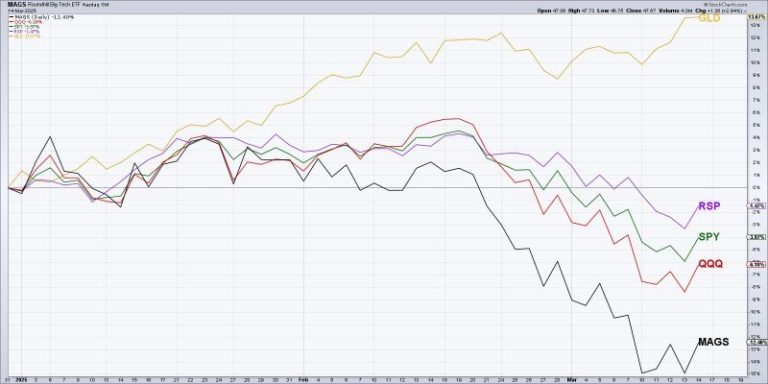
Whether you think gold has merit as a store of value, as a safe haven, or for no reason at all, there is no denying that gold has registered much stronger returns than stocks so far in 2025.

The S&P 500 index is now down about 4.0% for the year, even with Friday’s strong finish to the week. The Roundhill Big Tech ETF (MAGS) is down 12.4%, while the growth-heavy Nasdaq 100 is down about 6.2%. The SPDR Gold Shares (GLD), meanwhile, is up another 13.7% in 2025 after an exceptionally strong 2024.

There have been a number of times over my career where people have pushed back when gold is doing well. They have claimed that it’s just an anomaly, or that it shouldn’t go higher because of some particular reason.  My answer is always to bring up the chart and remind us both, “The market doesn’t care what we think!”

Gold Prices Remain in a Primary Uptrend

Let’s break down gold’s outperformance in greater detail using a daily chart of GLD.  At a time when many stocks and ETFs have broken below moving average support, gold stands out as remaining above two upward-sloping moving averages.

GLD has featured two clear consolidation phases since the end of 2023, one from April to July of 2024, and the other from October through December 2024. In both cases, the ETF bounced off price support a number of times before eventually resolving these patterns to the upside. Consolidations are very common in long-term bullish phases. What’s important is that the uptrend continues after the price exits the range, as we’ve often seen recently with GLD.

We can also apply our proprietary Market Trend Model to gold prices, which can help us to better compare the trend in gold to other ETFs and indexes. We can see that the GLD is currently bullish on all three time frames, compared to the S&P 500, which is now bearish on the short-term and medium-term time frames. When stocks are in a confirmed downtrend, I prefer to look for things that remain in primary uptrends, and gold fits the bill.

Gold Stocks Are Catching Up to Physical Gold

I’m often asked whether it’s better to play gold using an ETF that holds physical gold versus one that offers exposure to gold stocks. By focusing on the relative performance of gold stocks compared to gold futures, we can perhaps identify where opportunities could lie going forward.

Here we’re showing the VanEck Vectors Gold Miners ETF (GDX), along with RSI and then the relative performance of GDX vs. GLD.  When that ratio is sloping higher, gold stocks are outperforming physical gold. Going into the end of last year, the GLD was outperforming as gold stocks experienced a significant pullback. But, so far in 2025, we’ve noticed a strong reversal in relative performance which shows gold stocks are performing better.

The GDX is now testing its October 2024 high around $43.50, and we would consider a confirmed break above this level as an additional sign that gold stocks could continue a “catch up trade” versus physical gold. And with so many gold stocks starting to appear in the top decile of the StockCharts Technical Rating (SCTR), we see this as an area of emerging strength in the weeks to come.

Looking for our daily market recap show? CHART THIS with David Keller, CMT runs every trading day at 5pm ET over on our YouTube channel!

RR#6,

Dave

P.S. Ready to upgrade your investment process? Check out my free behavioral investing course!


David Keller, CMT

President and Chief Strategist

Sierra Alpha Research LLC


Disclaimer: This blog is for educational purposes only and should not be construed as financial advice. The ideas and strategies should never be used without first assessing your own personal and financial situation, or without consulting a financial professional.

The author does not have a position in mentioned securities at the time of publication. Any opinions expressed herein are solely those of the author and do not in any way represent the views or opinions of any other person or entity.

Disclosures: Author holds position in GLD.

Is a new market uptrend on the horizon? In this video, Mary Ellen breaks down the latest stock market outlook, revealing key signals that could confirm a trend reversal. She dives into sector rotation, explains why defensive stocks are losing ground, and shares actionable short-term trading strategies for oversold stocks. Don’t miss these crucial market insights to spot the next rally before it takes off!

This video originally premiered March 14, 2025. You can watch it on our dedicated page for Mary Ellen’s videos.

New videos from Mary Ellen premiere weekly on Fridays. You can view all previously recorded episodes at this link.

If you’re looking for stocks to invest in, be sure to check out the MEM Edge Report! This report gives you detailed information on the top sectors, industries and stocks so you can make informed investment decisions.