
Author

admin

Browsing

After a blistering snapback rally over last the week, a number of the Magnificent 7 stocks are actively testing their 200-day moving averages.  Let’s look at how three of these leading growth names are setting up from a technical perspective, and see how this week could provide crucial clues to broader market conditions into April.

META Remains Above an Upward-Sloping 200-Day

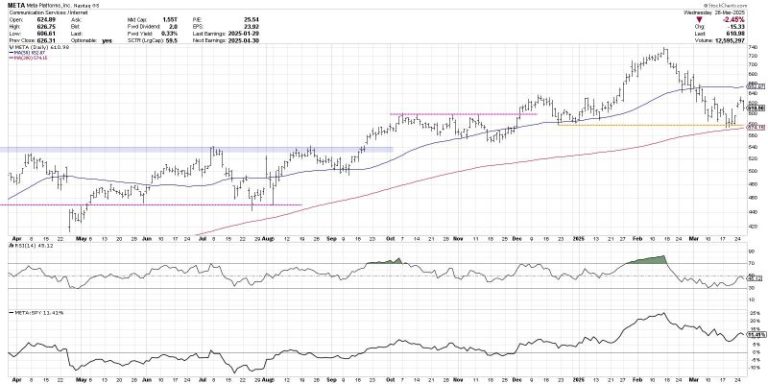
While most of the Mag 7 names already broke below their 200-day moving averages, Meta Platforms (META) is one of the few that have remained above this key trend indicator.  We can see a very straightforward downtrend of lower lows and lower highs from the mid-February peak around $740 to last week’s low around $575.

With the recent bounce, META has now established clear support at the 200-day as well as the December 2024 swing low.  This “confluence of support” suggests that a break below $575 would confirm a new downtrend phase for this leading internet stock.  Only if we saw a break back above the 50-day moving average around $650 would we consider an alternative bullish scenario here.

Will AMZN Hold This Long-Term Trend Barometer?

While META is still holding its 200-day moving average, Amazon.com (AMZN) broke below its 200-day back in early March.  The recent bounce off $190 has pushed AMZN back above the 200-day this week, with the Monday and Friday lows sitting almost perfectly on this long-term trend indicator.

The most important question here is whether Amazon will be able to hold above its 200-day, but given the meager momentum readings, a failure here seems more likely.  Note how despite the recent uptrend move, the RSI has remained below the 50 level through mid-week.  This lack of upside momentum indicates a lack of willing buyers, and suggests a breakout here as an unlikely outcome.  

Similar to the chart of META, we’re watching for any move above the 50-day moving average, which would tell us to consider the recent upswing to have further upside potential.  

Failure Here Would Signal Renewed Weakness for TSLA

Now we come to one of the weaker charts out of the mega cap growth names, Tesla Inc. (TSLA).  Tesla lost over half its value from a peak around $480 in mid-December 2024 to its March 2025 low around $220.  This week’s pop higher has pushed TSLA right up to the 200-day moving average, but no further.

Tesla was one of the first Magnificent 7 stocks to set a peak, as many of these growth names continued to make higher highs into early 2025.  TSLA finally registered an oversold condition for the RSI in late February, before a bounce in mid-March which pushed the RSI back above the crucial 30 level.

When a stock fails to break above the 200-day moving average, as we see so far this week for Tesla, it means that there just isn’t enough buying power present to reverse the longer-term downtrend phase.  Until and unless TSLA can push above the 200-day, we’d much rather look for opportunities elsewhere.  

As legendary investor Paul Tudor Jones is quoted, “Nothing good happens below the 200-day moving average.”  Given the recent upswings for these key growth stocks, and their current tests of this long-term trend barometer, investors should be prepared for a failure at the 200-day and brace for what could come next for the Magnificent 7.

RR#6,

Dave

PS- Ready to upgrade your investment process?  Check out my free behavioral investing course!

David Keller, CMT

President and Chief Strategist

Sierra Alpha Research LLC

Disclaimer: This blog is for educational purposes only and should not be construed as financial advice.  The ideas and strategies should never be used without first assessing your own personal and financial situation, or without consulting a financial professional.  

The author does not have a position in mentioned securities at the time of publication.    Any opinions expressed herein are solely those of the author and do not in any way represent the views or opinions of any other person or entity.

Gold at $3,100 and silver at $50? That might’ve sounded wild a year or two ago, but it’s now the upper trajectory some analysts are eyeing. With consumer confidence cratering to a 12-year low, inflation expectations rising, and central banks hoarding bullion like it’s the latest fashion, gold is holding firm above $3,000 per ounce and silver is knocking on $34.

There’s another thing to consider: the gold-to-silver ratio is still high, reaching 91:1 on Monday and 89.7 on Tuesday, hinting that silver may be massively undervalued. If the ratio snaps back to historical norms, silver could explode past $40, even $50, while gold edges toward $3,100 or higher.

FIGURE 1. CHART OF GOLD/SILVER RATIO. The historical average is at 65:1, well below the data on the chart. Any level above 87 signals a potential buying opportunity.

Note how the price of silver, namely its rallies highlighted in the shaded area below the chart, is responding to the ratio. I’m going to cover this in more detail below, as the ratio serves not only as guidance but also as an important component for an entry setup.

So, if analysts are targeting $3,100, where is gold now, and what setup might it present? Take a look at a daily chart.

FIGURE 2. DAILY CHART OF GOLD. Gold is pulling back, an ideal setup for those who are bullish on the yellow metal.

Gold has pulled back from its all-time high of $3,056, coinciding with an overbought reading in the Relative Strength Index (RSI). The Quadrant Lines give you a wide range of support levels for entry.

  • The second quadrant, containing the previous swing high at $2,960, may see some bulls jumping in.
  • Below that, the third and fourth quadrants coincide with the two previous swing lows near $2,890 and $2,840.

Staying within and bouncing from these quadrants could signal continued strength in the current swing. Below that level would indicate the end of the current uptrend, and whether the price reverses or falls into a range, you will likely find plenty of support at the two areas highlighted in magenta.

Next, take a look at a daily chart of silver.

FIGURE 3. DAILY CHART OF SILVER. According to the gold/silver ratio, silver may be poised for another leg up.

Take a look at the green circles highlighting where the gold/silver ratio exceeded 89. These are relatively high levels, considering that the average ratio reading is between 65 to 75 depending on the historical average you’re measuring. As soon as the ratio falls below that level, silver tends to rally. You see this twice in January, plus once in February and March; now that the ratio has risen above this level once again, will silver rally in response? That’s the big question, and one you should keep focused on.

The $40–$50 target range that many analysts are eyeing is still a distance away. The RSI, holding above the 50 line, suggests there’s room for more upside before hitting overbought territory.

If you’re bullish on silver, hoping for it to reach the projected levels above $40 and toward $50, here’s what you should focus on:

  • Silver would need to break above resistance levels at $34.25, the most recent swing high, and $34.75, which would see the grey metal enter its 12-year high territory, paving the way to $40 and above.
  • If silver pulls back, it should stay above (ideally) $32.75 and $31.75.
  • A close below $31.75, even if it finds support at the next swing low at $30.75, would signal weakness and likely invalidate the current uptrend.

What does this mean for investors using ETFs like SLV and GLD?

As a stock investor, you’re likely not seeking exposure to precious metals in the futures or spot market. The most commonly traded metals-backed options are the following ETFs:

  • SPDR Gold Shares (GLD), which you could learn more about in the StockCharts’ Symbol Summary; and
  • iShares Silver Trust (SLV), whose info is also available in the Symbol Summary.

The prices will differ as ETFs are structured differently. With that said, what do these price moves mean for the ETFs?

  • If gold climbs to $3,100 an ounce, GLD—designed to track 1/10th of an ounce—could be trading in the $310 to $330 range.
  • If silver makes a run at $50, SLV could surge right alongside it, potentially hitting $50 per share.

If you’re looking to ride the metals rally without holding physical bullion, these ETFs offer a direct and highly liquid way to gain exposure. And if silver’s historical catch-up to gold kicks in, SLV could potentially deliver the bigger upside.

At the Close

Gold and silver are both showing signs of strength, backed by macroeconomic pressure, historical ratios (at least for silver), and the overall technical context. Silver could be setting up for a catch-up move that might outperform gold in percentage terms. So, stay nimble, watch your levels, and remember that when silver moves, it often moves fast.


Disclaimer: This blog is for educational purposes only and should not be construed as financial advice. The ideas and strategies should never be used without first assessing your own personal and financial situation, or without consulting a financial professional.

The lithium market continued to battle headwinds during the first quarter of 2025 as residual oversupply weighed on prices, pushing them to a four year low.

Weaker-than-expected demand to start the year also added pressure to the oversupplied market, resulting in the lithium carbonate CIF North Asia price to fall below US$9,550 per metric ton, its lowest point since 2021.

Analysts have suggested the persistent downturn is the signaling of a market bottom. This theory is further supported by a projected production reduction that will help absorb market oversupply.

“Lithium market conditions — particularly during the latter part of 2024 – led to growing producer restraint, both in China and elsewhere,” wrote Fastmarkets’ head of battery raw material analytics Paul Lusty. “Australian production cuts started in January 2024 but built momentum during the year, with several miners announcing production cuts, plans to place plants on care and maintenance and the suspension of planned expansions owing to market conditions.”

The global commodities firm is forecasting a shift in market dynamics, with analysts projecting a much tighter balance ahead. Initial estimates peg 2025’s surplus at 10,000 metric tons before the market moves into a deficit position in 2026.

How are Canadian lithium stocks performing against this backdrop?

This list was created on March 25, 2025, using TradingView’s stock screener, and all data was current at that time. Only companies with market caps above C$10 million for the TSX and TSXV and above C$5 million for the CSE are included.

1. Power Metals (TSXV:PWM)

Company Profile

Year-to-date gain: 163.04 percent
Market cap: C$196.57 million
Share price: C$1.21

Exploration company Power Metals holds a portfolio of diversified assets in Ontario and Québec, Canada. The company’s flagship Case Lake project in Ontario hosts spodumene-bearing lithium-cesium-tantalum pegmatites.

In November 2024, Power Metals identified a new pegmatite zone at Case Lake through soil sampling. The samples from the zone, located north-northwest of its West Joe prospect, revealed elevated levels of cesium, tantalum, lithium and rubidium, which the company said ‘affirmed prospective drill targets’ for its winter program.

On February 10, Power Metals announced the beginning of work associated with the maiden mineral resource estimate and preliminary economic assessment for Case Lake, which it plans to release in Q1 and Q2 of 2025 respectively. Days later on February 14, the company followed that announcement by releasing the final assays from its Phase 3 drilling at Case Lake, including “exceptional cesium oxide and tantalum intercepts” from the West Joe prospect.

The company’s share price rose in the weeks following the pair of announcements to reach a Q1 high of C$1.46 on February 25.

2. NOA Lithium Brines (TSXV:NOAL)

Company Profile

Year-to-date gain: 41.18 percent
Market cap: C$46.99 million
Share price: C$0.36

NOA is a lithium exploration and development company with three projects in Argentina’s Lithium Triangle region. The company’s flagship Rio Grande project and prospective Arizaro and Salinas Grandes land packages total more than 140,000 hectares.

In late January, NOA reported its completion of 28 vertical electrical sounding geophysics tests at the Rio Grande project as part of its 2025 exploration program.

The recent testing expands on past studies and will aid NOA’s water exploration program, refining one of three identified potential water sources.

In a subsequent corporate update on February 7, NOA outlined its plans for Q1 2025, which largely focused on the advancement of the Rio Grande project through geophysical evaluation and water exploration drilling. The company also plans to review engineering proposals for preliminary economic assessment work.

The company’s share price began climbing in early February and reached a Q1 high of C$0.37 on March 13.

The high came days after a Simply Wall Street report highlighted insider buying at the company, a signal of strong internal confidence. According to the report, NOA insiders invested C$862,600 over the prior six months, with C$358,000 of that coming in a single transaction by CEO and Director Gabriel Rubacha. Additionally, they had not sold any shares in the prior 12 months.

3. Frontier Lithium (TSXV:FL)

Company Profile

Year-to-date gain: 35.56 percent
Market cap: C$141.38 million
Share price: C$0.61

Pre-production mining company Frontier Lithium aims to be a strategic and integrated supplier of premium spodumene concentrates as well as battery-grade lithium salts in North America.

The Company’s flagship PAK lithium project, which is a joint venture with Mitsubishi (TSE:8058), holds the “largest land position and resource” in a premium lithium mineral district located in the Great Lakes region of Ontario, Canada. Frontier also owns the Spark deposit, located northwest of the PAK project.

Shares of Frontier Lithium reached a Q1 high of C$0.79 on March 4. After already trending upwards through February, its share price peaked alongside news that the Government of Canada and the Ontario Government supported the company’s plans to build a critical minerals refinery in Northern Ontario.

Once complete the proposed lithium conversion facility will process lithium from PAK into around 20,000 metric tons of lithium salts per year. “This expected capacity would support the production of batteries for approximately 500,000 electric vehicles per year,” Frontier’s statement reads.

4. Q2 Metals (TSXV:QTWO)

Company Profile

Year-to-date gain: 30.77 percent
Market cap: C$144.59 million
Share price: C$1.02

Exploration firm Q2 Metals is exploring three lithium properties — Cisco, Mia and Stellar — in the Eeyou Istchee James Bay region of Québec, Canada. Its Mia project hosts the Mia trend, which spans over 10 kilometers, and its Stellar lithium property comprises 77 claims 6 kilometers north of the Mia property.

In 2024, Q2 Metals acquired the Cisco lithium property and spent much of the year exploring the area. In December, Q2 acquired a 100 percent interest in 545 additional mineral claims, tripling its land position at the Cisco lithium property. A February 12 update reported that metallurgical testing on 2024 drill core showed that the primary lithium-bearing mineral in Cisco pegmatite is spodumene.

On February 26, Q2 announced that investors exercised 12.8 million share purchase warrants at C$0.60 each, generating C$7.68 million in proceeds for the company. The warrants were issued through a private placement in February 2023.

Shares of Q2 jumped to a Q1 high price of C$1.08 on March 18. The following day, later the company released some early results from its ongoing winter drill program, which is targeting 6,000 to 8,000 meters of drilling using two diamond drill rigs. The first four holes intersected “multiple wide intercepts of spodumene pegmatite, expanding previously identified mineralization.” The longest continuous interval of spodumene mineralization is 179.6 meters.

5. Wealth Minerals (TSXV:WML)

Company Profile

Year-to-date gain: 20 percent
Market cap: C$18.47 million
Share price: C$0.06

Lithium exploration company Wealth Minerals owns three exploration-stage projects — Kuska, Pabellón and Yapuckuta— all located in Chile.

On February 3, Wealth Minerals released its first news of the year, announcing it penned a joint venture development deal with the Quechua Indigenous Community of Ollagüe for the development of the Kuska project.

Under the deal the Quechua community will hold a 5 percent free-carried interest and a board seat in the JV, ensuring community participation. The partnership may also explore additional projects in the region.

On February 6, Wealth Minerals acquired the Pabellón lithium project, consisting of a portfolio of 26 mineral exploration licenses with an area of 7,600 hectares located in Northern Chile near the Chile-Bolivia border. The project may serve as an additional source of material to Kuska.

The surface of Pabellón hosts South America’s only geothermal power plant, Cerro Pabellón, which is majority owned by electricity company ENEL (MIL:ENEL). Wealth Minerals stated it is considering installing a direct lithium extraction unit next to the plant.

The company’s share price spiked in mid-January, and touched a Q1 high of C$0.095 on January 31, February 7 and February 10.

Securities Disclosure: I, Georgia Williams, hold no direct investment interest in any company mentioned in this article.

This post appeared first on investingnews.com

Here’s a quick recap of the crypto landscape for Wednesday (March 26) as of 9:00 p.m. UTC.

Bitcoin and Ethereum price update

Bitcoin (BTC) is currently trading at US$86,622.95, a 1.7 percent decrease over the past 24 hours. The day’s trading range has seen a low of US$85,862.55 and a high of US$87,812.64.

The crypto market is under pressure following an executive order from US President Donald Trump to issue “secondary tariffs” of 25 percent on countries that purchase oil from Venezuela.

Bitcoin performance, March 26, 2025.

Chart via TradingView.

Ethereum (ETH) is priced at US$2,002.36, a 3.6 percent decrease over 24 hours. The cryptocurrency reached an intraday low of US$1.985.69 and a high of US$2,058.49.

Altcoin price update

  • Solana (SOL) is currently valued at US$137.76, down 5.2 percent over the past 24 hours. SOL experienced a low of US$136.39 and a high of US$144.21 on Wednesday.
  • XRP is trading at US$2.38, reflecting a 3.3 percent decrease over the past 24 hours. The cryptocurrency recorded an intraday low of US$2.36 and a high of US$2.45.
  • Sui (SUI) is priced at US$2.58, showing a 4.6 percent increase over the past 24 hours. It achieved a daily low of US$2.52 and a high of US$2.64.
  • Cardano (ADA) is trading at US$0.7285, reflecting a 2.7 percent decrease over the past 24 hours. Its lowest price on Wednesday was US$0.722, with a high of US$0.7632.

Crypto news to know

GameStop’s Bitcoin bet sparks meme stock rally

GameStop (NYSE:GME) shares surged close to 20 percent on Wednesday after the company announced plans to add Bitcoin to its treasury reserve assets, mirroring Michael Saylor’s Strategy (NASDAQ:MSTR). The move comes as GameStop struggles with declining brick-and-mortar sales, having pivoted toward e-commerce under CEO Ryan Cohen.

Speculation around the retailer’s crypto ambitions grew after Cohen was seen with Saylor on social media last month. Analysts warn that GameStop’s exposure to Bitcoin could introduce more volatility to its stock.

The company, however, has been aggressive in cutting costs, doubling its fourth quarter net income to US$131.3 million despite a 30 percent revenue drop.

Microsoft declines after data center news

Shares of crypto miners and Microsoft (NASDAQ:MSFT) closed down after TD Cowen alleged that the tech conglomerate has abandoned plans for new data centers in the US and Europe.

Share prices for Bitcoin miners, including Bitfarms (NASDAQ:BITF), CleanSpark (NASDAQ:CLSK), Core Scientific (NASDAQ:CORZ), Hut 8 (NASDAQ:HUT) and Riot Platforms (NASDAQ:RIOT), dropped between 4 and 12 percent. Microsoft closed down 1.31 percent, while daily losses for the miners fell between 7 and 12 percent.

According to Bloomberg, Google (NASDAQ:GOOGL) and Meta Platforms (NASDAQ:META) have picked up some of the leases Microsoft has allegedly canceled or deferred over the last six months, although neither company has confirmed. In a statement from Microsoft obtained by the publication, the company said “significant investments” have left it “well positioned to meet (its) current and increasing customer demand.”

“While we may strategically pace or adjust our infrastructure in some areas, we will continue to grow strongly in all regions,” the spokesperson said. “This allows us to invest and allocate resources to growth areas for our future.”

Ethereum’s Pectra upgrade launches on testnet

Ethereum’s Pectra upgrade launched on the Hoodi testnet on Wednesday after a series of technical issues delayed the mainnet launch, which was originally slated for sometime in March.

If the launch is successful, Pectra could hit the mainnet by April 25. The Pectra upgrade aims to improve Ethereum’s scalability, staking efficiency and developer capabilities.

USDC launches in Japan

Circle launched its stablecoin, USDC, in Japan on Wednesday. The launch was made possible through a strategic partnership with SBI Holdings (TSE:8473), a Japanese financial firm.

The launch comes after Circle and SBI received regulatory approval from Japan’s Financial Services Agency (FSA) earlier this month. The FSA’s green light paved the way for the companies to introduce USDC to the Japanese market, marking a significant step in the adoption of stablecoins in the country.

Following the regulatory approval, a launch date was announced on Monday (March 24).

At the time of this writing, USDC’s market capitalization was US$60.15 billion.

Securities Disclosure: I, Giann Liguid, hold no direct investment interest in any company mentioned in this article.

Securities Disclosure: I, Meagen Seatter, hold no direct investment interest in any company mentioned in this article.

This post appeared first on investingnews.com

Battery Age Minerals Ltd (ASX: BM8; “Battery Age” or “the Company”) is pleased to advise of its participation at the Ignite Investment Summit being held this week in Hong Kong.

BM8’s Chief Executive Officer, Mr Nigel Broomham, will be presenting the Company’s strategy for progressing its diversified & strategic portfolio of projects in Austria, Argentina and Canada today at 11.00am AWST. Attached is the presentation that Mr Broomham will be speaking to at the conference.

Investors can register to attend the conference at: weareignite.com/contact/#investor

Battery Age CEO Nigel Broomham commented:

‘Fresh from recent field visits to Austria and Argentina, and following positive advancements across our Bleiberg, El Aguila, and Falcon Lake projects, we look forward to presenting a number of updates and meaningful insights to a fantastic group of investors and stakeholders.”

Click here for the full ASX Release

This post appeared first on investingnews.com

Keith Weiner, founder and CEO of Monetary Metals, shares his outlook for gold in 2025.

While he’s been bearish in the past and doesn’t consider himself a cheerleader, Weiner believes currently a ‘buy the dips’ market for the yellow metal.

Securities Disclosure: I, Charlotte McLeod, hold no direct investment interest in any company mentioned in this article.

This post appeared first on investingnews.com

Fintech lender Affirm said Tuesday that it’s reached an agreement with JPMorgan Chase to offer its buy now, pay later loan services to merchants on the bank’s payments network.

U.S. merchants who use JPMorgan to handle payments can soon add Affirm to their checkout pages, according to a release. Consumers will have access to loans ranging from 30 days to 60 months, according to Affirm.

The deal follows a similar announcement from rival Klarna last month, in which the Swedish fintech said it would be available to JPMorgan’s merchants. Affirm and Klarna are increasingly going head-to-head as the buy now, pay later field matures in the U.S.; Affirm is publicly traded and seeking to steadily grow profits, while Klarna recently filed for a U.S. IPO.

“The demand for diverse payment options, flexibility, and seamless transactions from both merchants and their customers is at an all-time high,” Michael Lozanoff, global head of merchant services at J.P. Morgan Payments, said in the release.

“By incorporating Affirm as a payment method into our Commerce Platform, we are empowering businesses to deliver the services they need and the experiences that customers increasingly expect as part of their retail journey,” he said.

Affirm said the deal was an expansion of existing banking and processing relationships with JPMorgan, the largest U.S. bank by assets. It wasn’t immediately clear when the new option would be available to merchants.

This post appeared first on NBC NEWS

For the first time in nearly 10 years, a Berkshire Hathaway employee claimed Warren Buffett’s $1 million grand prize for his company’s NCAA bracket contest.

An anonymous employee from aviation training company FlightSafety International, a subsidiary of Buffett’s Berkshire, won the annual internal bracket contest after correctly calling 31 of the 32 games in the first round of the men’s basketball tournament dubbed March Madness, according to a statement.

The 94-year-old Oracle of Omaha was finally able to give out the big prize after relaxing the rules multiple times since the competition’s inception in 2016. Originally, Buffett, a Creighton basketball fan, set out to award anyone who could perfectly predict the Sweet 16.

Then, in 2024, after the $1 million jackpot remained unclaimed, participants were given the advantage of waiving the results of the eight games among the No.1 and No. 2 seeds. Still, nobody cracked the code.

This year, the rules were changed again so anyone who picks the winners of at least 30 of the tournament’s 32 first-round games would be eligible to win the prize.

In fact, 12 Berkshire employees guessed 31 of the 32 first-round games correctly. The $1 million prize went to the person from that group that picked 29 games consecutively before a loss. That winner went on to pick 44 of the 45 games correctly.

The other 11 contestants are getting $100,000 each.

This post appeared first on NBC NEWS

The stronger-than-expected Services PMI reported on Monday injected optimism into the stock market. There was also some relief as news hit that the April 2 implementation of tariffs may be scaled back.

On Tuesday, however, the market hit the brakes and stalled the upside momentum. Consumer confidence fell by 7.2 points in March, a sign that U.S. consumers are worried about the economic outlook. This, along with uncertainty about tariffs and other policies, will likely remain the focus in investors’ minds.

The bigger focus should be on whether the recent upside move in the broader stock market indexes has legs. Let’s shift our attention to the charts of the broader markets.

The Technical Picture

In the daily chart of the S&P 500 below, the index crossed above its 200-day simple moving average (SMA) on Monday, a big hurdle for the index to overcome. Alas, the lack of follow-through on Tuesday could mean the 200-day may now act as a support level. The index could also bust through its January lows and start moving up toward its 50-day SMA.

FIGURE 1. S&P 500 INDEX BROKE ABOVE 200-DAY SIMPLE MOVING AVERAGE. Will the index break above its January lows? That would be the next big hurdle.Chart source: StockCharts.com. For educational purposes.

Market breadth is showing signs of expanding, with the S&P 500 Bullish Percent Index above 50, the NYSE Advance-Decline Line starting to trend higher, and the percentage of S&P 500 stocks trading above their 200-day SMA shy of 50%.

The picture isn’t as positive for the Nasdaq Composite as it is for the S&P 500. The Nasdaq is approaching its 200-day SMA, and market breadth is showing signs of improvement, although slight (see chart below).

FIGURE 2. DAILY CHART OF THE NASDAQ COMPOSITE. The index is approaching its 200-day SMA while its breadth is showing slight signs of expanding.Chart source: StockCharts.com. For educational purposes.

Of the three broader indexes, the Dow is the one showing the most promising upside move (see chart below). Like its close cousins, it crossed above its 200-day SMA, but its market breadth has expanded more than the S&P 500 and Nasdaq. Its BPI is at 60 and the A-D Line is relatively high. The percentage of Dow stocks trading above their 200-day SMA is at 19%, but remember, the Dow has only 30 stocks in the index.

FIGURE 3. DAILY CHART OF THE DOW JONES INDUSTRIAL AVERAGE. The 200-day SMA is now a support level. All three breadth indicators are showing signs of rising.Chart source: StockCharts.com. For educational purposes.

Small-cap stocks have lagged the larger indexes and, even though the S&P 600 Small Cap Index ($SML) bounced off its March 13 low, there’s not enough follow-through to carry small caps higher. Replace the symbol in any of the above charts with $SML.

Bonds turned around on Tuesday in response to the weaker consumer confidence data. The 10-year U.S. Treasury Yield Index ($TNX) rose until the consumer confidence data was released, after which it slid lower. This was the move that should have raised eyebrows.

Bond Yields Also Teeter-Totter

Movements in Treasury yields are very telling about the state of the economy. To keep tabs on the movement in Treasury yields and the U.S. dollar, investors should monitor the Japanese yen. This may not be something you usually look at, but, given we’re in an environment where conditions change from one day to the next, it’s helpful to add a chart of the U.S. dollar relative to the yen in your ChartLists.

The daily chart of $USDJPY below has an overlay of the 21-day exponential moving average (EMA). The bottom panel monitors the performance of the 10-year yields.

FIGURE 4. DAILY CHART OF THE U.S. DOLLAR VS. JAPANESE YEN. The currency pair gives an idea of the overall health of the U.S. economy.Chart source: StockCharts.com. For educational purposes.

Generally, when U.S. Treasury yields fall, the U.S. dollar weakens relative to the yen. On Monday, the dollar rose relative to the yen when equities and Treasury yields rose, but fell on Tuesday, in conjunction with the fall in yields. You can see the close correlation between the two in the chart above.

On Monday, $USDJPY broke above the 21-day EMA. On Tuesday, the EMA acted as a support level. Can the dollar hold on to this support level and continue to strengthen relative to the yen? Yields generally rise when the economy is growing, so monitoring this chart regularly will give you a general idea of how the U.S. economy is performing.

Other Market Activity

Sector rotation was all over the place, moving back and forth from offensive to defensive. On Tuesday, Utilities, Health Care, and Real Estate were the worst-performing sectors. Communication Services, Consumer Discretionary, and Financials were the best-performing sectors. However, the change was modest, so there’s not enough to confirm a move from offensive to defensive or vice versa.

Closing Bell

Overall, the market isn’t showing convincing directional movement. Tuesday’s market activity was a bit like watching paint dry—not too exciting relative to what we have seen in the last few weeks. The upside move we saw since Friday seems to have slowed. The Cboe Volatility Index ($VIX) eased and closed at around 17, so today’s lackluster price movement didn’t do anything to make investors fearful.

The most important data this week will probably be the February PCE, which is released on Friday. Let’s see if that stirs things up.


Disclaimer: This blog is for educational purposes only and should not be construed as financial advice. The ideas and strategies should never be used without first assessing your own personal and financial situation, or without consulting a financial professional.

Titanium Sands Limited (“TSL”) is pleased to announce the progression of the approval processes for its Mannar Heavy Mineral Project in Sri Lanka, following the release by the CEA of the Terms of Reference for the Mannar Island Environmental Impact Assessment (EIA).

  • Central Environment Authority (CEA) has provided the Terms of Reference (ToR) for the environmental assessment of the Mannar Heavy Mineral Project following site visits and input from 35 regulatory bodies and government departments
  • The ToR contains the requirements for the environmental studies for an Environmental Impact Assessment (EIA)
  • On completion of the EIA, the Geological Survey and Mines Bureau (GSMB) will then be in a position to issue an Industrial Mining License (IML) for the Project
  • The ToR outlines environmental, heritage, social and economic requirements necessary for GSMB approval of the IML
  • TSL is focused on delivering economic benefits to the people of Mannar, through job creation and generational wealth, while preserving cultural heritage and protecting the environment

The release of the ToR on 20 March 2025 followed a series of CEA meetings and presentations, culminating in the Scoping Presentation on 22 August 2024 and the Scoping Site Visit on 19 February 2025 by stakeholders in the Project. Submissions made by stakeholders at both the scoping meetings have been included in the ToR which forms the basis of the requirements of the EIA.

TSL’s Managing Director, Dr James Searle said“the release of the ToR is a significant step forward in the regulatory approvals process for this Project. The Project will deliver a high-grade mineral sands operation that will create significant employment opportunities and become a source of wealth for local communities, as well as a significant boost in revenues to the Government of Sri Lanka.

TSL is focused on delivering a low impact environmentally friendly project, with the highest levels of social awareness and inclusion. As heavy minerals have been mined for decades on the Sri Lankan mainland, TSL looks forward to building on the size and quality of the industry making a significant impact to the economic benefits of Sri Lanka”.

Next Steps

ToR

The ToR has been prepared on input from 35 departments and regulatory bodies within Sri Lanka’s Government. TSL’s EIA consultants will be required to address the following as outlined in the ToR:

  • Overview of the proposed project and reasonable alternatives
  • Report on existing environment and surrounds
  • Report on anticipated environmental impacts
  • Prepare an Environmental Management Plan (EMP) and monitoring program
  • Assess all aspects of nature and wildlife restrictions
  • Host community consultation and engagement.

The ToR also requires a report on any areas beyond the project site where there is potential for environmental impacts.

Environmental Impact Assessment

The EIA process will commence immediately. The EIA consultants will now be in a position to prepare a draft EIA to address the requirements of the ToR. The EIA will address baseline and impact assessments, mitigation measures and proposed strategies and management plans culminating in an efficient and environmentally successful project. The final EIA submission for GSMB review and approval is expected mid 2025, with support from government agencies and community groups.

As part of the EIA process, community consultation and comment will be undertaken with Mannar communities ensuring any other issues or concerns are addressed in the EIA.

Recent meetings with all of CEA, GSMB and Board of Investment (BoI) in Sri Lanka have led to the understanding that on completion of the EIA, formal IML approval would be granted in a timely manner.

Click here for the full ASX Release

This post appeared first on investingnews.com