Author

admin

Browsing

Amid rising production and weakening demand, the global nickel market is forecast to swing into a 198,000 metric ton (MT) surplus in 2025, according to the International Nickel Study Group (INSG).

In an April 24 release, the INSG said that world primary nickel production is expected to reach 3.735 million MT this year, outpacing the primary usage forecast of 3.537 million MT for 2025.

The nickel sector recorded surpluses of 170,000 MT in 2023 and 179,000 MT in 2024.

‘The world economy is currently facing changes to national policies, namely related to trade. This will probably contribute to a higher level of uncertainty regarding raw materials markets,’ the group notes.

Prices for nickel, a critical component in stainless steel and electric vehicle (EV) batteries, have struggled under mounting oversupply. After losing more than 7 percent in 2024, nickel prices continued to show volatility in Q1 2025.

Nickel hit five year lows in the US$15,000 per MT range in early April, driven by a combination of global overproduction, tight ore availability and geopolitical tensions, including the escalation of US tariffs on Chinese goods.

Indonesia, the world’s largest nickel producer, is at the heart of these market dynamics. The INSG said ‘delays in the issuance of mining permits’ are creating ore tightness, even as refined production continued at elevated levels.

In 2024, Indonesia mined an estimated 2.2 million MT of nickel, accounting for over half of global output.

However, regulatory uncertainty has compounded challenges for Indonesian producers.

The country’s newly approved royalty hikes, which increase the rate from 10 percent to between 14 and 19 percent depending on nickel prices, have sparked backlash from industry stakeholders. In a letter shared with the government, they called the increases “unrealistic and (not reflective of) the current state of the industry.”

Filipino policymakers have proposed following Indonesia’s earlier example by banning exports of raw nickel, a move that, if implemented, could introduce fresh instability to global supply chains reliant on Southeast Asian ore.

China’s expanding nickel output

In China, the INSG forecasts further growth in primary nickel output in 2025, fueled by expansions in nickel cathode and nickel sulfate production. This growth is expected even as nickel pig iron output declines.

Yet demand in China — the world’s largest nickel consumer — faces headwinds. Tariffs from the US and sluggish activity in key sectors like construction and home appliances have pressured stainless steel demand.

According to the INSG, stainless steel production in China grew 10.6 percent year-on-year in the first quarter of 2025, with analysts expecting another year of surplus.

At the same tiime, the nickel-intensive EV battery market has been slower to expand than anticipated. Increased reliance on lithium iron phosphate (LFP) batteries, which do not require nickel, and rising demand for plug-in hybrids over fully electric vehicles, have both dampened growth prospects for nickel demand.

US tariffs deepen market volatility

The Trump administration’s escalating tariffs against China have also weighed heavily on the market — nickel prices dropped 11.5 percent in the week after new tariffs were announced on April 2.

The impact of tariffs on midstram and downstream battery products has been especially severe.

Thomas Matthews, an analyst at CRU Group, explained during a recent webinar that US tariffs on Chinese goods will soon amount to 173 percent for energy storage batteries and 143 percent for EVs.

“We’ve already seen that there was significant amounts of stockpiling prior to the tariffs being implemented,” he said, adding, “But there are also now huge volumes of batteries that are sitting in US bonded warehouses, which is proving to be a major headache for the importers.’ Matthews also noted that although imports of cobalt and lithium remain exempt from new tariffs, “nickel, interestingly, is currently not exempt.”

The INSG’s next meetings are scheduled for October 6, 2025. In the meantime, with surplus forecasts rising and demand signals weakening, nickel faces another challenging year ahead.

Securities Disclosure: I, Giann Liguid, hold no direct investment interest in any company mentioned in this article.

Keep reading…Show less
This post appeared first on investingnews.com

Challenger Gold Limited (ASX: CEL) (“CEL” the “Company”) notes the ASX Release by Austral Gold Limited titled ‘Austral Gold Provides Update on Casposo Plant Refurbishment’ today. The release provides an update on the refurbishment of the Casposo Processing Plant and reports that the refurbishment is on track for the start up of commercial operations in the second half of 2025.

HIGHLIGHTS

  • Austral Gold announced that Casposo Plant refurbishment is advancing safely and efficiently across all core workstreams.
  • Austral update aligns with second independent plant inspection commissioned by CEL.
  • CEL’s inspection was undertaken by the same process engineers that completed the Audit of the Casposo Plant and Restart Plan in December 2024.
  • Key takeaways from the second inspection report commissioned by CEL are:
    • Robust advancement across all key processing areas
    • Progress in line with existing refurbishment schedule
    • Solid-liquid separation capacity (previously identified as a key risk) appears adequate for the required 1000 TPD capacity
    • Sufficient time remaining to complete all maintenance work to meet the commissioning target in Toll Milling Agreement during the second half of 2025.

The Austral update aligns with a second independent plant independent inspection report received by the Company during April 2025. This report was prepared by the leading process group that completed the independent Audit of the Casposo Plant in December 2024 (ASX Release dated 13 December 2024).

Background to Toll Milling

The Company has executed a binding Agreement with Casposo Argentina Mining Limited, the operator of the Casposo Plant located in San Juan Argentina. This Toll Milling Agreement secures processing of a minimum of 450,000t of near surface Hualilan mineralised material over 3 years (ASX Release dated 30 December 2024).

The Casposo Plant, located 170km from Hualilan via established roads, has historically produced over 323,000 ounces of gold and 13.2 million ounces of silver. During operations, the plant achieved average annual production of 40,000 ounces of gold and 1.6 million ounces of silver at recoveries of 90% for gold and 79% for silver. The plant has been on care and maintenance.

The primary objective of this Toll Milling strategy is to capitalise on the current high gold price (above US$3,300/oz) to generate early cash flow. This cashflow will be allocated towards the construction of the standalone Hualilan Gold project including a Flotation with Tails Leach (“FTL”) circuit, a potential Heap Leach (“HL”) pad at Hualilan, and open pit mining fleet.

Click here for the full ASX Release

This post appeared first on investingnews.com

JetBlue Airways is getting ready to announce a partnership with another U.S. airline with a larger network in the coming weeks, the carrier’s president said Tuesday. One possibility: United Airlines.

JetBlue’s leaders have repeatedly said they need a partnership to better compete against larger airlines like Delta Air Lines and United.

JetBlue’s planned acquisition of Spirit Airlines was blocked by the Justice Department last year, while its partnership in the Northeast with American Airlines unraveled after the carriers lost an antitrust lawsuit in 2023.

The New York airline has been in talks with several carriers this year about a partnership. JetBlue’s president, Marty St. George, said on an earnings call on Tuesday that the company expects to make an announcement this quarter. He emphasized that the partner’s bigger network would allow customers to earn and burn loyalty points on JetBlue.

“If you are a customer in the Northeast and you love JetBlue for leisure, but twice a year you have to go to Omaha or Boise, these are places that you can’t earn TrueBlue points on now and when this partnership goes forward, you will be able to,” St. George said.

United Airlines could possibly get a foothold (again) into JetBlue’s home hub of John F. Kennedy International Airport in New York through the partnership. “We don’t engage in industry speculation,” a United Airlines spokeswoman said.

An Alaska Airlines spokeswoman said the carrier doesn’t have plans to partner with JetBlue and is focused on its recent merger with Hawaiian Airlines.

Southwest Airlines declined to comment. A Delta Air Lines spokesman said there was no pending announcement from the carrier about a partnership with another airline.

JetBlue declined to comment further.

American had been in talks to revive a different version of its partnership with JetBlue, but those failed and American said Monday that it sued JetBlue.

“Ultimately, we were unable to agree on a construct that preserved the benefits of the partnership we envisioned, made sense operationally or financially,” American Airlines Vice Chair Steve Johnson said in a letter to employees on Monday.

This post appeared first on NBC NEWS

Pfizer CEO Albert Bourla on Tuesday said uncertainty around President Donald Trump’s planned pharmaceutical tariffs is deterring the company from further investing in U.S. manufacturing and research and development. 

Bourla’s remarks on the company’s first-quarter earnings call came in response to a question about what Pfizer wants to see from tariff negotiations that would push the company to increase investments in the U.S. It comes as drugmakers brace for Trump’s levies on pharmaceuticals imported into the country — his administration’s bid to boost domestic manufacturing.

“If I know that there will not be tariffs … then there are tremendous investments that can happen in this country, both in R&D and manufacturing,” Bourla said on the call, adding that the company is also hoping for “certainty.”

“In periods of uncertainty, everybody is controlling their cost as we are doing, and then is very frugal with their investment, as we are doing, so that we are prepared for remit. So that’s what I want to see,” Bourla said.

Bourla noted the tax environment, which had previously pushed manufacturing abroad, has “significantly changed now” with the establishment of a global minimum tax of around 15%. He said that shift hasn’t necessarily made the U.S. more attractive, saying “it’s not as good” to invest here without additional incentives or clarity around tariffs.

“Now [Trump] I’m sure — and I know because I talked to him — that he would like to see even a reduction in the current tax regime particularly for locally produced goods,” Bourla said, adding a further decrease would be would be a strong incentive for manufacturing in the U.S.

Unlike other companies grappling with evolving trade policy, Pfizer did not revise its full-year outlook on Tuesday. However, the company noted in its earnings release that the guidance “does not currently include any potential impact related to future tariffs and trade policy changes, which we are unable to predict at this time.”

But on the earnings call on Tuesday, Pfizer executives said the guidance does reflect $150 million in costs from Trump’s existing tariffs.

“Included in our guidance that we didn’t really speak about is there are some tariffs in place today,” Pfizer CFO Dave Denton said on the call.

“We are contemplating that within our guidance range and we continue to again trend to the top end of our guidance range even with those costs to be incurred this year,” he said.
This post appeared first on NBC NEWS

Today, Carl and Erin made a big announcement! They are retiring at the end of June so today was the last free DecisionPoint Trading Room. It has been our pleasure educating you over the years and your participation in the trading room has been fantastic! Be sure and sign up to follow the DecisionPoint Blog on StockCharts.com where we do plan to publish articles periodically. (Subscribers: you will be notified via email as to how your subscription will be handled. Stay tuned.)

After the big announcement, Carl opened the show with the DP Signal Tables to give us a sense as to the market’s overall trend and condition.

Carl then went through his regular market overview that included Bitcoin, Bonds, Yields, Crude Oil, Gold, Gold Miners and the Dollar.

Once finished with the market overview, Carl walked us through the Magnificent Seven in the short and intermediate terms by looking at both the daily and weekly charts.

The pair took questions including a discussion on relative strength using the Silver Cross Index and Golden Cross Index.

Erin took the controls and went through the 26 indexes, sectors and industry groups that have under the hood indicators. She walked us through the CandleGlance and explained her findings along the way.

Questions popped up again with Carl discussing his strategy of using dividend paying stocks in retirement. He mentioned the Dividend Aristocrats and Dividend Kings lists as a great source to find good dividends. Also a shout out to The Bahnsen Group ETF (TBG).

Erin finished by looking at viewer symbol requests.

It has been a great run learning and teaching about technical analysis. Thank you again for your support over the years!

01:10 DP Signal Tables

03:48 Market Overview

16:18 Magnificent Seven

22:53 Questions (Relative Strength with Silver Cross and Golden Cross Indexes)

29:18 Sector Rotation and Market CandleGlance

34:57 Question regarding dividend paying stocks

39:51 Symbol Requests


Technical Analysis is a windsock, not a crystal ball. –Carl Swenlin


(c) Copyright 2025 DecisionPoint.com


Disclaimer: This blog is for educational purposes only and should not be construed as financial advice. The ideas and strategies should never be used without first assessing your own personal and financial situation, or without consulting a financial professional. Any opinions expressed herein are solely those of the author, and do not in any way represent the views or opinions of any other person or entity.

DecisionPoint is not a registered investment advisor. Investment and trading decisions are solely your responsibility. DecisionPoint newsletters, blogs or website materials should NOT be interpreted as a recommendation or solicitation to buy or sell any security or to take any specific action.


Helpful DecisionPoint Links:

Trend Models

Price Momentum Oscillator (PMO)

On Balance Volume

Swenlin Trading Oscillators (STO-B and STO-V)
ITBM and ITVM

SCTR Ranking

Bear Market Rules


Real Estate and Healthcare Swapping Positions in Top 5

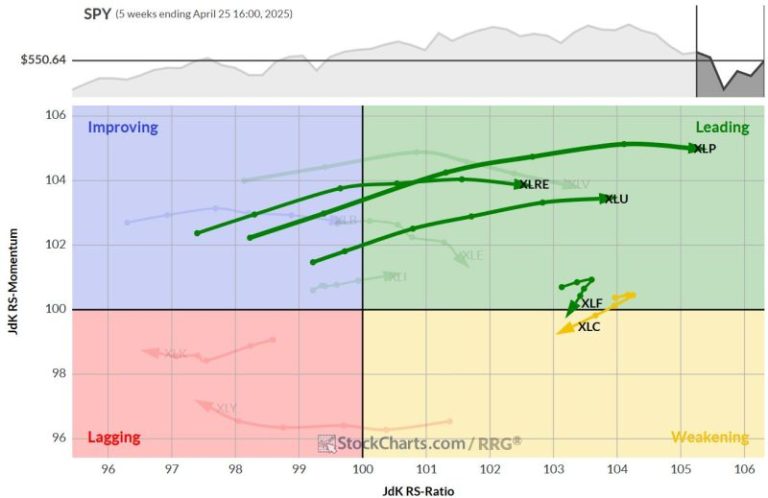
The top five sectors show remarkable stability, with Consumer Staples, Utilities, Financials, and Communication Services holding steady in the top four positions. The only change is Real Estate replacing Health Care, a shift that underscores the ongoing defensive tilt in the market. In the bottom half of the ranking, Materials and Consumer Discretionary swapped positions.

  1. (1) Consumer Staples – (XLP)
  2. (2) Utilities – (XLU)
  3. (3) Financials – (XLF)
  4. (4) Communication Services – (XLC)
  5. (6) Real-Estate – (XLRE)*
  6. (5) Healthcare – (XLV)*
  7. (7) Industrials – (XLI)
  8. (9) Materials – (XLB)*
  9. (8) Consumer Discretionary – (XLY)*
  10. (10) Energy – (XLE)
  11. (11) Technology – (XLK)

Weekly RRG

Looking at the weekly Relative Rotation Graph (RRG), we observe ongoing strength in Consumer Staples and Utilities. Both sectors are advancing further into the leading quadrant and continue to gain on the RS ratio axis.

Real Estate is also making a notable move deeper into the leading quadrant. Financials and Communication Services are positioned on the brink of the weakening quadrant. However, they are still sustaining elevated RS ratio levels, which keeps them securely in the top five — at least for now.

Daily RRG

  • Consumer Staples and Utilities: Both reside within the weakening quadrant, but at high RS ratio levels. This combination, along with their strength on the weekly RRG, keeps them well inside the top five.
  • Communication Services: Moved into the lagging quadrant but with a very short tail close to the benchmark. This positioning allows it to remain in the top five — for now.
  • Financials: Similar to Communication Services, close to the benchmark with a slightly longer tail but not showing significant loss of relative strength.
  • Real Estate: Made a significant move, pushing into the leading quadrant on the daily RRG, combining with its strong weekly tail to secure its spot in the top five.

Consumer Staples

The Consumer Staples sector remains range-bound on the weekly chart, causing relative strength to stabilize. With RRG lines at high levels, we might see some consolidation in the coming week — definitely something to keep an eye on.

Financials

Financials are picking up steam again, closing in the upper half of last week’s bar. This price strength is helping the relative strength line remain well within its rising channel. If the sector can maintain this momentum, it’s likely to stay among the top performers.

Utilities

Utilities are trading within their sideways channel, continuing to push relative strength against (or just above) resistance. This strength is keeping the RRG lines above 100. However, imho, we’ll need to see more relative strength in the coming weeks to keep Utilities at the top of the list.

Communication Services

Communication Services had a strong week, closing at the top of its range against former support, now acting as resistance. Based on the price chart, we might expect some resistance and difficulty for the sector to move higher this week. Despite this, the relative strength line remains within its rising channel, albeit losing some relative momentum at high RS ratio levels — not concerning at this time.

Real Estate

Real Estate — the new entrant in the top five — is benefiting from a strong bounce off the $36 low two weeks ago. It’s now starting to push relative strength higher, although not yet extremely strong. The RS momentum line is beginning to roll over while dragging the RS ratio higher.

For now, the combination of daily and weekly relative strength has been enough to displace Health Care and secure Real Estate’s spot in the top five.

Portfolio Performance

The defensive positioning of our portfolio has put a dent in performance relative to the broader market. We’re now trailing the S&P 500 by almost 3%. However, we’ve seen over the past few weeks that these differences can equalize rapidly when the market moves in the direction of the portfolio. So, I’m not too concerned at the moment — it’s all part of the ebb and flow of market dynamics.

#StayAlert and have a great week –Julius


Buy low, sell high. The trend is your friend. Sell in May and go away. Wall Street is teeming with familiar financial adages. But there’s one you may not have heard of: “When the VIX is high, it’s time to buy.”

Similar to “buy the dip,” the idea is that when the level of fear in the markets has reached its peak, it’s the perfect time to buy because stocks are most likely trading at deep discounts. To quote famed investor Warren Buffet of Berkshire Hathaway (NYSE:BRK.A,NYSE:BRK.B), “Be fearful when others are greedy, and greedy when others are fearful.”

In this article

    What is the VIX?

    VIX is shorthand for the Volatility Index (INDEXCBOE:VIX) of the Chicago Board Options Exchange (CBOE). Since 1993, the VIX has tracked real-time price changes of near-term S&P 500 (INDEXSP:.INX) options.

    Options are financial contracts that give holders the right to buy or sell an underlying asset — stocks, bonds, exchange-traded funds, contracts, etc. — at a certain price within a certain time period. Options prices for particular stocks are determined by the probability that the stock’s price will reach a certain level, known as the strike price or exercise price.

    The VIX tracks the S&P 500 as opposed to other indexes because it is considered the leading indicator of future volatility in the overall US stock market.

    For many knowledgeable investors, the VIX is a globally recognized go-to benchmark index for measuring the expectation of volatility in the stock market over the next 30 days based on how wide or narrow the swing in prices is for S&P 500 options.

    Why does the VIX go up when the market goes down?

    The VIX has an inverse relationship with the S&P 500, meaning that spikes in the VIX typically occur when stock prices drop.

    The more pronounced the options price swings on the S&P 500, the higher the risk of stock market volatility and the higher the VIX climbs — a signal that a crash may be imminent. On the flip side, a significant drop in the VIX could herald a rally.

    It’s important to note that the VIX is not a crystal ball, but rather a real-time snapshot of how investors are feeling about the level of near-term volatility in the market. Is the current sentiment negative or positive? Confident or fearful?

    “Volatility, or how fast prices change, is often seen as a way to gauge market sentiment, and in particular the degree of fear among market participants,” explains Investopedia. Hence why the VIX is also referred to as the “fear index.”

    Investors can use the VIX to measure the level of fear in the market and employ this information when making investment decisions. The higher the VIX level, the more likely the possibility that fear and uncertainty is driving the markets.

    What is a normal range for the VIX?

    The normal range for the VIX is values ranging between 12 and 20. Forbes advises investors that when the VIX is below a value of 20, that is reflective of a stable investment environment. A VIX value of 12 or lower is indicative of high optimism in the stock market — the mark of extremely bullish investor sentiment.

    Once VIX values rise above 20, the market is said to be experiencing “abnormally high volatility.” Once the VIX is seen pushing above 30, that’s a clear sign of a bear market — when investors fear there is too much uncertainty and risk in the stock market.

    In fact, five of the 10 highest VIX values since the index launched in 1993 occurred in the lead up to the 2008 financial crisis, while the remaining five are associated with the COVID-19-induced stock market crash in 2020.

    The VIX hit an all-time high of 82.69 on March 16, 2020, during the early days of the COVID-19 pandemic. The index’s second highest value, 80.86, was reached on November 20, 2008, as markets reeled from the fallout over mortgage-backed securities.

    What is the all-time highest recorded spike in the VIX index?

    The VIX recorded a record high spike on August 5, 2024, when it jumped 42 points to 65.73 intraday as markets around the world experienced sell offs and recession fears rose. This also marked the highest point of the VIX index since the COVID-19 pandemic.

    The VIX moved down to close at 38.56 by the end of the day, still quite high but well below the top 10 closes discussed above.

    Can you invest in the VIX?

    While you can’t invest directly into the VIX, there are a number of exchange-traded products (ETPs), such as futures contracts, options contracts and ETFs, that are based on the future anticipated value of the index.

    These are three VIX-associated ETPs available to investors:

          If investors are able to get the timing right, VIX futures ETFs can be a hedge against a market crash. However, the opportunities inherent in VIX ETPs don’t negate the fact that they do carry significant risk, and are not for those with a longer-term investment strategy or low risk tolerance.

          Analysts at ETF.com warn that these products “deliver poor long-term exposure to the VIX index … (and) have a history of erasing vast sums of investor capital over holdings periods as short as a few days.”

          In other words, VIX ETPs have a tendency to suffer from contango, which is when a futures price is higher than the current price. If held for too long a period, they lose their value, making them an unsuitable permanent hedge against market volatility.

          Investors with high risk tolerance and a knack for playing the short game can also buy VIX call options as a potential hedge against stock market downturns. But once again, as Investopedia cautions, it’s important to time the market right. Buying in the middle of a market crash can lead to oversized losses.

          Securities Disclosure: I, Lauren Kelly, hold no direct investment interest in any company mentioned in this article

          Keep reading…Show less
          This post appeared first on investingnews.com

          As data breaches and cyberattacks rise, cybersecurity exchange-traded funds (ETFs) are gaining traction.

          The term cybersecurity originated in 1989, and today is defined as the measures taken to protect a computer or computer system against unauthorized access or cyberattack threats. These measures can include people, policies and processes.

          The number of security incidents is increasing every year, as are the costs companies must pay. In fact, according to a 2024 research report from IBM (NYSE:IBM), the average cost of a single data breach event globally was US$4.48 million — up 10 percent over the previous year and the highest cost in the 19 years since the first report was issued.

          These threats are unlikely to fade anytime soon. The forecast for the cybersecurity market is strong through 2030, with trends in the space including the threats posed by AI and quantum computing.

          There are multiple ways to invest in the cybersecurity market, including cybersecurity ETFs, which offer a low-cost way to enter the space. ETF fees and expenses are typically lower than those associated with mutual funds or other types of actively managed financial instruments. What’s more, ETFs provide exposure to a basket of stocks, meaning investors can spread their risk around.

          According to ETF.com, there are nine cybersecurity ETFs listed in the US. Here’s a closer look at the top four cybersecurity ETFs by assets under management (AUM). ETFs with assets under management above US$500 million are included in this list. All numbers and figures were current as of April 28, 2025.

          1. First Trust NASDAQ Cybersecurity ETF (NASDAQ:CIBR)

          AUM: US$8.00 billion
          Expense ratio: 0.59 percent

          Launched in July 2015, this ETF tracks the NASDAQ CTA Cybersecurity Index (INDEXNASDAQ:NQCYBR) and includes companies categorized by the Consumer Technology Association as cybersecurity. The ETF’s 33 holdings are largely tech firms, but it also offers some exposure to the defense and aerospace sectors.

          The First Trust NASDAQ Cybersecurity ETF’s top holdings include CrowdStrike Holdings (NASDAQ:CRWD) at a weight of 8.79 percent, Broadcom (NASDAQ:AVGO) at 7.78 percent, Palo Alto Networks (NYSE:PANW) at 7.58 percent and Cisco Systems (NASDAQ:CSCO) at 7.13 percent. Infosys (NYSE:INFY)

          2. Amplify Cybersecurity ETF (ARCA:HACK)

          AUM: US$1.89 billion
          Expense ratio: 0.6 percent

          The oldest cybersecurity ETF on this list is the Amplify Cybersecurity ETF. Previously called ETFMG Prime Cyber Security ETF, this ETF began trading in November 2014 and tracks the ISE Cyber Security Index (INDEXNASDAQ:HXR). HACK is run by ETFMG, a lesser-known company among the goliath ETF managers, and it has had a 12.19 percent annualized return over the past five years.

          The cybersecurity ETF has 25 holdings, and its top holdings by weight include Broadcom at 8.67 percent, CrowdStrike Holdings at 6.84 percent and Cisco Systems at 6.25 percent.

          3. Global X Cybersecurity ETF (NASDAQ:BUG)

          AUM: US$986.89 million
          Expense ratio: 0.51 percent

          The newest ETF on this list is the Global X Cybersecurity ETF, which was founded in October 2019. The ETF tracks a market-cap-weighted global index of companies selected based on revenue related to cybersecurity activities, as companies must generate at least 50 percent of their revenue from cybersecurity to be included.

          The ETF has 23 holdings, with the top by weight being CrowdStrike at a weight of 7.8 percent, Fortinet (NASDAQ:FTNT) at a weight of 7.06 percent, Zscaler (NASDAQ:ZS) at 6.51 percent and Check Point Software Technologies (NASDAQ:CHKP) at 6.5 percent.

          4. iShares Cybersecurity and Tech ETF (ARCA:IHAK)

          AUM: US$909.79 million
          Expense ratio: 0.47 percent

          Last on this cybersecurity ETFs list is the iShares Cybersecurity and Tech ETF. Founded in June 2019, it tracks the NYSE FactSet Global Cyber Security Index (INDEXNYSEGIS:NYFSSEC) and has a focus on developed and emerging markets in the cybersecurity industry.

          The iShares Cybersecurity and Tech ETF has 37 holdings, including Trend Micro Incorporated (TSE:4704) at a weight of 5.23 percent, Okta (NASDAQ:OKTA) at 5.1 percent, Crowdstrike Holdings at 4.82 and Check Point Software Technologies at 4.75 percent.

          Securities Disclosure: I, Lauren Kelly, hold no direct investment interest in any company mentioned in this article.

          Keep reading…Show less
          This post appeared first on investingnews.com