Author

admin

Browsing

In this in-depth walkthrough, Grayson introduces the brand-new Market Summary Dashboard, an all-in-one resource designed to help you analyze the market with ease, speed, and depth. Follow along as Grayson shows how to take advantage of panels, mini-charts, and quick scroll menus to maximize your StockCharts experience.

This video originally premiered on May 12, 2025. Click on the above image to watch on our dedicated Grayson Roze page on StockCharts TV.

You can view previously recorded videos from Grayson at this link.

Reach Resources Limited (ASX: RR1 & RR1O) (“Reach” or “the Company”) is pleased to announce the completion of a new Mineral Resource Estimate (MRE) for the Pansy Pit deposit at its Murchison South Gold Project. The estimate, prepared by independent consultants Mining Plus, reported above a cut-off grade of 0.5g/t Au, confirms a near-surface inferred resource of 72kt @ 2.5g/t Au for 5,800 oz. This adds to the existing 61,300 oz gold resource at the nearby Blue Heaven deposit, bringing the total gold resource inventory at Murchison South to approximately 67,100 oz.

HIGHLIGHTS

  • Pansy Pit: Mining Plus confirms Mineral Resource Estimate (MRE) for the Pansy Pit Deposit at Murchison South:
    From Surface 72kt @ 2.5g/t Au for 5,800 oz Gold (Table 1)
  • Blue Heaven and Pansy Pit MRE, together total ~67,100 oz Gold
  • Pansy Pit MRE is based solely on review by Mining Plus of historical drilling
  • Historical drilling was only to 60m, mineralisation open at depth and along strike north and south (Figure 2)
  • The Pansy Pit has the potential to be a shallow, open pit mining operation, with mineralisation observed from surface
  • The Pansy Pit sits within granted Mining lease M59/662 and is just over 2km from the Company’s Blue Heaven deposit and on the south side of the Great Northern Highway (Figure 3)
  • The Pansy Pit provides evidence of the expansion potential along the Primrose Fault, notably to the south at the Shamrock deposit and to the north at the Pansy North and Jacamar deposits (Figure 3)

The Pansy Pit MRE is shown in Table 1 on page 3.

Click here for the full ASX Release

This post appeared first on investingnews.com

White Cliff Minerals Limited (“WCN” or the “Company”) (ASX: WCN; OTCQB: WCMLF) is pleased to announce further assay results from the recent reverse circulation drilling campaign at the Company’s 100% owned Rae Copper Project in Nunavut, Canada.

  • Further assays from Danvers confirm a shallow, high grade copper system that remains open at depth and along strike
  • Drilling continues to prove, previously unknown and untested, extensions to high grade mineralisation
  • Highlights from DAN25002:
    • 63m @ 2.23% Cu & 7.1g/t silver (Ag) from 9.14m, including a high-grade intercept of 15m @ 5% Cu & 16.9g/t Ag from 18.29m
  • DAN25004 returned two significant copper intervals:
    • 38m @ 1% Cu & 1.89g/t Ag from 7.62m, and
    • 72m @ 1.08% Cu & 4.22g/t Ag from 62.48m, including a high-grade intercept of 14m @ 2.32% Cu from 106.68m
  • Pre collar drilling at Hulk is complete, ready for an upcoming diamond drilling campaign
  • The Company is advancing discussions with its contracting partners to undertake targeted airborne geophysical surveys at Danvers across the 9.1km target fault zone and to also utilise the proven down hole electromagnetic survey across the broader Rae project which will support and help target these future campaigns
  • Further assays to come pending release from the laboratory

“Assays from Rae continue to exceed expectations: 175m @ 2.5% Cu, 58m @ 3.08% Cu, 52m @ 1.16% Cu and now further significant intercepts of 63m @ 2.23% Cu and 72m @ 1.08%. These high-grade intercepts from surface are rare in the exploration world as explorers over recent times have had to go deeper and deeper to identify additional copper resources.

Being the first mover into this highly prospective location, after more than a decade of inactivity due to political constraints – securing the licences organically and now having undertaken our first drill program, positions us well both for future work programmes and facilitate further discoveries.

We are not surprised by the increased attention into the broader region by many players. Infrastructure enhancements at Yellowknife and increased activity along the north-west passage provide far easier access than in previous decades when the last serious exploration was undertaken.

More recently we have seen increased state and federal conversations around road and port infrastructure development in this area to support regional development. Logistics that will positively impact the Rae Project. Given the project area is less than 80km by road to the deep-water port of Kugluktuk, these results will surely focus the spotlight on the development opportunities and benefits to the local and regional stakeholders.

The Rae Project area has the potential to help meet the global production void through proper systematic assessment of this underexplored copper landholding and we continue to look forward to updating shareholders with the next round of results as they come to hand over the coming weeks.”

Troy Whittaker – Managing Director

Click here for the full ASX Release

This post appeared first on investingnews.com

As struggling drugstore chains work to regain their footing, Walgreens is doubling down on automation. 

The company is expanding the number of retail stores served by its micro-fulfillment centers, which use robots to fill thousands of prescriptions for patients who take medications to manage or treat diabetes, high blood pressure and other conditions. 

Walgreens aims to free up time for pharmacy staff, reducing their routine tasks and eliminating inventory waste. Fewer prescription fills would allow employees to interact directly with patients and perform more clinical services such as vaccinations and testing.

Walgreens first rolled out the robot-powered centers in 2021, but paused expansion in 2023 to focus on gathering feedback and improving performance at existing sites. After more than a year of making upgrades, including new internal tools, the company said it is ready to expand the reach of that technology again.

Walgreens told CNBC it hopes to have its 11 micro-fulfillment centers serve more than 5,000 stores by the end of the year, up from 4,800 in February and 4,300 in October 2023. As of February, the centers handled 40% of the prescription volume on average at supported pharmacies, according to Walgreens. 

That translates to around 16 million prescriptions filled each month across the different sites, the company said. 

The renewed automation push comes as Walgreens prepares to go private in a roughly $10 billion deal with Sycamore Partners, expected to close by the end of the year. 

The deal would cap a turbulent chapter for Walgreens as a public company, marked by a rocky transition out of the pandemic, declining pharmacy reimbursement rates, weaker consumer spending and fierce competition from CVS Health, Amazon and other retail giants.

Like CVS, Walgreens has shifted from opening new stores to closing hundreds of underperforming locations to shore up profits. Both companies are racing to stay relevant as online retailers lure away customers and patients increasingly opt for fast home delivery over traditional pharmacy visits.

The changes also follow mounting discontent among pharmacy staff: In 2023, nationwide walkouts spotlighted burnout and chronic understaffing, forcing chains to reexamine their operational models.

Walgreens said the investment in robotic pharmacy fills is already paying off.

To date, micro-fulfillment centers have generated approximately $500 million in savings by cutting excess inventory and boosting efficiency, said Kayla Heffington, Walgreens’ pharmacy operating model vice president. Heffington added that stores using the facilities are administering 40% more vaccines than those that aren’t. 

“Right now, they’re the backbone to really help us offset some of the workload in our stores, to obviously allow more time for our pharmacists and technicians to spend time with patients,” said Rick Gates, Walgreens’ chief pharmacy officer.

“It gives us a lot more flexibility to bring down costs, to increase the care and increase speed to therapy — all those things,” he said. 

Gates added that the centers give Walgreens a competitive advantage because independent pharmacies and some rivals don’t have centralized support for their stores. Still, Walmart, Albertsons and Kroger have similarly tested or are currently using their own micro-fulfillment facilities to dispense grocery items and other prescriptions. 

Micro-fulfillment centers come with their own risks, such as a heavy reliance on sophisticated robotics that can cause disruptions if errors occur. But the facilities are becoming a permanent fixture in retail due to the cost savings they offer and their ability to streamline workflows, reduce the burden on employees and deliver goods to customers faster.

When a Walgreens retail pharmacy receives a prescription, the system determines whether it should be filled at that location or routed to a nearby micro-fulfillment center. Maintenance medications, or prescription drugs taken regularly to manage chronic health conditions, and refills that don’t require immediate pickup are often sent to micro-fulfillment.

At the core of each facility is a highly automated system that uses robotics, conveyor belts and barcode scanners, among other tools, to fill prescriptions. The operations are supported by a team of pharmacists pharmacy technicians and other professionals.

Instead of staff members filling prescriptions by hand at stores, pill bottles move through an automated and carefully choreographed assembly line. 

Pharmacy technicians fill canisters with medications for robot pods to dispense, and pharmacists verify those canisters to make sure they are accurate. Yellow robotic arms grab a labeled prescription vial and hold it up to a canister, which precisely dispenses the specific medication for that bottle.

Certain prescriptions are filled at separate manual stations, including inhalers and birth control pill packs. Each prescription is then sorted and packaged for delivery back to retail pharmacy locations for final pickup.

There are other security and safety measures throughout the process, said Ahlam Antar, registered group supervisor of a micro-fulfillment center in Mansfield, Massachusetts. 

For example, the robot pods automatically lock and signal an error with a red-orange light if a worker attaches a canister to the wrong dispenser, preventing the incorrect pills from going in a prescription, she said. 

Properly training workers at the centers to ensure accuracy and patient safety is also crucial, according to Sarah Gonsalves, a senior certified pharmacy technician at the Mansfield site. 

She said a core part of her role is to make sure that technicians can correctly perform the different tasks in the process. 

Antar, who has worked at the Mansfield site since its 2022 opening, said Walgreens has made improvements to the micro-fulfillment process after considering feedback from stores and patients during the paused expansion. That includes establishing new roles needed to support the process at the sites, such as a training manager for all 11 locations. 

The facilities also plan to transition to using smaller prescription vials after hearing concerns that the current bottles are too large, according to a Walgreens spokesperson. They said that will allow the centers to ship more prescriptions per order and reduce costs.

Heffington said the automated locations have helped reduce Walgreens’ overall prescription fulfillment costs by nearly 13% compared to a year ago. 

She said Walgreens has also increased prescription volume by 126% year-over-year, now filling more than 170 million prescriptions annually. The company hopes to raise that number to 180 million or even more. 

Heffington added that Walgreens implemented new internal tools to track the work across all 11 centers and provide real-time data on where a patient’s prescription is in the micro-fulfillment process. 

“If a patient called the store and said, ‘Hey, can you tell me where my prescription is today?’ [Workers] can do that with great specificity,” thanks to the new tools, Heffington said. 

Despite the company’s progress, Gates said there is more work to be done with micro-fulfillment centers. 

For example, he pointed to the possibility of shipping prescriptions directly to patients’ doorsteps instead of putting that burden on retail stores. 

“It’s only step one right now,” he said. 

Other improvements may still be needed at facilities, according to some reports. For example, WRAL News reported in April that some customers at a Walgreens store in Garner, North Carolina, say they are only getting partial prescription fills, with several pills missing, or their medicine is being delayed.

A customer views merchandise for sale at a Walgreens store in the Hollywood neighborhood of Los Angeles.

Christopher Lee | Bloomberg | Getty Images

Before Brian Gange’s Arizona store started relying on an automated facility, he walked into the pharmacy every morning knowing that a massive list of prescriptions was in his work queue waiting to be filled for the day. 

Now, with help from micro-fulfillment, that list is significantly smaller each day, according to Gange. 

“We don’t have to spend as much time on just those repetitive fulfillment tasks,” he told CNBC. “It really takes a huge weight off our shoulders.” 

Gange said that gives him and his team time to step behind the pharmacy counter and interact with customers face-to-face, answering questions, providing advice, performing health tests or administering vaccines. 

That kind of attention can make all the difference for a patient.  

For example, Gange recalls stepping away for five minutes to take a patient’s blood pressure despite being overwhelmed with tasks while working at a different Walgreens location several years ago. He ended up sending that person to the emergency room because their blood pressure was “off the charts.” 

That patient’s wife visited the pharmacy the next day to thank Gange, saying her husband “probably wouldn’t be here with us today” without that blood pressure test. 

“I shouldn’t have to question whether I have that five or 10 minutes to check a blood pressure for a patient,” Gange said. “Micro-fulfillment and centralized services are really what are going to allow us to be able to do that, to have that time.” 

“That really allows us to provide better care for them,” he added.

This post appeared first on NBC NEWS

Fox Corp. will launch its direct-to-consumer streaming service, to be called Fox One, ahead of the National Football League season later this year.

Fox CEO Lachlan Murdoch unveiled the name and timing of the company’s upcoming streamer during a quarterly earnings call Monday. The exact launch date and pricing will be announced in the coming months.

While Murdoch didn’t give specifics on pricing, he said during Monday’s call it would be in line with so-called wholesale pricing, meaning it would be similar to the cost of the channels for pay tv distributors. Cable TV subscribers will get access to the service at no additional cost, Murdoch said.

“Pricing will be healthy and not a discounted price,” he said.

“It would be a failure of us if we attract more connected subscribers … we do not want to lose a traditional cable subscriber to Fox One,” said Murdoch. He added the company is doing everything “humanly possible” to avoid more subscribers fleeing the cable bundle.

Fox plans to offer the app as part of bundles with other distributors and services, Murdoch said. He added many other streamers had already approached Fox about bundling and said the company “will be moving forward with a number of those relationships.”

On Monday Fox reported fiscal third-quarter revenue of $4.37 billion, up 27% from the same period last year.

Fox’s financials were lifted by the Super Bowl, which aired on the company’s broadcast network and free, ad-supported service, Tubi, during the most recent quarter. Some ads for Super Bowl 59, which attracted roughly 128 million viewers, cost $8 million apiece. Fox reported a 65% increase in advertising revenue during the quarter.

The media company, known for the cable TV channel Fox News and its sports offering on broadcast and cable, had been on the sidelines of streaming compared with its peers. While the company has the Fox Nation streaming app and Tubi, it has yet to offer all of its content in a direct-to-consumer offering.

Murdoch alerted investors in February of the company’s plans to offer the streaming service by the end of this year.

The decision came shortly after Fox, alongside Warner Bros. Discovery and Disney, abandoned efforts to launch Venu, a joint venture sports streaming app. Fox was the only one out of its partners without a subscription streaming app already in the market.

Warner Bros. Discovery offers its live sports content on streamer Max.

Disney’s ESPN has its ESPN+ app and is developing a new flagship streaming app that will reflect the content on its cable TV network. The company will unveil further details on the app this week. CNBC reported last week that ESPN plans to name the app simply ESPN.

This post appeared first on NBC NEWS
Epic Games said on Friday that it submitted Fortnite to Apple’s App Store, the month after a judge ruled in favor of the game maker in a contempt ruling.

Fortnite was booted from iPhones and Apple’s App Store in 2020, after Epic Games updated its software to link out to the company’s website and avoid Apple’s commissions. The move drew Apple’s anger, and kicked off a legal battle that has lasted for years.

Last month’s ruling, a victory for Epic Games, said Apple was not allowed to charge a commission on link-outs or dictate if the links look like buttons, paving the way for Fortnite’s return.

Apple could still reject Fortnite’s submission. An Apple representative did not respond to CNBC’s request for comment. Apple is appealing last month’s contempt ruling.

The announcement by Epic Games is the latest salvo in the battle between it and Apple, which has taken place in courts and with regulators around the world since 2020. Epic Games also sued Google, which operates the Play Store for Android phones.

Last month’s ruling has already shifted the economics of app development for iPhones.

Apple takes between 15% and 30% of purchases made using its in-app payment system. Linking to the web avoids those fees. Apple briefly allowed link-outs under its system but would charge a 27% commission, before last month’s ruling.

Developers including Amazon and Spotify have already updated their apps to avoid Apple’s commissions and direct customers to their own websites for payment.

Before last month, Amazon’s Kindle app told users they could not purchase a book in the iPhone app. After a recent update, the app now shows an orange “Get Book” button that links to Amazon’s website.

Fortnite has been available for iPhones in Europe since last year through Epic Games’ store. Third-party app stores are allowed in Europe under the Digital Markets Act. Users have also been able to play Fortnite on iPhones and iPads through cloud gaming services.

This post appeared first on NBC NEWS

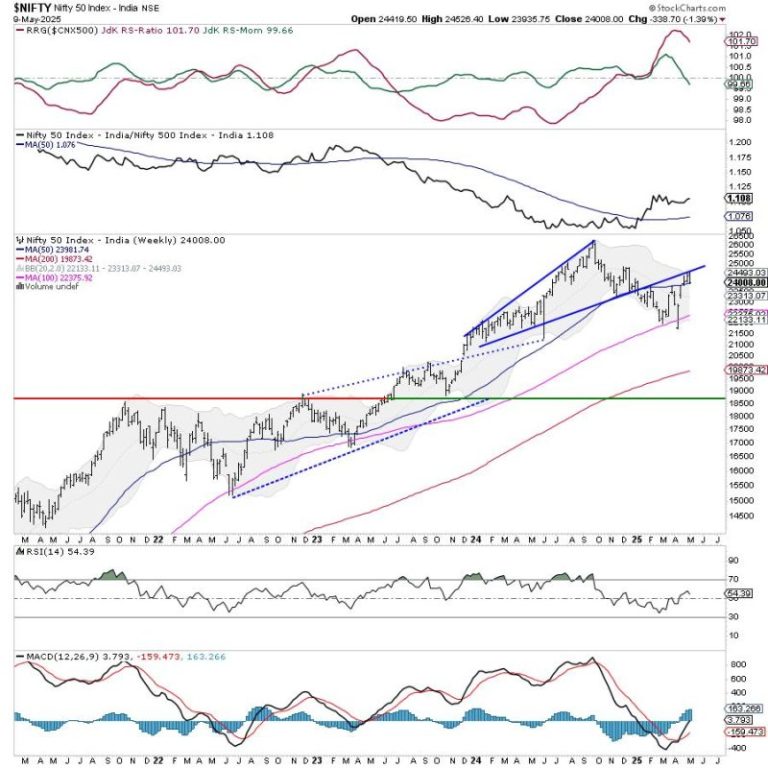
Amid ever-increasing uncertainties on the global front and similarly rising geopolitical tensions between India and Pakistan, the Indian equity markets demonstrated strong resilience. They consolidated before ending the week on just a modestly negative note. The trading range remained modest; the Nifty oscillated in a 590-point range. While the markets defended their key support levels, the volatility surged. The volatility barometer, the India Vix, spiked 18.49% to 21.63 on a weekly basis.. The headline index finally closed with a net weekly loss of 338.70 points (-1.39%).

A few important things to note from a technical perspective. The 200-DMA is at 24044; the 50-week MA is at 23983. This makes the zone of 23950-24050 a very important support zone for the Nifty. So long as the Index is able to defend this zone, it will continue consolidating in a defined range. Incremental weakness would creep in only if the 23900 level is violated decisively. On the higher side, as evident from the charts, the markets have continued to resist the rising trendline resistance. From now on, the Nift’s behavior vis-à-vis the zone of 23950-24050 would be crucially important to watch; the Index’s ability to defend or not defend this zone will dictate the trend over the coming weeks.

The levels of 24350 and 24600 are expected to act as probable resistance points in the coming week. The supports are at 23900 and 23630.

The weekly RSI is 54.36; it stays neutral and does not diverge against the price. The weekly MACD is bullish and stays above its signal line. A bearish engulfing candle has emerged. Its emergence near a pattern resistance adds credibility to the resistance placed near 24500-24600.

The pattern analysis of both daily and weekly charts shows that the Nifty has traded quite on the expected lines and within the analyzed range. It has continued resisting the rising trendline resistance near 24500-24600; it has so far defended the key that is created between the 200-DMA and the 50-week MA. The markets would weaken only if they violate the crucial 23900 level; so long as this point stays defended, we can expect the markets to consolidate in a defined range.

Based on the overall technical structure, it is likely that the markets will not see any immediate upward trend. While if the markets end up breaching the 23900 level remains to be seen, it is doubtful that they will initiate any sustainable trending upmove and move past the 24500 levels soon. The hedging activity and the cost of hedging have increased; this is evident from Vix, which has significantly risen over the past few days. While the Nifty has defended the key support levels so far, it remains in a technically challenging environment. It is strongly recommended that the market participants adopt a defensive approach by focusing on the low beta stocks and the stocks with improving relative strength. Staying low on leveraged positions, a continued cautious outlook is advised for the coming week.


Sector Analysis for the coming week

In our look at Relative Rotation Graphs®, we compared various sectors against the CNX500 (NIFTY 500 Index), representing over 95% of the free-float market cap of all the listed stocks. 

Relative Rotation Graphs (RRG) show that the Nifty PSE Index has rolled inside the leading quadrant. Infrastructure, Nifty Bank, PSU Bank, FMCG, Consumption, Commodities, and the Financial Services Indices are also inside the leading quadrant. These groups are likely to outperform the broader Nifty 500 Index relatively.

The Nifty Metal Index has rolled inside the weakening quadrant. This may cause the sector to slow down and give up on its relative performance. The Services Sector index also remains in this quadrant.

While the Nifty IT Index continues to languish in the lagging quadrant, the Auto and the Realty Indices are sharply improving their relative momentum against the broader markets while staying inside this quadrant.

The Nifty Midcap 100 index has rolled inside the improving quadrant; may see its relative performance bettering over the coming days. The Media and the Energy Indices are also inside this quadrant, and may continue seeing improvement in their relative performance against the broader markets.


Important Note: RRG charts show the relative strength and momentum of a group of stocks. In the above Chart, they show relative performance against NIFTY500 Index (Broader Markets) and should not be used directly as buy or sell signals.  


Milan Vaishnav, CMT, MSTA

Consulting Technical Analyst

www.EquityResearch.asia | www.ChartWizard.ae