Author

admin

Browsing

The market does not always follow the same script or sequence, but bear markets typically end with a bottoming process marked by specific stages. These include capitulation, a short-term reversal-thrust, a follow-through thrust and long-term regime change. The first two stages mark downside excess and the initial turn around, while the latter two signal strong follow through. Today’s report will look at the first two phases, and preview the last two.

Phase 1: Capitulation

The capitulation phase of a bear market occurs when traders throw in the towel as downside momentum and selling pressure accelerate. Usually, the capitulation phase occurs after an extended decline, and this phase is the first step to a bottom. The chart below shows SPY with Bollinger Bands (200,3), %B (200,3) and S&P 500 Percent Above 200-day SMA ($SPXA200R). Signs of capitulation emerge when %B is below 0 and/or fewer than 20% of S&P 500 stocks are above their 200-day SMAs. The blue dashed lines show capitulation in June 2022, September 2022 and early April 2025. Note that we initially covered this capitulation phase in a report on April 8th.

Phase 2: Short-term Thrust Signals (ZBT)

Phase 2 is marked by a sharp-reversal from oversold extremes and an upside thrust. The Zweig Breadth Thrust is perhaps the most famous thrust indicator these days. We covered the ZBT extensively over the last few weeks and introduced a strategy using this indicator. The chart below shows the S&P 1500 ZBT indicator in the lower window (10-day EMA of S&P 1500 AD%). A thrust signal triggered on April 24th and stocks followed through with further gains.  

Two Down and Two to Go

The capitulation phase showed excessive selling pressure and the thrust phase marked a short-term reversal. These are bullish events, but the market cup is not yet half full. SPY remains below its 200-day SMA and the late March high (see chart above). Medium-term thrust indicators have yet to trigger and long-term breadth remains bearish. The 14% surge over the last 17 days is impressive, but keep in mind that SPY surged 10% in nine days in March 2022, which was a bear market bounce.

TrendInvestorPro produced a report this week covering the four phases – and what to watch going forward. Click here to take a trial and get immediate access.

  • Phase 1: Capitulation
  • Phase 2: Short-term Thrust Signals
  • Phase 3: Medium-term Thrust Signals
  • Capitulation and Thrust Indexes
  • Phase 4: Long-term Indicators turn Bullish
  • Short-term Improvements, but Longer Term 

//////////////////////////////////////////////////////

The market does not always follow the same script or sequence, but bear markets typically end with a bottoming process marked by specific stages. These include capitulation, a short-term reversal-thrust, a follow-through thrust and long-term regime change. The first two stages mark downside excess and the initial turn around, while the latter two signal strong follow through. Today’s report will look at the first two phases, and preview the last two.

Phase 1: Capitulation

The capitulation phase of a bear market occurs when traders throw in the towel as downside momentum and selling pressure accelerate. Usually, the capitulation phase occurs after an extended decline, and this phase is the first step to a bottom. The chart below shows SPY with Bollinger Bands (200,3), %B (200,3) and S&P 500 Percent Above 200-day SMA ($SPXA200R). Signs of capitulation emerge when %B is below 0 and/or fewer than 20% of S&P 500 stocks are above their 200-day SMAs. The blue dashed lines show capitulation in June 2022, September 2022 and early April 2025. Note that we initially covered this capitulation phase in a report on April 8th.

Phase 2: Short-term Thrust Signals (ZBT)

Phase 2 is marked by a sharp-reversal from oversold extremes and an upside thrust. The Zweig Breadth Thrust is perhaps the most famous thrust indicator these days. We covered the ZBT extensively over the last few weeks and introduced a strategy using this indicator. The chart below shows the S&P 1500 ZBT indicator in the lower window (10-day EMA of S&P 1500 AD%). A thrust signal triggered on April 24th and stocks followed through with further gains.  

Two Down and Two to Go

The capitulation phase showed excessive selling pressure and the thrust phase marked a short-term reversal. These are bullish events, but the market cup is not yet half full. SPY remains below its 200-day SMA and the late March high (see chart above). Medium-term thrust indicators have yet to trigger and long-term breadth remains bearish. The 14% surge over the last 17 days is impressive, but keep in mind that SPY surged 10% in nine days in March 2022, which was a bear market bounce.

TrendInvestorPro produced a report this week covering the four phases – and what to watch going forward. Click here to take a trial and get immediate access.

  • Phase 1: Capitulation
  • Phase 2: Short-term Thrust Signals
  • Phase 3: Medium-term Thrust Signals
  • Capitulation and Thrust Indexes
  • Phase 4: Long-term Indicators turn Bullish
  • Short-term Improvements, but Longer Term 

//////////////////////////////////////////////////////

Gold trended down this week, dropping to just over US$3,200 per ounce on the first day of May.

While the yellow metal remains historically high after a strong run this year, its price has pulled back from last week’s record-setting level of US$3,500, causing concern for some market participants.

However, many experts agree that this week’s retreat isn’t a reason to worry.

His technical analysis shows that the US$3,100 to US$3,140 area will be important to watch moving forward — in his view, that’s when bullish players should start re-entering the space, boosting the price.

Soloway also outlined gold’s future price potential, saying he sees a potential path to US$7,000. Check out the full interview for more of his thoughts on gold, as well as silver and the US economy.

Bullet briefing — Fed to meet next week, US-Ukraine deal signed

Market watchers eye Fed meeting

Eyes are shifting to the US Federal Reserve’s next meeting, set to run from May 6 to 7. It follows initial numbers showing that real GDP contracted by an annual rate of 0.3 percent in Q1.

That’s the first negative reading since 2022, and as the news weighed on the stock market, US President Donald Trump took to social media to suggest the data is an ‘overhang’ from Joe Biden’s term.

Trump has pressured Fed Chair Jerome Powell to cut interest rates sooner than later, but CME Group’s FedWatch tool shows the vast majority of market participants expect rates to stay flat.

Trump advisor Elon Musk also has his eye on the Fed. Speaking to reporters on Wednesday (April 30), he said the US$2.5 billion renovation of the central bank’s headquarters could become a point of inquiry for the Department of Government Efficiency, better known as DOGE.

Calling the cost an ‘eyebrow raiser,’ Musk questioned where the money is being spent. The price of the project was initially set at US$1.9 billion in 2021, but has increased since then.

‘Since at the end of the day, this is all taxpayer money, I think we certainly — we should definitely — look to see if indeed the Federal Reserve is spending $2.5 billion on their interior designer’ — Musk

US, Ukraine sign critical minerals deal

The US and Ukraine signed a much-anticipated minerals deal on Wednesday, ending months of often-tense negotiations between the two countries. If approved by parliament in Ukraine, the agreement will set up a reconstruction investment fund that will be split 50/50 between each party.

According to Ukrainian officials, the deal is more equitable than previous versions.

The fund will be financed only by new licenses for critical materials, oil and gas; aside from that, Ukraine will not have to pay back wartime aid provided by the US.

While Ukraine had pushed for security guarantees from the US, that component ultimately wasn’t put in place. However, the US may provide new assistance to Ukraine, such as air defense systems.

A total of 55 minerals are reportedly covered in the arrangement, but more can be added in the future if there is consensus between the US and Ukraine. Although the US will get preferential rights to mineral extraction, Ukraine will have the final say on what is mined and where, and will retain subsoil ownership.

The agreement comes on the back of an increasing global focus on critical minerals, many of which are key for new technology and important industries like defense.

It’s worth noting that while Ukraine is home to a wide variety of these commodities, more geological data will be needed to determine commercial viability — for example, there is no up-to-date information on the country’s reserves of rare earths, which are important to the US.

Securities Disclosure: I, Charlotte McLeod, hold no direct investment interest in any company mentioned in this article.

This post appeared first on investingnews.com

Gold trended down this week, dropping to just over US$3,200 per ounce on the first day of May.

While the yellow metal remains historically high after a strong run this year, its price has pulled back from last week’s record-setting level of US$3,500, causing concern for some market participants.

However, many experts agree that this week’s retreat isn’t a reason to worry.

His technical analysis shows that the US$3,100 to US$3,140 area will be important to watch moving forward — in his view, that’s when bullish players should start re-entering the space, boosting the price.

Soloway also outlined gold’s future price potential, saying he sees a potential path to US$7,000. Check out the full interview for more of his thoughts on gold, as well as silver and the US economy.

Bullet briefing — Fed to meet next week, US-Ukraine deal signed

Market watchers eye Fed meeting

Eyes are shifting to the US Federal Reserve’s next meeting, set to run from May 6 to 7. It follows initial numbers showing that real GDP contracted by an annual rate of 0.3 percent in Q1.

That’s the first negative reading since 2022, and as the news weighed on the stock market, US President Donald Trump took to social media to suggest the data is an ‘overhang’ from Joe Biden’s term.

Trump has pressured Fed Chair Jerome Powell to cut interest rates sooner than later, but CME Group’s FedWatch tool shows the vast majority of market participants expect rates to stay flat.

Trump advisor Elon Musk also has his eye on the Fed. Speaking to reporters on Wednesday (April 30), he said the US$2.5 billion renovation of the central bank’s headquarters could become a point of inquiry for the Department of Government Efficiency, better known as DOGE.

Calling the cost an ‘eyebrow raiser,’ Musk questioned where the money is being spent. The price of the project was initially set at US$1.9 billion in 2021, but has increased since then.

‘Since at the end of the day, this is all taxpayer money, I think we certainly — we should definitely — look to see if indeed the Federal Reserve is spending $2.5 billion on their interior designer’ — Musk

US, Ukraine sign critical minerals deal

The US and Ukraine signed a much-anticipated minerals deal on Wednesday, ending months of often-tense negotiations between the two countries. If approved by parliament in Ukraine, the agreement will set up a reconstruction investment fund that will be split 50/50 between each party.

According to Ukrainian officials, the deal is more equitable than previous versions.

The fund will be financed only by new licenses for critical materials, oil and gas; aside from that, Ukraine will not have to pay back wartime aid provided by the US.

While Ukraine had pushed for security guarantees from the US, that component ultimately wasn’t put in place. However, the US may provide new assistance to Ukraine, such as air defense systems.

A total of 55 minerals are reportedly covered in the arrangement, but more can be added in the future if there is consensus between the US and Ukraine. Although the US will get preferential rights to mineral extraction, Ukraine will have the final say on what is mined and where, and will retain subsoil ownership.

The agreement comes on the back of an increasing global focus on critical minerals, many of which are key for new technology and important industries like defense.

It’s worth noting that while Ukraine is home to a wide variety of these commodities, more geological data will be needed to determine commercial viability — for example, there is no up-to-date information on the country’s reserves of rare earths, which are important to the US.

Securities Disclosure: I, Charlotte McLeod, hold no direct investment interest in any company mentioned in this article.

This post appeared first on investingnews.com

In the truncated week due to one trading holiday, the markets extended their gains and closed the week on a positive note. While remaining largely within a defined range, the Nifty continued consolidating above its 200-DMA while not adopting any sustainable directional bias. While the Index continued defending its key support levels, it oscillated in the range of 535.10 points. Volatility continued moving higher; the India Vix surged by 6.41% to 18.26 on a weekly basis. While staying positive, the headline index closed with a net weekly gain of 307.35 points (+1.28%).

From a technical standpoint, the Nifty has kept its underlying bias intact; it is currently consolidating above the 200-DMA positioned at 24050. The 50-week MA is placed at 23962. This makes the 24950-24050 a strong 200-point support zone for the Nifty for the coming weeks and the foreseeable short term. So long as the Index keeps it above this 200-point support zone, it will just consolidate and not show any major drawdowns. However, any violation of 24900 will increase the possibility of some corrective retracement. Watching Nifty’s behavior vis-à-vis the zone of 23950-24050 would be crucial over the coming days.

The geopolitical tensions between India and Pakistan remain ingrained in the market behavior; the rise in Vix shows increased hedging activity by the market participants. Monday is likely to see a stable start to the day; the levels of 24550 and 24780 are likely to act as resistance levels. The supports come in at 24050 and 23900. The trading range is expected to stay wider than usual.

The weekly RSI stands at 57.92. While the RSI has formed a fresh 14-period high, it remains neutral and does not show any divergence against the price. The weekly MACD is bullish and trades above its signal line.

The pattern analysis shows that on the daily chart, the Nifty crossed above the 200-DMA a few days ago; now, it is consolidating just above this important level. It has penetrated the 50-week MA placed at 23962, and this level is now expected to act as support in the event of any corrective retracement. Importantly, the Nifty has resisted the rising trendline pattern resistance near 24600. This trendline begins at 21130 levels and joins the subsequent rising bottoms.

The coming week will require a more cautious approach as the markets not only deal with key resistance levels but also with geopolitical tensions that remain embedded in the backdrop. The investors will need to move away from the stocks that have risen over the past weeks and move to those sectors and stocks that are readying for a fresh move. While focusing more on low-beta stocks, the leverage, too, needs to be curtailed. The Index has risen over 2500 points over the past three weeks, and if it consolidates a bit, it should not surprise the market participants. A highly cautious and stock-specific approach is advised for the coming week.


Sector Analysis for the coming week

In our look at Relative Rotation Graphs®, we compared various sectors against the CNX500 (NIFTY 500 Index), which represents over 95% of the free-float market cap of all the listed stocks.

Relative Rotation Graphs (RRG) show the Nifty FMCG index has rolled inside the leading quadrant. The PSU Bank, Infrastructure, and Consumption Index are also inside the leading quadrant. The Metal, Commodities, Financial Services, and Nifty Bank Index are also inside this quadrant, but they are giving up on their relative momentum. However, these groups may continue to outperform the broader markets relatively.

The Services Sector Index has rolled inside the weakening quadrant.

While the Nifty IT index continues to languish inside the lagging quadrant, the Midcap 100, Auto, Realty, and Pharma Indices are seen improving their relative momentum while being inside the lagging quadrant.

The Nifty Media, PSE, and Energy Indices are inside the improving quadrant; they are expected to better their relative performance against the broader markets.


Important Note: RRG charts show the relative strength and momentum of a group of stocks. In the above Chart, they show relative performance against NIFTY500 Index (Broader Markets) and should not be used directly as buy or sell signals.  


Milan Vaishnav, CMT, MSTA

Consulting Technical Analyst

www.EquityResearch.asia | www.ChartWizard.ae


Riches are found in reactions—your reactions to changes in the markets. By this, I mean that if you spot a change in money flowing from one asset class to another, one sector to another, one industry to another, before the masses notice, you will be rewarded handsomely. My experience has been that your profits will accumulate dramatically and consistently.

A fine example of this principle in the corporate arena is the global footwear and accessories retailer, Aldo. The company has 1,600 stores in 80 countries and is immensely profitable. Their secret sauce: quick reactions to market trends. When they identify a change in fashion trends, they’re 50 percent quicker than their competition in designing, producing and delivering the hottest styles. Yes, fifty percent faster, and that’s gold to their bottom line.

This can be your secret sauce to investment profits as well. Your personal portfolio of ChartLists is the equivalent of Aldo’s design department, production department, and delivery department all bundled together. It facilitates quick reactions to current observable stock market opportunities.

In simplistic terms, your personal collection of ChartLists is like giving a runner a bicycle or giving a Jeep driver a Porsche. ROI (return on investment of your time and efforts) becomes supercharged. Your ChartLists allow you to become a “force of consistency.” They will also help you embrace one of Charlie Munger’s key investment tenets, “Try to be consistently not stupid.”

To achieve this end, I humbly suggest that you could best start with the Stock Market Mastery ChartPack.

Assembling your portfolio of ChartLists is analogous to building your custom dream house. There are sensational books of checklists that systematically ask you a comprehensive series of questions and bring up features you should consider. The end result should be a custom home you love, that fits you perfectly, and that accommodates your unique lifestyle. Think of the Stock Market Mastery ChartPack, then, as an extensive checklist—a buffet of pre-populated and organized ChartLists, from which you build your own custom collection of ChartLists that fits your investing methodology perfectly and facilitates your personal Investor Self. These 80 ChartLists are carefully structured, all pre-populated with expertly designed charts and a carefully-crafted organization to maximize your precious time and insights. Indeed, nearly all the informational breadcrumbs the market has to offer will be made clear to you and offer you a profitable trail to follow. Your reflexes and reactions just got supercharged. It is that easy.

Trade well; trade with discipline!

Gatis Roze, MBA, CMT

StockMarketMastery.com

With the major averages logging a strong up week across the board, and with the Nasdaq 100 finally retesting its 200-day moving average from below, it can feel like a challenging time to take a shot at winning charts. You may ask yourself, “Do I really want to be betting on further upside after an incredibly strong April?”

When the macro environment feels less certain, I find it’s helpful to go back to tried-and-true technical analysis approaches. By identifying stocks with constructive chart patterns, we can hopefully focus our attention on names that could do well regardless of the overall market movements in the coming weeks.

With that bottom-up investing justification in mind, let’s review three recent earnings names that are showing strong technical profiles going into next week.

Visa Inc. (V)

Both Visa (V) and Mastercard (MA) reported earnings, and both stocks experienced an upside follow-through after their quarterly report. Visa has been pounding out a consistent pattern of lower lows and lower highs since the end of February, but this week appears to have broken that downtrend pattern.

After Tuesday’s earnings release, Visa completed a move out of the downtrend phase by breaking trendline resistance using the major peaks from February and March. Wednesday’s up day pushed V back above the 50-day moving average, a level which had repelled a previous breakout attempt in mid-April. MA has now broken above its late March high, and a similar move next week would suggest a retest of all-time highs for Visa.

Coca Cola Co. (KO)

The Consumer Staples sector pulled back this week, and leading names in the sector, such as Coca-Cola (KO), experienced a brief drop post-earnings. KO is demonstrating a cup-and-handle pattern, although we’ve not seen the breakout that would serve to confirm a bullish outlook.

We’ve used the Annotations tool to draw a rectangle marking the resistance zone from the September 2024 peak. Subsequent peaks in March and April 2025 have retested this same range, forming the cup-and-handle pattern which often precedes a strong upthrust. The trigger for this pattern is a confirmed break above the rim of the cup, and, with this week’s pullback, investors will have to wait for this bullish confirmation.

We’ve noted the bearish momentum divergence in recent months, with the higher price highs in March and April marked by weaker RSI peaks. With this bearish divergence clearly signalling a weaker momentum profile, we would need to see a valid break above $74 on stronger RSI readings to negate the divergence and confirm an upside breakout.

CME Group Inc. (CME)

Since I discussed the exchanges with Jay Woods on my Market Misbehavior podcast back in February, I’ve been following the resilient uptrend of higher highs and higher lows. The daily chart features a series of consolidation patterns followed by upside breakouts that have led to further gains.

This is the kind of chart that I think about when someone asks, “But if you’re buying the new highs list, isn’t that too late?” The chart of CME shows that new highs often lead to even more new highs. And when a stock like CME Group keeps pulling back to an ascending 50-day moving average, I’m reminded the essence of trend-following is to remain invested in charts that continue to work.

In the immortal words of legendary technical analyst Paul Montgomery, “The most bullish thing the market can do is go up!”


I had the pleasure of heading back into the StockCharts TV studio this week to shoot the “Top Ten Stocks for May 2025” video with Grayson Roze. Visa was one of the five stocks I contributed. Check out the other nine in this week’s video!

RR#6,

Dave

P.S. Ready to upgrade your investment process? Check out my free behavioral investing course!


David Keller, CMT

President and Chief Strategist

Sierra Alpha Research LLC


Disclaimer: This blog is for educational purposes only and should not be construed as financial advice. The ideas and strategies should never be used without first assessing your own personal and financial situation, or without consulting a financial professional.

The author does not have a position in mentioned securities at the time of publication. Any opinions expressed herein are solely those of the author and do not in any way represent the views or opinions of any other person or entity.

We just wrapped up a busy week jam-packed with key economic data and big tech earnings. And we have some positive news: the market held up pretty well. May is off to a good start.

Strong earnings from META Platforms (META) and Microsoft (MSFT) gave the stock market a boost. Together, their strong performance helped the Nasdaq Composite ($COMPQ) break above its 50-day simple moving average (SMA).

On Friday, the rally got an extra shot in the arm from a better-than-expected jobs report—177,000 jobs added vs. 135,000 expected. That helped fuel a market-wide rally, with all the major indexes ending the week in positive territory. The Dow Jones Industrial Average ($INDU) closed up 1.46%, the S&P 500 ($SPX) up 1.42%, and the Nasdaq Composite ($COMPQ) up 1.41%.

A quick glance at the Equities panel (US Indexes tab) in the Market Summary page shows that the S&P 500, Dow Industrials, Russell 1000, and the Wilshire 5000 had nine consecutive up days. This is quite the reversal after trade war outcomes spooked investors. The weekly streak isn’t too shabby either, with many indexes displaying four consecutive up streaks. More indexes are now trading above their 50-day moving averages compared to a few days ago.

What Does This Mean Going Forward?

After a negative statistic in the Q1 GDP growth, the strong jobs report put recessionary fears in the rearview mirror. However, this also lowers the chances of the Federal Reserve cutting interest rates in the May FOMC meeting. And looking at the CME FedWatch Tool, the probability of a rate cut in June has dropped to 36.4%, so it may be July before we see a rate cut. But this scenario could change between now and June.

Does this week’s price action mean the equity market is reversing? One thing is clear: The situation is much more positive than it was three weeks ago. But to get an objective view, it’s best to focus on the charts.

The Technical PoV

The daily chart of $SPX below shows that Friday’s close basically wipes out the “post Liberation Day” losses. Essentially, all the volatile action that took place in the last month was an emotional reaction to the uncertainty that investors were battling against. It was an emotional roller coaster. Now that the S&P 500 is back to the high of April 2, does it mean things have returned to business as usual?

FIGURE 1. DAILY CHART OF S&P 500. The index closed at around the same level it did on Liberation Day. Chart source: StockCharts.com. For educational purposes.

Seasonally, May is a good month in the stock market, as are June and July. You can see this in the seasonality chart of the S&P 500. The data supports some of the price action we’re seeing, especially among sectors and industry groups.

Sector Snapshot

All 11 S&P sectors closed in the green on Friday. For the week, Industrials, Technology, and Financials were the leading sectors. It’s interesting to note that Friday’s leading sector, Financials, is showing signs of recovery after the April fall. The daily chart of the Financial Select Sector SPDR (XLF) shows the ETF trading above its 50- and 200-day SMAs. Its relative strength index (RSI) is also rising.

FIGURE 2. DAILY CHART OF XLF. The ETF broke above its 50-day moving average and its relative strength is also rising. Chart source: StockCharts.com. For educational purposes.

Of the three, the Technology sector is technically the weakest. It’s trading below its 200-day SMA, and its 50-day SMA is below its 200-day SMA. To see strength return to the broader market, the Technology sector needs show technical strength.

The Nasdaq Composite Bullish Percent Index ($BPCOMP) is at 46.52. It showed a reversal from a level just above 20 and crossed above 30, indicating a bull alert. A cross above 50 would be a favorable bull signal.

FIGURE 3. NASDAQ COMPOSITE BULLISH PERCENT INDEX. After a sharp reversal from above 20, $BPCOMPQ crossed above the 30 level and is approaching the 50 level. Chart source: StockCharts.com. For educational purposes.

Keep an eye on this chart, since a break above 50 could be an early signal of improving breadth in the Nasdaq Composite.

At the Close

While the stock market’s price action seems to have regained some of its momentum, there needs to be more confirmation to suggest a trend reversal. Keep an eye on the charts of the broader indexes, sectors, and the BPIs. Look for technical indicators to confirm the rally’s strength and keep an eye on interest rate expectations.


End-of-Week Wrap-Up

  • S&P 500 up 2.92% on the week, at 5686.67, Dow Jones Industrial Average up 3.0% on the week at 41,317.43; Nasdaq Composite up 3.42% on the week at 17,977.73.
  • $VIX down 8.86% on the week, closing at 22.64.
  • Best performing sector for the week: Industrials
  • Worst performing sector for the week: Energy
  • Top 5 Large Cap SCTR stocks: Palantir Technologies, Inc. (PLTR); Duolingo Inc. (DUOL); Summit Therapeutics PLC (SMMT); MicroStrategy (MSTR); Roblox Corp (RBLX)

On the Radar Next Week

  • Earnings season continues with Berkshire Hathaway (BRK-B), Palantir Technologies (PLTR), Taiwan Semiconductor Manufacturing Company (TSM), Novo Nordisk (NOVO-B.CO), Ford (F), Advanced Micro Devices (AMD), and several others reporting.
  • ISM Services PMI
  • Fed Interest Rate Decision/Press Conference
  • Fed speeches from Kugler, Goolsbee, Waller, Williams, and others on Friday

Disclaimer: This blog is for educational purposes only and should not be construed as financial advice. The ideas and strategies should never be used without first assessing your own personal and financial situation, or without consulting a financial professional.

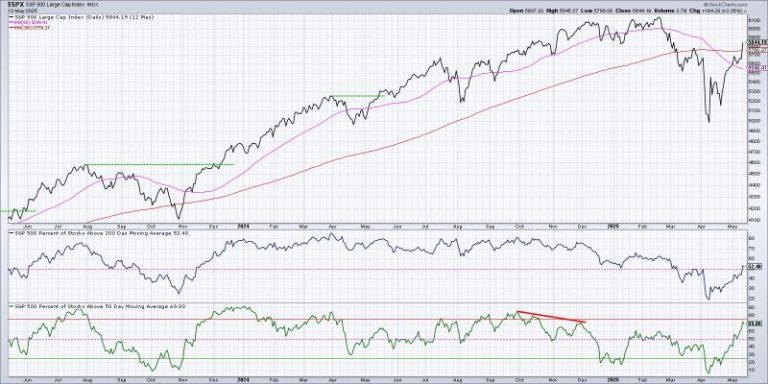
I feel like the short-term risk is turning once again and I’ll explain why in my analysis below. Please don’t misunderstand. I suggested a bottom was in place a few weeks ago and I LOVE what has been happening in terms of manipulation/accumulation and I LOVE the fact that we were able to quickly regain both the 20-day EMA and 50-day SMA on our major indices.

However, here are the four major indices and where they’re at currently on their respective charts and their next key overhead resistance levels:

Dow Jones

We did manage to close just above the 50-day SMA here, but the Dow Jones still appears vulnerable to me. Given the fact that the S&P 500 has room to run up to what is now major price resistance at 5782, I could see the Dow Jones moving a bit higher to challenge the late-March high at approximately 42750. That could serve as a neckline.

S&P 500

20-day EMA resistance? No problem, went right through. Gap resistance 5500? Ditto. 50-day SMA resistance. Ditto. This rally has been impressive. Key levels of price resistance have failed and this tells me that we’re not going to violate the low at 4835. It’s set in stone, in my opinion. There are still a couple of key resistance levels on the S&P 500 that we’ll have to deal with next week. The first will be the early-April rebound attempt that failed near 5700. Today’s intraday high was 5700. The next one, however, will be the biggest on the chart and that’s where we last failed in late March – at 5782.

NASDAQ 100:

Looks similar to the S&P 500, but I did add the RSI to this chart. During downtrends, RSI 60 tends to be rather big resistance. We see many rallies fail at or near that level. The NDX just crossed RSI 60….barely. At our Friday intraday high, the NASDAQ 100 pulled within 100 points (less than 0.5%) of the late-March high near 20250. I don’t know if we turn here or not, but I do know the risks are elevated.

Russell 2000:

The 197 level offered great price support on multiple occasions, so when we see a heavy-volume breakdown like we saw in early April, we should recognize how important it is to clear that same price resistance on the way back up. We did so on Friday with gusto. I absolutely LOVE the sudden accumulation that’s taken place in the IWM. I believe that will result in a much larger move at some point later this year. But are we due for another round of selling first, perhaps at upcoming price resistance levels marked above? We’ll soon find out.

Be careful ahead, especially if a rising-volume, reversing candle prints on our major indices sometime next week.

Sentiment

Check out this 5-day SMA of the equity only put call ratio ($CPCE):

We just hit 0.55, showing the most complacency we’ve seen in the past 5 weeks or so. Extreme low readings have previously marked corrections and/or cyclical bear markets and that was one key topping indicator that I discussed back in January/February. Other prior moves down to 0.55 have also resulted in short-term tops. I thought the current .55 reading was worth pointing out for this reason.

Seasonality could also play a role. Early May (through the 5th) tends to provide historical tailwinds, but the middle part of May (6th through 25th) has a history of being rather challenging. The 5th is Monday, so given everything I’ve discussed above and knowing that our bullish seasonal window could soon be closing, watch for a potential reversing candle as a sign to think about reducing risk (covered calls, S&P 500 puts for insurance, moving to cash, etc.).

I’m not ready to definitively call a short-term top here, but I do want to point out that the SHORT-TERM risks of being long right now are growing. Do with that what you may.

If you’d like to follow more articles of mine, please CLICK HERE to join the tens of thousands who’ve already subscribed to our FREE EB Digest newsletter. There is no credit card required and you may unsubscribe at any time.

Happy trading!

Tom

The world’s oceans are increasingly becoming an important new frontier in the geopolitical and economic race for critical minerals, with countries fast-tracking plans for deep-sea mining.

Meanwhile, the global body tasked with regulating such activities is struggling to keep pace.

As sovereign states ramp up efforts to access seabed resources crucial for clean energy and defense technologies, the International Seabed Authority (ISA) finds itself sidelined — raising alarms among environmentalists and nations alike.

Stoking these tensions, US President Donald Trump signed an executive order earlier this month with the aim of expediting deep-sea mineral extraction in both national and international waters.

The directive, which calls for faster permitting and exploration, bypasses multilateral negotiations at the ISA and uses a 1980 domestic statute — the Deep Seabed Hard Mineral Resources Act — to justify the unilateral action.

The order “establishes the US as a global leader in seabed mineral exploration and development both within and beyond national jurisdiction,’ signaling Washington’s intent to secure independence from Chinese mineral supply chains.

But the move has drawn fierce criticism from multiple fronts.

“The US authorization … violates international law and harms the overall interests of the international community,” said Chinese foreign ministry spokesman Guo Jiakun. Such sentiments echo concerns that unilateral actions could unravel decades of work toward collective seabed governance under the United Nations (UN) Convention on the Law of the Sea.

At the heart of the dispute lies the ISA, the UN agency responsible for regulating mining in international waters.

Though it has issued over 30 exploratory permits, it has yet to finalize rules for commercial extraction. That regulatory vacuum has encouraged countries to approach the issue alone and in accordance with their own different agendas.

Norway reverses course on deep-sea mining

In January 2024, Norway became the first country to approve commercial-scale deep-sea mining within its own exclusive economic zone, greenlighting exploration across 280,000 square kilometers — an area larger than the UK.

The move, passed through parliament despite strong domestic and international opposition, is part of the country’s bid to secure metals like cobalt, scandium and lithium for green technologies.

“We will have a relatively long period of exploration and mapping activity to close the knowledge gap on the environmental impact,” Walter Sognnes, co-founder of Loke Marine Minerals, a Norwegian company focused on deep-sea exploration, told the BBC in an interview at the time the news was announced

However, environmentalists argued that the plan undermined Norway’s own standards.

“The Norwegian government always highlighted that they want to implement the highest environmental standards,” said Martin Webeler of the Environmental Justice Foundation.

“That is hypocritical whilst you are throwing away all the scientific advice.”

The Norway Institute of Marine Research also criticized the government’s decision, saying the existing environmental impact assessment was based on limited data and not representative of the vast areas opened for mining. It called for an additional five to 10 years of research before proceeding.

Against that backdrop, Norway reversed course, suspending its deep-sea mining plans at the end of 2024 following mounting political and environmental pressure.

The first licensing round, originally set for 2025, was blocked after the Socialist Left Party threatened to withhold support for the government’s budget unless the initiative was halted.

India eyes Clarion-Clipperton zone, Pacific Islands at crossroads

For its part, India has announced plans to ramp up its presence in the Pacific’s Clarion-Clipperton zone, one of the world’s most mineral-rich deep-sea regions. Although the ISA has already granted India two exploration contracts, the country has opted to hold off on operations as regulations remain in flux.

M. Ravichandran, secretary of the country’s Ministry of Earth Sciences, said the country is seeking to apply to the UN-backed ISA next year to focus on exploring the zone.

Meanwhile, the resource-rich Pacific Islands are emerging as battlegrounds in this high-stakes race.

Kiribati, a small island nation with jurisdiction over 75,000 square kilometers of prospective seabed, is reportedly in talks with China after a previous deal with Canada’s The Metals Company (NASDAQ:TMC) collapsed late last year.

In a statement dated March 17, the Kiribati government called discussions with Chinese ambassador Zhou Limin “an exciting opportunity” to explore its deep-sea resources.

But critics say such moves by smaller nations are often driven by economic desperation and can lead to exploitative outcomes. This tension is familiar in Papua New Guinea, where the failure of the Nautilus Minerals project left environmental damage and financial losses in its wake.

Some Pacific nations are now calling for a global moratorium on seabed mining, citing concerns about the unknown risks to ecosystems and the climate.

Patchwork governance, fragmented oversight

The race toward seabed mining is exposing a critical flaw in global governance: fragmentation. The ISA, which was supposed to provide a unified framework, is losing relevance as more countries chart independent courses.

“The harm caused by deep-sea mining isn’t restricted to the ocean floor: it will impact the entire water column, top to bottom,” Jeff Watters, vice president for external affairs at the Ocean Conservancy, told the Guardian.

A study by the Natural History Museum and the UK’s National Oceanography Center analyzing a 1970s test site concludes that some sediment dwellers were able to recover, but larger animals dependent on polymetallic nodules did not return — likely because the nodules, which take millions of years to form, were destroyed.

Despite these warnings, the Metals Company continues to push forward. It has said it plans to mine by the year’s end, pending US government approval, as CEO Gerard Barron remains unfazed by the backlash.

“Here there’s zero flora,” Barron told the BBC in a January 2024 interview. “If we measure the amount of fauna… in the form of biomass, there is around 10g per square metre. That compares with more than 30kg of biomass where the world is pushing more nickel extraction, which is our equatorial rainforests.”

Beyond environmental concerns, the deep-sea mining surge is reshaping geopolitical dynamics. China, which dominates global production and processing of rare earths, has long used its position as leverage in trade disputes. In response to US tariffs, Beijing recently introduced new export controls on rare earths — further intensifying the mineral arms race.

Trump’s executive order makes clear that seabed mining is now viewed as a national security imperative.

“It’s not just drill, baby, drill. It’s mine, baby, mine,” said Secretary of the Interior Doug Burgum at a recent conference. “We will literally be at the mercy of others that are controlling our supply chains,” he warned.

But this approach risks setting a dangerous precedent. If powerful nations begin issuing their own licenses outside multilateral systems, others are likely to follow suit. The result could be a patchwork of conflicting claims and reduced protections, particularly for vulnerable maritime nations.

With the ISA still developing a mining code and more countries rejecting its pace, the world faces a dilemma: how to balance the urgent demand for critical minerals with the equally pressing need to preserve fragile marine ecosystems.

Securities Disclosure: I, Giann Liguid, hold no direct investment interest in any company mentioned in this article.

Keep reading…Show less
This post appeared first on investingnews.com