
Author

admin

Browsing

Silver has lagged behind gold’s record run, causing the gold-silver ratio to stretch near historic extremes.

With the gold price buoyed by central bank buying and silver increasingly tied to industrial demand, the disconnect between the two traditional safe-haven metals has widened.

But could the silver price finally be poised for a breakout?

During a recent silver-focused webinar, Sprott (TSX:SII,NYSE:SII) founder Eric Sprott, former Hecla Mining (NYSE:HL) CEO Phil Baker and technical analyst Michael Oliver joined host Simon Catt of Arlington Group to unpack what’s driving silver’s sluggish performance, and whether a reversal could be on the horizon.

The panelists explored silver’s shifting applications, the impact of macro forces like Bitcoin speculation and why some investors see today’s dynamics as a potential launchpad for silver’s next big move.

Understanding silver supply and demand

The silver price surged in 2024, rising from around US$22 per ounce at the start of the year to nearly US$35 by the end of October. Since then, silver has largely stayed in the US$30 to US$32 range, briefly breaking US$34 mark in March.

The metal has seen some support in 2025 due to instability in global financial markets caused by US President Donald Trump’s tariffs and the threat of reciprocal import fees against key trading partners.

These foreign policy shifts by the world’s largest economy have created uncertainty for investors who have been increasingly looking to traditional safe havens like silver and gold to de-risk their portfolios.

However, today’s tariff turmoil overshadows a fundamental shift in the silver market over the past several years, which has seen industrial demand growth start to outpace traditional investment demand.

The most notable demand increase has been due to the energy transition and silver’s use in solar panels.

While firms like Goldman Sachs (NYSE:GS) have predicted that industrial demand will wane over the next few years, Catt’s panelists presented different points of view. Sprott said there will be further demand from the electric vehicle (EV) market as producers look to solid-state batteries, which are not only safer, but also quicker to charge.

“I think (solid-state batteries) will bring back EVs to being viewed as economic,’ he said. ‘Plus the whole processing of solar panels and generating electricity more and more inexpensively over time, it’s just going to make the demand for silver continue to rise here when we already have a shortfall,” he told listeners.

Baker pointed out that solar currently makes up 29 percent of silver’s total 1.2 billion ounces of annual demand, and noted that if that were to disappear, it would have a massive impact on the silver market. However, he also said that even if there were a significant policy shift in the US, there would still be considerable demand for solar worldwide.

“Even in the US, the policy really is ‘all of the above’ — all forms of energy. So I’m not concerned about solar cells diminishing. Could they go flat? Yeah, that’s fine. Flat at 300 million ounces? That’s great demand for silver,” he added.

While most solar demand comes from China, the panelists also discussed India’s growing role in the sector. The country has recently been working to increase domestic production of solar panels.

“(Prime Minister Narendra) Modi made a policy decision a year ago to grow the solar industry in India. So in India, only about 10 percent of their demand for silver is used for industrial purposes. In China, it’s 90 percent, and so what you’re going to have in India is you’re going to see their solar panel growth skyrocket,” Baker said.

Of course, demand isn’t the only factor influencing the silver industry.

Supply constraints have helped push the market into a structural deficit over the past several years.

Silver is primarily a by-product metal in the production of copper, nickel, zinc and gold, which makes it highly dependent on dynamics in those markets. As Baker pointed out, silver isn’t a significant source of revenue.

“So even if the price of silver rises significantly, they’re not going to change their operations because it’s not going to matter for a big copper producer,” he explained. Unless there are dramatic production swings for those commodities, supply and demand are unlikely to come into balance in the near term.

Silver price poised to break out?

Over the past year, silver has tested US$35 twice. Using technical analysis, Oliver compared this to how the silver price tested resistance at the US$26 level three times before breaking through.

What he’s seeing in momentum indicators now is similar to what happened at that time. In the lead up, momentum was flat, but once silver hit US$26, momentum saw an immediate 10 percent gain.

‘It came back up a third time to US$26, watch out. It blew your head off,’ he said. ‘Okay, you go back to US$35 again, and the price says, ‘You better watch out, I’m at a triple top, and if I go to US$36, it’s a triple-top breakout.”

“The only issue is now which week punches up there to that 10 percent over level. I think — who knows, it might even be tomorrow, but I think soon we’ll get up there,” Oliver said.

Silver price, May 15, 2022, to May 16, 2025.

Oliver went on to examine the gold-silver ratio, which he said could be suggesting a breakout is overdue. Traditionally, the ratio falls between 40 and 80 to 1, but it’s now closer to 100 to 1.

“I bet both of these metrics will pretty much coincide in terms of upturn, meaning not only a net price upturn in silver, but a relative performance upturn in silver versus gold, and I think that’ll shock people more than anything … especially if all of a sudden silver wakes up in a shocking, rapid way,’ Oliver noted.

‘That’s going to surprise most investors. I think it’s about to happen, the technicals are ripe.’

Silver market still facing manipulation

Addressing manipulation, Sprott suggested silver has been manipulated for the last half century.

‘I look at silver as a market that’s been manipulated for 50 years. We have about eight to 12 major international banks who are short over 500 million ounces of silver on the COMEX, have always been short that product,’ he said.

‘They always make stabs at knocking it down, trying to cover, but the shorts go back up.’

However, Sprott said as the price has gone from the US$20 range to closer to US$35 it has become more difficult for these banks to maintain their positions. “The same thing is true in gold, but in gold we all know that in the last year, when it broke through US$2,000 (per ounce) for the fourth time, it was over for the commercial banks,” he noted.

He went on to discuss how trading on the COMEX seems contrary to what is going on in other markets, saying that when international markets are open, gold and silver prices trade higher, but when the COMEX opens, they tend to fall.

“If you just traded COMEX and you bought silver at the starting value, it’d be worth about 2 or 3 percent of what it started at, whereas if you bought it in non-COMEX hours, it would be worth 600 percent more,’ Sprott said.

In his view, the suppression is ‘obvious.’ However, he predicts that the gold-silver ratio will correct in the near future, and the silver price will start to outperform gold.

What’s the outlook for the silver price?

For his part, Sprott sees the silver price going much higher.

“I’m sure we’re going to be through US$50. It used to trade at 15 to 1 to the price of gold. At today’s price of gold, that would be over US$200. I have no reason to think we’re not going there,” he said.

Oliver had a similar price prediction.

“I think the first surge could get you well above US$50. I think you’d get up in the US$60s and US$70s before you even pause, and I think it could occur rapidly,” he said. Oliver also explained that cryptocurrencies like Bitcoin aren’t an alternative and appear more like a speculative bubble. Given the size of the US debt, Treasuries aren’t as attractive to investors, which is causing further compression in monetary metals markets.

Although Baker didn’t provide a price prediction, he did express support for a market driven by supply and demand fundamentals, saying that “this is a very, very unique time.”

Securities Disclosure: I, Dean Belder, hold no direct investment interest in any company mentioned in this article.


This post appeared first on investingnews.com

Sector Rotation Shakeup: Industrials Take the Lead

Another week of significant movement in the sector landscape has reshaped the playing field. The Relative Rotation Graph (RRG) paints a picture of shifting dynamics, with some surprising developments in sector leadership. Let’s dive into the details and see what’s happening under the hood.

  1. (6) Industrials – (XLI)*
  2. (4) Financials – (XLF)*
  3. (1) Utilities – (XLU)*
  4. (2) Communication Services – (XLC)*
  5. (3) Consumer Staples – (XLP)*
  6. (8) Technology – (XLK)*
  7. (5) Real-Estate – (XLRE)*
  8. (9) Materials – (XLB)*
  9. (11) Energy – (XLE)*
  10. (10) Consumer Discretionary – (XLY)
  11. (7) Healthcare – (XLV)*

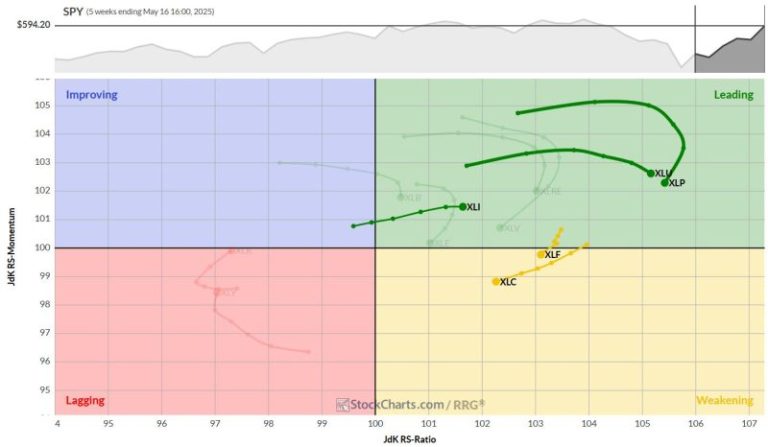
Weekly RRG

On the weekly RRG, Utilities and Consumer Staples maintain their high positions on the RS-Ratio scale. However, there are signs of waning momentum. Staples has rolled over within the leading quadrant and is now showing a negative heading. Utilities, while still strong, are losing some of their relative momentum.

Financials and Communication Services are hanging on in the weakening quadrant, but their tails are relatively short — indicating potential for a quick turnaround.

The show’s star, Industrials, has made a beeline for the leading quadrant, climbing on the RS-Ratio scale while maintaining a positive RRG heading.

Daily RRG

Switching to the daily RRG, we get a more granular view. Utilities, Staples, and Financials are found in the lagging quadrant, but Staples and Utilities are showing signs of life, turning back up towards the improving quadrant.

Financials, meanwhile, are hugging the benchmark.

The daily chart confirms Industrials’ strength, mirroring its weekly performance.

Communication Services, however, is showing some worrying signs — it’s dropped into the weakening quadrant on the daily RRG, confirming its vulnerable position on the weekly chart.

Industrials

XLI flexes its muscles, pushing against overhead resistance around the $144 mark.

A break above this level could trigger a further acceleration in price.

The relative strength line has already broken out of its consolidation pattern, propelling both RRG lines above 100 and driving the XLI tail deeper into the leading quadrant.

Financials

The financial sector continues its upward trajectory, trading above its previous high and closing in on the all-time high of around $53.

Like Industrials, a break above this resistance could spark a new leg up.

The RS line is moving sideways within its rising channel, causing the RRG lines to flatten—something to watch.

Utilities

XLU has finally broken through its overhead resistance, approaching its all-time high around $83.

After months of pushing against the $80 level, this breakout is a clear sign of strength.

The RS line is still grappling with its own resistance, but the RS-Ratio line continues its gradual ascent.

Communication Services

While XLC is moving higher on the price chart, its relative strength is lagging.

The sideways movement in the RS line is causing both RRG lines to move lower, with the RS-Momentum line already below 100.

This sector is rapidly approaching the lagging quadrant on the daily RRG—definitely one to watch for potential risks.

Consumer Staples

XLP is approaching the upper boundary of its trading range ($83-$85), where it is running into resistance. The inability to push higher while the market is moving up is causing relative strength to falter.

The recent strength has pushed both RRG lines well above 100, but the current loss of relative strength is now causing the RRG-Lines to roll over.

The tail is still comfortably within the leading quadrant, but this loss of momentum could signal a potential setback.

Portfolio Performance

The model portfolio’s defensive positioning has led to some underperformance relative to SPY, with the gap now just under 6%.

However, the model is sticking to its guns, maintaining a defensive stance with Staples and Utilities firmly in the top five.

It’s worth noting that Healthcare has now definitively dropped out of the top ranks. Nevertheless, with Staples and Utilities holding firm, and Technology and Consumer Discretionary still in the bottom half, the overall positioning remains cautious.

These are the periods when patience is key. We need to let the model do its work and wait for new, meaningful relative trends to emerge. It’s not always comfortable to endure underperformance, but it’s often necessary to capture longer-term outperformance.

#StayAlert, –Julius


Astute Metals NL (ASX: ASE) (“ASE”, “Astute” or “the Company”) is pleased to report assay results from the first of six holes completed as part of its highly successful April 2025 diamond drilling campaign at the 100%-owned Red Mountain Lithium Project in Nevada, USA. Drill-hole RMDD003 has returned three high- grade intersections of lithium mineralisation:

  • 32.4m @ 3,260ppm Li / 1.74% Lithium Carbonate Equivalent1 (LCE) from 57.2m, including an internal high-grade zone grading 8.6m @ 5,060ppm Li / 2.69% LCE from 67.7m;
  • 13.8m @ 1,330ppm Li / 0.71% LCE from 39.6m; and
  • 23.3m @ 1,610ppm Li / 0.86% LCE from 94.4m to End-of-hole.

Key Highlights

  • Outstanding lithium mineralisation returned in assays for diamond drill-hole RMDD003, which intersected:
    • 32.4m @ 3,260ppm Li from 57.2m, including 8.6m of ultra high-grade mineralisation @ 5,060ppm Li from 67.7m;
    • 13.8m @ 1,330ppm Li from 39.6m; and
    • 23.3m @ 1,610ppm Li from 94.4m to end-of-hole
  • RMDD003 marks the highest-grade lithium intercept recorded to date at Red Mountain.
  • Mineralisation successfully extended 630m north of previous northernmost intersection in hole RMDD002.
  • Hole ends in lithium, with mineralisation remaining open down-dip to the east and along strike to the north.
  • Assays pending from five other recently completed drill- holes.

To hear CEO Matt Healy discuss this ASX Release click here

The thick zones of lithium mineralisation encountered in the northernmost drill-hole at Red Mountain highlight the increasing scale of the project, with strong lithium mineralisation now intersected in all drill- holes spanning a north-south strike extent of over 5.6km and surface sample geochemistry indicating further potential to the north, south and west of the current drilled extents7, 9 (Figure 3).

Of particular significance in hole RMDD003 is the high-grade nature of the mineralisation. The nearest drill-hole is RMDD002, which intersected 32.1m @ 2,050ppm within a broader 86.9m intersection at 1,470ppm Li from 18.3m. The high-grade zone in RMDD002 has persisted north to RMDD003, and increased in grade significantly to over 3,000ppm lithium.

Assays are pending for the other five holes drilled as part of the April diamond drilling campaign.

Astute Chairman, Tony Leibowitz, said:

“Our 2025 exploration campaign is off to a fantastic start, with exceptional assays returned for the first step-out diamond hole, RMDD003. We are impressed by the thickness and grade of the mineralisation, with the high-grade intercept returned from this hole showing that the previously identified high-grade zone extends for a considerable distance to the north.

“This provides further indication that Red Mountain is unfolding as a lithium discovery of significance in North America. With mineralisation now defined by drilling over a strike length of almost 6 kilometres, we are looking forward to seeing what the remaining drill-holes will deliver. The information obtained from this round of drilling should put us on a clear trajectory to advance Red Mountain towards a maiden JORC Mineral Resource Estimate later this year.”

Background

Located in central-eastern Nevada (Figure 4) adjacent to the Grand Army of the Republic Highway (Route 6), which links the regional mining towns of Ely and Tonopah, the Red Mountain Project was staked by Astute in August 2023.

The Project area has broad mapped tertiary lacustrine (lake) sedimentary rocks known locally as the Horse Camp Formation2. Elsewhere in the state of Nevada, equivalent rocks host large lithium deposits (see Figure 4) such as Lithium Americas’ (NYSE: LAC) 62.1Mt LCE Thacker Pass Project3, American Battery Technology Corporation’s (OTCMKTS: ABML) 15.8Mt LCE Tonopah Flats deposit4 and American Lithium (TSX.V: LI) 9.79Mt LCE TLC Lithium Project5.

Astute has completed substantial surface sampling campaigns at Red Mountain, which indicate widespread lithium anomalism in soils and confirmed lithium mineralisation in bedrock with some exceptional grades of up to 4,150ppm Li2,8 (Figure 3).

A total of 13 RC and diamond drill holes have been drilled at the project for a combined 1,944m, prior to this current drilling program. These campaigns were highly successful, intersecting strong lithium mineralisation in every hole9.

Scoping leachability testwork on mineralised material from Red Mountain indicates high leachability of lithium of up to 98%, varying with temperature, acid strength and leaching duration, and proof of concept beneficiation test-work has indicated the potential to upgrade the Red Mountain mineralisation10,11.

Results

Hole RMDD003 successfully intersected three zones of lithium mineralised clay-bearing mudstones and sandstone, separated by narrow zones of unmineralised rocks (Figure 1). The intersections are as follows:

  • 13.8m @ 1,330ppm Li / 0.71% LCE from 39.6m to 53.4m;
  • 32.4m @ 3,260ppm Li / 1.74% LCE from 57.2m to 89.6m; and
  • 23.3m @ 1,610ppm Li / 0.86% LCE from 94.4m to End-of-hole (117.7m).

The best grades were developed in the most clay-rich zones (Figure 2). An internal very high-grade zone of 8.6m returned a grade of 5,060ppm Li, with a maximum single sample grade of 5,660ppm Li from 69.2-70.7m (227-232ft), which is the drill sample with the highest lithium grade achieved to date at the project.

Click here for the full ASX Release

This post appeared first on investingnews.com

White Cliff Minerals Limited (“WCN” or the “Company”) (ASX: WCN; OTCQB: WCMLF) is pleased to announce it has received firm commitments to raise approximately A$14.4m (before costs) through the issue of 384,615,398 new, fully paid ordinary shares in the Company. Utilising the “flow-through shares” provisions under Canadian tax law 307,692,321 shares will be issued at an issue price of A$0.0403 per share representing a 38.9% premium to WCN’s last trading price of A$0.029 (14 May 2025) for a total of A$12.40m (Flow-Through). Additionally, the Company has received firm commitments to raise $2 million (before costs) through a share placement to new and existing sophisticated and professional investors (Placement). 76,923,077 shares will be issued under the Placement at $0.026 per share, being a 10.3% discount to the Company’s last closing price before trading halt.

  • Capital raise cornerstoned by the Company’s Strategic Advisor, John Hancock and his private family office, Astrotricha Capital SEZC.
  • The capital raise was significantly oversubscribed and the Company received investment from a number of new Australian, United Kingdom, Hong Kong and Singaporean financial institutions as well as existing institutional and sophisticated shareholders
  • Funds will be used to expand and accelerate drilling and exploration activities at the Company’s Rae Copper Project with drilling set to recommence from mid-July
  • Drilling activities will include both reverse circulation and diamond drilling, providing the Company flexibility in its targeting approach
  • Aerial and downhole geophysics are to be undertaken to further refine drill targets across the Rae Copper Project
  • Following encouraging visual results, the Company expects to update shareholders on further assays results for holes 5, 6 and 7 at Danvers, expected to be received over the coming weeks

”The successful completion of this capital raise is a testament to the quality of our Rae Copper Project and the confidence that investors have in our exploration strategy. The ability to access the less dilutive flow through funds at a circa 40% premium is a huge advantage and value accretive for shareholders. Further, John Hancock and his Astrotricha Capital Family Office cornerstone position in the raise, along with the support of other high net worth investors introduced by Astrotricha, reflects their shared vison for the future of WCN and underpins the Company’s development plans for the Rae Copper Project.

The outlook for copper prices remains robust and the Company is poised to ramp up exploration efforts as we capitalise on its strong financial position following this raise, in addition to the ongoing conversion of WCNO options. Following recent high-grade results, this upcoming drilling at Danvers will lay the foundation for a maiden exploration target at the project over the coming period. We are very excited about the potential to delineate a material resource around the immediate drilling area at Danvers and to potentially encompass additional deposits along the regional 7km + strike.

In parallel, drilling will commence at the major sedimentary hosted copper target at Hulk. The pre collars that we have completed at Hulk sit only about 50mtrs above the target horizon and with diamond rigs planned to arrive in the coming months at which time we plan to drill all project areas and deliver on the potential for an additional major copper discovery at our Rae Project.”

Troy Whittaker – Managing Director

“Starting out as a Strategic Advisor to WCN with an initial invested stake, I have now become the Company’s largest shareholder and am pleased to see another well executed and strongly supported capital raise at a premium to the share price. The WCN focus has been on minimising existing shareholder dilution whilst attracting strategic investor capital to accelerate exploration and at the same time, securing the Company’s financial position for the longer term. There is now global investor interest in WCN’s prospects and I look forward to further upcoming drill results.”

John Hancock – Strategic Advisor to WCN

Click here for the full ASX Release

This post appeared first on investingnews.com

Uvre Limited (ASX: UVA) (the Company or Uvre) is pleased to announce that highly regarded mining entrepreneurs Norman Seckold and Peter Nightingale will be appointed non-executive directors of Uvre with effect from settlement of the acquisition by the Company of 100% of the issued share capital of MEL (Acquisition). Norman Seckold and Peter Nightingale will emerge with 16.5% and 1.3% respective stakes in the Company upon settlement of the Acquisition and Equity Raise.

Highlights

  • Uvre has signed a binding agreement to acquire 100% of the fully paid ordinary shares in the capital of Minerals Exploration Limited (MEL) from the shareholders of MEL (Vendors). MEL’s wholly owned subsidiary is New Zealand gold explorer Otagold Limited (Otagold).
  • Highly regarded mining executives Norman Seckold and Peter Nightingale, who are major shareholders of MEL, will join Uvre as Non-executive Directors.
  • Norman Seckold was previously Chairman of the New Zealand gold developer Santana Minerals (ASX:SMI) and is currently Chairman of Alpha HPA (ASX:A4N), Nickel Industries (ASX:NIC), Fulcrum Lithium (ASX:FUL) and Sky Metals (ASX:SKY).
  • Subject to receipt of Shareholder approval, Uvre will issue 75 million fully paid ordinary shares in the capital of Uvre (Shares) at a deemed issue price of 8c per Share for a total of $6.0 million as the full consideration to the Vendors, including Mr Seckold who is the largest shareholder of MEL.
  • The acquisition of MEL is subject to completion of several conditions precedent, including due diligence on MEL, Otagold and the permits held by Otagold. The acquisition is also contingent on Uvre raising at least $4.0 million in a single tranche share placement at 8c per Share, to be lead managed by Bell Potter Securities Ltd (Equity Raise). The Equity Raise will be subject to shareholder approval.
  • Firm commitments have been secured for the $4.0m Equity Raise following a well-supported bookbuild, including incoming directors Norman Seckold ($500,000) and Peter Nightingale ($100,000) subject to shareholder approval.
  • Otagold holds a 100% interest in three exploration permits, one prospecting permit and one prospecting permit application in New Zealand covering 332sqkm of highly prospective ground (the Permits).
  • Otagold’s flagship asset is the Waitekauri Gold Project located 8km west of OceanaGold Corporation’s Waihi gold mine (10Moz) on New Zealand’s North Island; Waitekauri also sits adjacent to three other +1Moz Au deposits.
  • Extensive gold mineralisation and numerous drilling targets already identified at Waitekauri, which had historical production grade of 48g/t Au+Ag.
  • Uvre has executed a binding Share Sale Agreement (SSA) with the Vendors, MEL and Otagold with due diligence well advanced; Uvre will shortly call a shareholder meeting to approve the transaction, expected to be around the end of June 2025.

Uvre Executive Chairman Brett Mitchell said:

“This transaction is an exceptional opportunity for Uvre on several levels.

“Norm and Peter will bring a wealth of knowledge and experience in the resources business, along with a track record of creating substantial shareholder value through resource asset exploration and proįect development.

“The Otagold proįects led by Waitekauri have compelling gold exploration upside in a tier-one įurisdiction, as shown by the extensive mineralisation and drilling targets already identified.

“The combination of Norman’s well-known record in building successful mining proįects combined with the talented Uvre team, the immense exploration upside at these proįects and the strong financial position which will follow the placement will leave Uvre very well-placed to create significant value”.

Norman Seckold said:

“This transaction will enable Uvre to unlock what we believe is the substantial value of these proįects.

“We will have the assets, the team, the experience and the financial strength to conduct the immediate exploration programs which will maximise our ability to create value.

“The work we have already done on the proįects shows they are highly prospective and with the support of the Uvre team and access to capital, we can take them to the next level with the aim of building substantial gold inventories in a tier one location”.

Otagold Projects Summary

Otagold holds a 100% interest in three exploration permits, one prospecting permit and one prospecting permit application on New Zealand’s North and South Islands, covering 332km2 of highly prospective ground.

Click here for the full ASX Release

This article includes content from Uvre Limited, licensed for the purpose of publishing on Investing News Australia. This article does not constitute financial product advice. It is your responsibility to perform proper due diligence before acting upon any information provided here. Please refer to our full disclaimer here.
This post appeared first on investingnews.com

If you didn’t check in on the stock market the last couple of weeks, you might be surprised to see how strong they were this week.

The three major stock indexes — S&P 500 ($SPX), Nasdaq Composite ($COMPQ), and Dow Jones Industrial Average ($INDU) — broke through their 200-day simple moving averages (SMAs) and are about 3–5% away from their all-time highs.

The Dow took a bit of a hit early this week, mostly because shares of UnitedHealth Group, Inc. (UNH) took a tumble. By Friday, though, the Dow recovered.

A Clearer Outlook Ahead

After dealing with an uncertain market, we’re finally seeing some encouraging signs. Large-cap growth stocks are trying to regain the lead, market breadth is improving (i.e. broader participation), and the Cboe Volatility Index ($VIX) has cooled off significantly.

Another helpful signal — the Bullish Percent Index (BPI) — is above 50% for the major indexes. This suggests that bulls are in control. In the 11 S&P sectors, there’s been a switcheroo. Consumer Staples and Utilities now have a BPI below 50%.

FIGURE 1: BULLISH PERCENT INDEXES FOR THE S&P SECTORS. Consumer Staples and Utilities are below 50%.

Want to dig into this yourself? You can view the full picture on the Market Summary page at StockCharts.com.

Image source: StockCharts.com. For educational purposes.

AI Stocks Back in the Spotlight

If you’ve been following the buzz around artificial intelligence (AI), you know it’s a hot area. This week proved that AI stocks still had their mojo. A mix of headlines, from new global investments in AI to easing tech regulations, gave these stocks a boost.

The VanEck Vectors Semiconductor ETF (SMH) jumped over 10% this week. And NVIDIA Corp. (NVDA), one of the biggest names in AI, surged 16% for the week. The stock is now trading above its 200-day SMA and approaching its February high, which could act as a resistance level. This is the first time NVDA’s stock price broke above its 200-day SMA after breaking below it on February 27.

Other big names like Broadcom Inc. (AVGO) and Taiwan Semiconductor Mfg. (TSM) also saw solid gains.

FIGURE 2. SEMICONDUCTORS MARKETCARPET. Note that NVDA, AVGO, and TSM saw strong gains this week.Image source: StockCharts.com. For educational purposes.

Investors Turning Toward “Offense”

Investors are rotating into offensive sectors such as Technology and Consumer Discretionary and moving away from traditionally “safe” areas like Utilities and Staples. This is an indication that investors are feeling more confident.

News of lower tariffs between the U.S. and China has eased fears, which is reflected in the performance of bellwether industries such as Home Builders, Transportation, and Retail. The SPDR S&P Retail ETF (XRT) took a big hit on the possibility of high tariffs but bounced in early April. This week, the ETF gapped up and is now trading above its 200-day SMA (see chart below).

FIGURE 3. DAILY CHART OF SPDR S&P RETAIL ETF (XRT). After getting hammered, XRT is showing signs of recovery. The stock is now gaining some traction. It’s trading above its 200-day SMA, and momentum is strengthening.Chart source: StockCharts.com. For educational purposes.

XRT’s relative strength index (RSI) is rising above 70 and the percentage price oscillator (PPO) is well above zero. Both indicators suggest a rise in momentum.

A Word of Caution: Consumers Are Still Nervous

Amidst the excitement, we can’t ignore one concerning signal: consumer sentiment.. The latest reading of the University of Michigan’s consumer sentiment index came in at 50.8, which is pretty close to the June 2022 reading of 50, when inflation was over 9%.

Results showed that consumers are worried about inflation — the expectation was a high 7.3%. Walmart (WMT) executives even mentioned during its recent earnings call that higher tariffs might lead to price increases. This is something to keep in the back of your mind because, when consumer sentiment weakens, it could ripple through the stock market.

Inflation expectations are starting to climb higher. The probability of the interest rate cuts has dropped, according to the CME FedWatch tool. Cuts in June and July are off the table now. The chart below is worth adding to one of your ChartLists.

FIGURE 4: INFLATION EXPECTATIONS ARE CREEPING HIGHER. It’s worth monitoring this chart because higher prices lead to less consumer spending and declining consumer confidence. This can be a headwind for equity markets.Chart source: StockCharts.com. For educational purposes.

The Bottom Line

When the stock market reverses course as quickly as it did this week, it doesn’t hurt to be skeptical. Before getting caught up in the euphoria, keep an eye on things like offensive vs defensive sector rotation, market breadth indicators, and key fundamentals such as inflation expectations. If inflation heats up again, the Fed will be reluctant to cut interest rates. This is the kind of thing that can put the brakes on a market rally.


End-of-Week Wrap-Up

  • Dow Jones Industrial Average: 42,654 (+ 3.41%)
  • S&P 500: 5,958.38 (+ 5.27%)
  • Nasdaq Composite: 19,211 (+7.15%)
  • $VIX: 17.24 (-21.28%)
  • Best performing sector for the week: Technology
  • Worst performing sector for the week: Health Care
  • Top 5 Large Cap SCTR stocks: Palantir Technologies, Inc. (PLTR); Nebius Group NV (NBIS); NRG Energy, Inc. (NRG); Robinhood Markets Inc. (HOOD); Super Micro Computer, Inc. (SMCI)

On the Radar Next Week

  • May PMI Flash
  • April Existing Home Sales
  • Earnings from Home Depot (HD), Lowe’s Companies (LOW), Toll Brothers, Inc. (TOL), XPeng Inc. (XPEV), Snowflake (SNOW), Baidu Inc. (BIDU), and several others.
  • Fed speeches from Bostic, Jefferson, Williams, and others.

Disclaimer: This blog is for educational purposes only and should not be construed as financial advice. The ideas and strategies should never be used without first assessing your own personal and financial situation, or without consulting a financial professional.

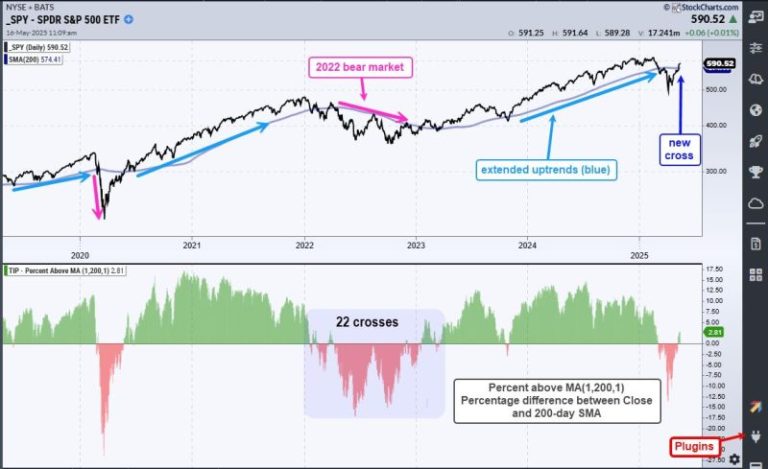
SPY and QQQ crossed above their 200-day SMAs with big moves on Monday, and held above these long-term moving averages the entire week. The V-Reversal was extraordinary and SPY seems short-term overbought, but this cross above the 200 day SMA cross is a bullish signal for the most important market benchmark. Despite a bullish signal, long-term moving averages are trend-following indicators and it is important to set realistic expectations.

***** This is an abbreviated version of a research report covering the 200-day SMA, performance improvements and a twist for QQQ. Recent reports at TrendInvestorPro covered the V-Reversal, the Bottoming Process and an Exit Strategy for the Zweight Breadth Thrust. Click here to take a trial and get immediate access. *****

The chart below shows SPY with the 200-day SMA (blue). This 200-day cross captured two big uptrends since 2020 and foreshadowed the bear market in 2022. Even though these three signals look great, there were plenty of whipsaws along the way. SPY crossed the 200-day SMA 141 times since 2005, which averages 7 crosses per year. Averages can be deceptive because some years have more crosses than others. SPY did not cross its 200-day in 2021 and 2024, but there were 22 crosses between January 2022 and March 2023.

The indicator window shows Percent above MA (1,200,1) to better highlight these crosses. It turns positive (green) with a bullish cross and negative (red) with a bearish cross. The values are the percentage difference between the close and the 200-day SMA.  

There is no such thing as a perfect indicator. Trend-following indicators are great at catching big trends, but they are also prone to whipsaws (failed signals). Whipsaws are simply the price of admission for a trend-following strategy. We must take the good (big trends) with the bad (whipsaws). As the chart above confirms, trend-following works over time because one good trend pays for the whipsaws.

Chartists can improve 200-day SMA signals with a little smoothing. For example, use a 5-day SMA instead of the close. Since 2005, the 5-day SMA crossed its 200-day SMA 55 times, which averages out to 3 per year. Fewer signals means fewer whipsaws. Also note that this smoothing generated higher returns and lower drawdowns.

The chart above shows the SPY with Percent above MA (5,200,1). This indicator captures the percentage difference between the 5 and 200 day SMAs. Instead of 22 crosses between January 2022 and March 2023, the 5-day SMA crossed the 200-day SMA just 8 times. This indicator is part of the TIP Indicator Edge Plugin for StockCharts ACP.

We can reduce whipsaws even more by adding a signal filter. This next section will cover signal filters and performance metrics for SPY. We then show how other ETFs perform and add little twist to improve performance for QQQ signals. This section continues for subscribers to TrendInvestorPro. Click here to take a trial and get immediate access. 

////////////////////////////////////////