Atlantic Lithium (A11:AU) has announced Spodumene Pegmatite Discovered at Agboville and Rubino
Download the PDF here.
This post appeared first on investingnews.com
Atlantic Lithium (A11:AU) has announced Spodumene Pegmatite Discovered at Agboville and Rubino
Download the PDF here.

Augustus Minerals (AUG:AU) has announced High-Grade Gold Samples extend Clifton East Strike to 1km
Download the PDF here.

Retail traders and investors often don’t get the credit they deserve. But in April, they showed they’ve got serious market smarts.
While headlines screamed about a tanking stock market — remember, post-Liberation Day— retail investors waited patiently. And when the time felt right, they jumped in, adding $40 billion to the stock market during the month. Just this past Monday, retail investors poured another $5.4 billion in by day’s end. That was more than a third of the day’s trading volume!
If this keeps up, May could beat April in terms of total inflows.
Many of you probably remember the dot-com boom and the painful bust that followed. A lot of retail traders jumped in thinking they were buying the dip. Unfortunately, the market had other plans. Many retail traders got wiped out because they ended up buying at the peak rather than the dip.
This is the risk “buy the dip” buyers face. Sometimes it works. Sometimes it doesn’t. So, how do you protect your portfolio value, especially now that you’re managing some of your investments?
Taking control of your finances doesn’t mean you need to stare at a screen all day. But checking in on the market regularly can go a long way. Even a quick peek at the Market Summary page at the end of each day (or once a week) can help you stay on track.
You’ll get a snapshot of how the major indexes are performing, what their daily or weekly streaks are, and if they are above specific moving averages. Here’s a little snippet of the page. There’s a lot more to discover on the page.
Let’s say you bought shares of NVIDIA Corp. (NVDA) after it dipped in early April. Despite how well the stock performed in 2024, you can’t just “set it and forget it.”
You will want to monitor how the S&P 500 ($SPX), Nasdaq ($COMPQ), and Nasdaq 100 ($NDX) are performing since NVDA is a heavily weighted stock in these indexes.
Here’s what you can do:
The Market Summary page also gives you access to market internals that can help you determine the health of the indexes. These include the Advancing/Declining Issues, Bullish Percent Index (BPI), and New Highs/New Lows, among many others.
Since your focus is semiconductor stocks, you would closely watch the related indexes. For BPI, you’d go one step further and monitor the Technology Sector BPI ($BPINFO).
The US Industries panel displays the performance of the Semiconductors.
At this point, it’s worth analyzing the chart of the SPDR S&P Semiconductor ETF (XSD), the ETF included in the Market Summary page. The six-month daily chart below shows that XSD is now trading below its 200-day SMA, which is a reason for concern.
FIGURE 1. DAILY CHART OF XSD. The ETF fell below its 200-day SMA on Wednesday and is underperforming SPY. Chart source: StockCharts.com. For educational purposes.
Note that XSD is holding on to the support of the May 12 low, which is when the price gapped up. Gaps often get filled, so a fall below where XSD closed on Wednesday could take the ETF down to the $210 level.
In addition, the ETF’s performance relative to the S&P 500 ETF (SPY) over the last six months is at -3.96%. This indicates that semiconductors are trying hard to re-establish their pre-2025 leadership position. If XSD continues to underperform SPY, it would be more reason to be concerned.
Seeing this chart should prompt you to pull up the chart of NVDA. Is the stock following the same pattern as the ETF?
Looking at the six-month daily chart of NVDA, it’s still above its 200-day SMA, unlike XSD. However, NVDA’s stock price is flirting with the support of its May 14 low. A breach of the low could take NVDA’s stock price to its 200-day SMA or lower. This wouldn’t be good for the overall equity market because NVDA is such a heavyweight in the U.S. large-cap indexes.
FIGURE 2. DAILY CHART OF NVDA STOCK. Wednesday’s price action suggests the possibility of a pullback. If price falls below the May 14 low, the next stop could be the 200-day SMA. Chart source: StockCharts.com. For educational purposes.
Before entering your position, you should have identified your profit target and exit point based on your risk tolerance level. Remember, when managing your investments, discipline is key.
The Market Summary page is a tool that can help you stay ahead of the stock market without overwhelming you.
Here is one way to use the Market Summary page:
There are many more ways to use the Market Summary page, and we’ll be sharing more in upcoming articles.
Whether you’re hands-on with your investments, semi-retired, or retired, staying informed can help you feel confident and in control.
So go on, check out the Market Summary page, explore the charts, and stick to your trading plan.
Disclaimer: This blog is for educational purposes only and should not be construed as financial advice. The ideas and strategies should never be used without first assessing your own personal and financial situation, or without consulting a financial professional.

Jupiter Energy (JPR:AU) has announced Variation to Noteholder Agreements
Download the PDF here.

Here’s a quick recap of the crypto landscape for Wednesday (May 21) as of 9:00 p.m. UTC.
Get the latest insights on Bitcoin, Ethereum and altcoins, along with a round-up of key cryptocurrency market news.
Bitcoin (BTC) was priced at US$108,452 as markets closed, up 1.5 percent in 24 hours. The day’s range for the cryptocurrency brought a low of US$106,490 and a new all-time high of US$109,400.
Bitcoin performance, May 21, 2025.
Chart via TradingView.
Bitcoin surpassed its previous record of US$109,228, set on January 20. Following this peak, the price quickly declined to approximately US$106,000 within an hour, but subsequently stabilized around US$107,000.
Ethereum (ETH) finished the trading day at US$2,507.94, a 0.5 percent increase over the past 24 hours. The cryptocurrency reached an intraday low of US$2,473.89 and saw a daily high of US$2,597.51.
A bold options trade is betting Bitcoin could hit US$300,000 by the end of June.
According to market data, call options at that stratospheric strike price were the second most traded on Deribit on Tuesday (May 20), hinting at a mix of speculative enthusiasm and hedging behavior among traders.
While some analysts remain optimistic — Standard Chartered (LSE:STAN,OTC Pink:SCBFF), for instance, sees Bitcoin possibly reaching US$120,000 by Q2 — no major forecast comes close to US$300,000.
On Tuesday, Bitcoin hovered near US$107,000, not far from its record high of US$109,241 in January.
Still, market experts caution that without a strong catalyst, the current rally may not sustain its upward trajectory. Betting markets like Polymarket place only a 9 percent chance of Bitcoin hitting even US$250,000 this year, underscoring how isolated this US$300,000 wager truly is.
Bitget has officially surged into third place among global crypto exchanges, reporting US$757.6 billion in futures trading volume and US$68.6 billion in spot volume for April of this year.
The Seychelles-based platform has made a name for itself through features like copy trading, which allows users to mimic high-performing traders in real time. Bitget’s April performance stood out despite a broader market correction, expanding its market share to 7.2 percent and pushing its user base above 120 million. The exchange’s rise signals increasing demand for advanced crypto trading products beyond the traditional buy-and-hold strategy.
XRP joined the roster of cryptocurrencies traded on CME Group’s (NASDAQ:CME) derivatives exchange as the firm launched futures contracts that pulled in over US$19 million in notional volume on Sunday (May 18).
The first day’s tally easily eclipsed Solana’s March debut of US$12.3 million, putting XRP alongside BTC, ETH and SOL in CME’s crypto futures lineup. Offered in both micro (2,500 XRP) and standard (50,000 XRP) sizes, the cash-settled contracts allow investors to speculate on XRP’s price without owning the token.
The timing is noteworthy, as the US Securities and Exchange Commission (SEC) continues to drag its feet on pending exchange-traded fund applications for XRP and SOL, leaving futures as the most viable institutional gateway.
XRP futures could see broader uptake if regulatory clarity around token classification progresses. The SEC’s recent legal moves against other issuers may also increase demand for regulated products like these.
Crypto.com and Kraken have both secured Markets in Financial Instruments Directive (MiFID) licenses to offer crypto derivatives in Europe. Crypto.com secured its license through the acquisition of A.N. Allnew Investments, a Cyprus-based financial firm. Kraken acquired an unnamed Cypriot investment firm to gain its MiFID license.
A MiFID license allows entities to offer crypto derivatives in the EU. Platforms must meet strict regulations, enabling them to provide complex crypto financial products to more European investors under harmonized EU rules.
The moves underscore the increasing maturity of the cryptocurrency market and the proactive steps exchanges are taking to operate within established legal and financial frameworks in key global jurisdictions.
The SEC has charged crypto firm Unicoin and four top executives with running what it calls a US$100 million securities fraud scheme, alleging the company lied about its assets and sales performance.
According to the complaint, Unicoin misled investors by falsely claiming to own prime real estate in locations like Thailand and Argentina, inflating the value of these assets by over US$1 billion. The company also allegedly exaggerated the sales of its ‘rights certificates,’ stating it had raised US$3 billion when the real figure was just US$110 million.
The SEC is seeking disgorgement and civil penalties, and notes that Unicoin rejected a prior attempt to settle the matter.
CEO Alexander Konanykhin told investors last month that the company had “declined to show up” for an SEC settlement meeting, labeling it an “ultimatum.”
Robinhood Markets (NASDAQ:HOOD) has proposed a 42 page framework to the SEC for national regulation of tokenized real-world assets (RWAs), as reported by Forbes on Tuesday.
The proposal also outlines the creation of the Real World Asset Exchange (RRE), a trading platform that would offer off-chain trade matching and on-chain settlement. To ensure efficiency, transparency and global compliance, the RRE would integrate KYC and AML tools through partnerships with Jumio and Chainalysis.
A central aspect of Robinhood’s proposal is the concept of token-asset equivalence. This would classify tokens representing assets like US Treasury bonds as the underlying asset itself, rather than a derivative.
This approach aims to enable institutions and broker-dealers to manage tokenized RWAs within the current regulatory structure, potentially simplifying custody, trading and settlement procedures.
As enterprises continue to build BTC holdings, a new analytical metric, days to cover mNAV, is being used to estimate how long it would take a company to acquire enough BTC to match its market capitalization.
The calculation uses the company’s current multiple of net asset value (mNAV) and its daily BTC yield, incorporating compounding to provide a forward-looking, growth-adjusted valuation.
The formula is: Days to Cover = ln(mNAV) / ln(1 + BTC Yield)
Data from significant Bitcoin-acquiring companies like Strategy (NASDAQ:MSTR), Metaplanet (TSE:3350,OTCQX:MTPLF) and Semler Scientific (NASDAQ:SMLR) between October 2024 and May 2025 indicates an increasingly efficient market that facilitates Bitcoin accumulation for large entities.
The formula was proposed by Adam Back on May 9, and gained traction after being reposted by X user @ActuallyClimber on May 14. CoinDesk reported on its increasing adoption within crypto circles on Wednesday.
Securities Disclosure: I, Giann Liguid, hold no direct investment interest in any company mentioned in this article.
Securities Disclosure: I, Meagen Seatter, hold no direct investment interest in any company mentioned in this article.
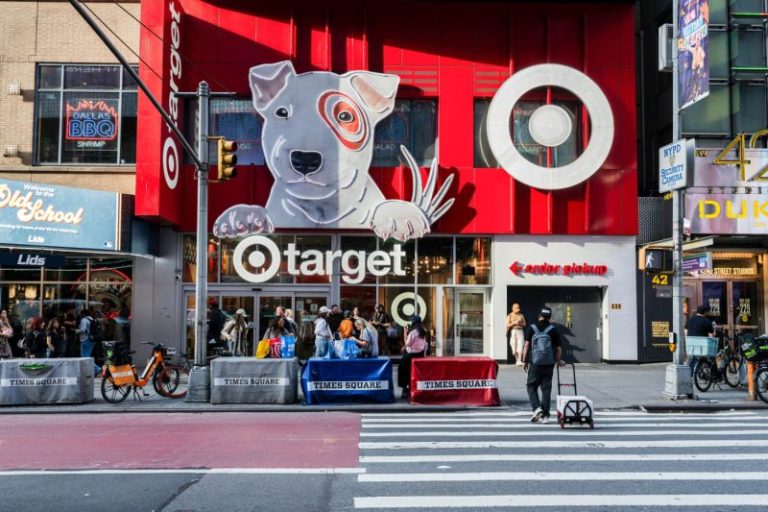
Raising prices on consumers to cover the costs of President Donald Trump’s tariffs will be Target’s ‘very last resort,’ CEO Brian Cornell said Wednesday.
The remarks came as Target reported weaker-than-expected sales in its first quarter and cut its full-year forecast. The retailer, whose business hasn’t fared as well against rivals better known for bargain prices, has “many levers to use in mitigating the impact of tariffs,” Cornell said.
Major retailers appear to be treading cautiously around the question of price hikes after Trump slammed Walmart last weekend for warning that shoppers could pay more due to tariffs. In the days since, Target, Lowe’s and Home Depot have each made carefully worded remarks about the potential for higher prices or minimized discussion of tariffs altogether.
Walmart said last week that it customers would likely start seeing some prices climb as soon as this month because tariffs have created a more “challenging environment to operate in.” While presidents typically avoid appearing to dictate individual companies’ strategies, Trump castigated Walmart on his social media platform, demanding that it “EAT THE TARIFFS” and adding, “I’ll be watching, and so will your customers!!!”
“We’ll keep prices as low as we can for as long as we can given the reality of small retail margins,” Walmart told NBC News Saturday in response to Trump’s post. Days later, Home Depot all but ruled out near-term price hikes, citing its scale and supply-chain arrangements. Lowe’s barely mentioned tariffs when it reported earnings Wednesday but said just 20% of what its shoppers buy now comes from China, after years of diversifying its sourcing.
For Target, Cornell emphasized that tariffs were just one factor in a series of “massive potential costs” the company is grappling with. He pointed to consumer uncertainty over the direction of the economy and a high-profile backlash over Target’s watering down of its diversity, equity and inclusion policies. The retailer had expanded those initiatives after police murdered George Floyd in its hometown, Minneapolis, five years ago this weekend.
Target has rolled out discounts over the past year to lure inflation-weary shoppers and touted plans to expand its third-party marketplace to offer a broader range of items. To deal with new trade policy challenges, it’s negotiating with vendors, reassessing its product lineup and adjusting its foreign supply chain, Chief Commercial Officer Rick Gomez told investors Wednesday.
‘Half of what we sell comes from the U.S.,’ he said, adding that Target is expanding production in the United States and in other countries outside of China, whose exports currently face a 30% import tax.
Target’s stock fell more than 5% Wednesday during a broader market sell-off.
Some major companies that sell products at leading retailers have raised prices or said they’re considering doing so, including toolmaker Stanley Black & Decker, consumer products giant Procter & Gamble, sportswear brand Adidas and toy maker Mattel.
Mattel, the maker of Barbie dolls, has also come under fire from Trump, who threatened to hit it with 100% tariffs this month, after it signaled price hikes were on the table.
Big companies generally have more latitude to handle cost increases and other economic headwinds than their smaller counterparts. The U.S. Chamber of Commerce and independent business owners have warned that tariffs threaten to snuff out many small operators, chipping away at the competition for already large corporate rivals.
The National Retail Federation, which represents some of the biggest retailers in the country, has emphasized that risk in lobbying against new levies. “Small and medium-sized businesses will be disproportionately affected by the tariffs, with many saying they will have to raise prices or shut down,” it says on its website.
So far, “consumers are still spending despite widespread pessimism fueled by rising tariffs,” NRF Chief Economist Jack Kleinhenz said in a statement last week after retail sales eked out a modest 0.1% rise in April.
But even the largest multinational companies aren’t insulated from tariff-driven uncertainty, the NFR and industry analysts say. Like Target, several large firms have revised or scrapped their financial outlooks in recent weeks, unsure how the White House’s trade agenda will affect them. Nike plans to increase prices on several items between now and June 1, a person familiar with the matter told NBC News on Wednesday.
Not every retailer is voicing tariff jitters. The parent company of T.J. Maxx and Marshalls beat sales estimates Wednesday and maintained its full-year forecast. The discounter, which buys unsold merchandise from other brands that have already paid tariffs on much of it, said it expects to be able to handle the pressure from higher import taxes.
Sportswear brand Canada Goose, which makes popular winter jackets, also exceeded Wall Street expectations. But it joined the slew of companies pulling their forecasts for the rest of the year, citing an “unpredictable global trade environment.”

We now know who won the contest to attend an intimate dinner with President Donald Trump by buying his cryptocurrency — and he’s a familiar face to Securities and Exchange Commission regulators and law enforcement officials.
Justin Sun, a Chinese-born crypto entrepreneur, confirmed in an X post Tuesday that he was behind the account, labeled ‘SUN,’ that purchased the most $TRUMP meme coin to sit at the president’s table at a crypto-focused gala scheduled for Thursday.
‘Honored to support @POTUS and grateful for the invitation from @GetTrumpMemes to attend President Trump’s Gala Dinner as his TOP fan!’ Sun wrote. ‘As the top holder of $TRUMP, I’m excited to connect with everyone, talk crypto, and discuss the future of our industry.’
He capped the post with an American flag emoji.
Critics have blasted the dinner contest as potentially unconstitutional and a blatant opportunity for corruption. Trump has not publicly commented on the accusations, and the Office of Government Ethics has declined to comment. A White House official did not immediately respond to a request for comment Tuesday.
The Trump administration is not directly involved in administering $TRUMP coin. As for the dinner, a White House official said in a statement that the president ‘is working to secure GOOD deals for the American people, not for himself.’
‘President Trump only acts in the best interests of the American public — which is why they overwhelmingly re-elected him to this office, despite years of lies and false accusations against him and his businesses from the fake news media,” White House spokesperson Anna Kelly said.
While Trump has not been as aggressive in directly promoting cryptocurrencies as some campaign backers in the industry had hoped, his administration has abandoned or paused many pending cases that had been brought against crypto entrepreneurs and businesses.
That includes Sun, who was charged in 2023 with market manipulation and offering unregistered securities. Regulators sought various injunctions against him that would have largely prevented him from participating in crypto in the U.S. The Verge, a tech industry website, had also reported Sun was the target of an FBI investigation.
But in February, the SEC, now controlled by Trump appointees, agreed to a 60-day pause of the suit in order to seek a resolution.
Two months earlier, Sun purchased $30 million in crypto tokens from World Liberty Financial (WLF), the crypto venture backed by Trump and his family, the website Popular Information reported.
Eventually, Sun became the largest publicly known investor in World Liberty after he brought his funding total to $75 million.
According to Bloomberg News, per the terms of World Liberty’s financial structure, 75% of the proceeds of token sales like Sun’s get sent to the Trump family as a fee — meaning they may have directly earned as much as $56 million.
On Jan. 22 — two days after Trump was inaugurated — Sun posted on X, “if I have made any money in cryptocurrency, all credit goes to President Trump.”
In April, The Wall Street Journal reported that Joe Biden’s Justice Department had been investigating Sun, noting that researchers had estimated that more than half of all illicit crypto activity took place on Sun’s Tron blockchain platform. The Journal said it wasn’t clear whether the investigation was ongoing. It said Sun’s representatives declined to comment about what they called “baseless allegations about legal matters” while denying Tron enables criminal activity.
Sun may now be a multibillionaire, with a net worth estimated at $8.5 billion, according to Forbes. He reportedly was forced to spend $2 billion to shore up one of his crypto firms that was facing collapse in 2022.
He did not immediately respond to a request for comment about what he hoped to get out of the dinner with the president.
Sun has also earned headlines for purchasing ‘Comedian,’ an art installation composed of a banana duct-taped to a wall, for $6.2 million, and for buying lunch with Warren Buffett for $4.57 million.

Sports giant Fanatics is pitting fans against greats Tom Brady, Kevin Durant and Alex Rodriguez at an upcoming marketing event.
The company announced Tuesday it is introducing a skills-based competition at Fanatics Fest 2025, taking place June 20-22 in New York City. Fanatics says more than $2 million will be given away in prizes, including a $1 million cash prize for first place, a Ferrari 812 GTS for second place and a Lebron James collectors card worth $250,000 for third place. If no fans finish in the top three, falling short of the celebrity competitors, the highest-scoring fan will receive $100,000.
If a celebrity competitor comes in first, they take home the seven-figure prize.
“I think the thinking was, how do we create even more of an insane environment where fans and athletes and streamers are all running around, in this case, quite literally, having a great time and showcasing all of that,” said Lance Fensterman, CEO of Fanatics Events.
It’s the second Fanatics Fest after the inaugural event last year drew more than 70,000 fans and brought together major sports leagues and hundreds of current and former athletes. The offerings last year included league activations, autograph sessions and a trading cards and collectibles show.
This year, Fanatics is hoping to go even bigger — with a goal of bringing in 100,000 attendees — as the company continues to broaden its reach in sports marketing.
Michael Rubin acquired Fanatics in 2011 after merging it with his company, GSI Commerce. What began as a sports e-commerce platform has evolved in recent years into a diverse sports platform offering trading cards and sports memorabilia, live shopping, betting and gaming, as well as an events business.
Fifty fans will be selected to compete at Fanatics Fest 2025 against top talent that also includes comedian Kevin Hart, former New England Patriot Rob Gronkowski, Los Angeles Clippers shooting guard James Harden and Olympic gymnast Jordan Chiles.
The competition will include Major League Baseball pitching accuracy, National Hockey League slapshot accuracy, National Football League passing accuracy, a National Basketball Association shooting competition, a FIFA goal scoring challenge and a golfing contest. Fans can apply to participate by submitting a short video in the Fanatics app.
While Fanatics’ events business represents just a small fraction of business — last valued at $25 billion, according to a person familiar with the company — Fensterman said Fanatics Fest creates a lot of positive sentiment around the company.
“It’s incredibly impactful in terms of bringing the entire ecosystem together for the sole focus of delighting,” he said.
In the absence of unified federal legislation on cryptocurrencies, New York is establishing its own comprehensive regulations for the sector as it looks to become the world’s crypto capital.
Adrienne Harris, superintendent of the New York Department of Financial Services (DFS), is playing a key role in this endeavor, and she says her approach is grounded in experience, not ideology.
“I have never been a believer that you should have ideology in financial regulation,” Harris said during a discussion at last week’s Consensus conference, held from May 14 to 16 in Toronto.
“I really am a firm believer that you can protect consumers and markets, look after the safety and soundness of companies and be good for business all at the same time. And we really seek to prove that out every day at DFS.”
Appointed in 2021, Harris described her stints in big law, the US Department of the Treasury, the Obama White House, Silicon Valley and academia. Her influence as a regulator has arguably been most deeply felt in crypto, where New York’s licensing regime — particularly its much-discussed BitLicense — has served as both a gatekeeper and a benchmark.
“There is unnecessarily tough, and then there’s necessarily tough,” Harris explained. “I think prior to me and my team coming in, things were probably unnecessarily tough … the team was under-resourced. There were maybe 30 people in the crypto unit. Now we have 60 people that are dedicated to virtual currency every day, all day.”
Under Harris’ leadership, the DFS has implemented an applications manual, instituted pre-application meetings and issued nine pieces of regulatory guidance. These reforms aim to demystify a process long criticized as opaque.
And while the BitLicense remains difficult to obtain, Harris believes the outcome justifies the rigor: “FTX, Voyager and Celsius didn’t pass our test, and therefore couldn’t do business in New York.”
This tough-but-fair regulatory stance has elevated New York’s position not only domestically, but also globally.
Even with various international counterparts, Harris told the Consensus audience that New York has become “the gold standard” in how virtual currencies are regulated. That international recognition is becoming increasingly formalized through initiatives like the DFS’ transatlantic regulatory exchange program with the Bank of England.
“They’ve sent us some senior staff. We’ve sent them some senior staff. It was really an arm-wrestling match to see who was going to get to move to London for six months to a year,” Harris joked. The program, which focuses on payments and cryptocurrencies, is already expanding to include other regulators in Europe and Asia.
Closer to home, Harris said the DFS is also working closely with Congress on stablecoin legislation.
“There isn’t a version of any of those bills — be it House or Senate, Rs or Ds — that don’t come to me and to the team to say, ‘Give us your feedback, give us your technical assistance, your insights,’” she said.
The DFS has already pioneered its own stablecoin guidelines, which require that any licensed stablecoin in New York be fully backed by a reserve of assets. That initiative, like much of DFS’ crypto framework, has been driven by a regulatory unit that Harris described as perhaps the largest of its kind anywhere in the world.
“We have folks that came from the (US Federal Reserve), we have cryptographers, we have financial crime experts … we have some real sort of crypto bros on the team. So it’s a great mix of expertise.”
Despite building out that workforce to 60 full-time crypto regulators, Harris admitted that resource constraints remain.
She noted that the DFS has hired more than 600 people across the department during her tenure and continues to recruit — especially amid talent shifts from federal agencies.
The result of all this work, Harris argued, is a regulatory environment that fosters innovation rather than hinders it.
“It used to be that people would say the regulations stifled that ecosystem, that innovation. But what we’ve learned over time is that that clarity, that certainty, that transparency really provides a fertile ground for that innovation,’ she said.
That sentiment is reflected in how regulated firms market themselves abroad. “Our regulated crypto companies market the fact that they are regulated by DFS,” Harris continued. “When they go overseas, they are telling those other regulators, ‘We have a license from DFS.’ And it goes a long way toward growing the ecosystem in New York.”
She also credited state leadership for supporting a dual agenda of consumer protection and economic development, citing New York Governor Kathy Hochul’s ‘steadfast commitment’ to making sure New York is a hub for responsible innovation. This growth aligns with Mayor Eric Adams’ ambition to make New York City the crypto capital not just of the US, but also the world — an aspiration Harris sees as within reach, if not already reality.
“When we think about crypto — having the fastest-growing sector in New York — put that together with the fact that New York is really the financial capital of the world. That is an environment, I think, perfect for the crypto ecosystem.”
Looking ahead, Harris said the DFS will continue on its current path, even as it hopes for stronger federal engagement.
“Hopefully we have federal legislation done, and some of those federal rules will be coming into place,” she said.
“We’re thinking about, of course, (artificial intelligence) and crypto. We’re thinking about deepfakes and market manipulation and crypto, and how those things overlap.”
Securities Disclosure: I, Giann Liguid, hold no direct investment interest in any company mentioned in this article.
In this video, Frank dives into some of his favorite features on StockCharts.com. He then dissects the S&P 500 and Bitcoin price action, before exploring the the XLK Technology ETF’s explosive move off the lows. He also highlights a few recent trade ideas and setups worth watching. Get trade ideas and chart setups worth watching in today’s technical review.
This video originally premiered on May 20, 2025.
You can view previously recorded videos from Frank and other industry experts at this link.