
Author

admin

Browsing

Tolu Minerals Limited (“Tolu”) is pleased to announce the granting of its Ipi River tenement EL 2780 (Figure 1) covering 395.56 km2 of highly prospective copper-gold mineralisation. The historically discovered Ipi River porphyry deposit within EL 2780, located 55 km northwest of the Tolukuma gold mine is one of several under-explored porphyry style Cu-Au-Mo systems with epithermal Au overprint within Tolu’s exploration portfolio.

HIGHLIGHTS:

  • Ipi River tenement EL2780 granted by the Mineral Resource Authority
  • Preliminary interpretation of Airborne MT imagery indicates five previously unknown copper-gold targets that require further exploration and drill testing
  • The newly advanced Airborne MT survey provides electrical resistivity imaging of the top 1km to define geological targets and structures related to copper-gold mineralisation, as well as magnetic data to assist in the exploration process
  • Ipi River Porphyry System represents a historically under-explored Cu-Au-Mo system where previous rock sampling results returned up to 10.10% copper and 167g/t gold
  • Douglas Kirwin, renowned porphyry and epithermal specialist, is appointed to the Advisory Board
Iain Macpherson, MD & CEO of Tolu Minerals Ltd. said:

“I’m pleased to report the progression of our exploration strategy with the award of Exploration License EL 2780 consisting of highly prospective ground within the Ipi River tenement. This award, coupled with our recent and historical exploration programmes at Ipi River, reinforces Tolu’s position as an emerging, important explorer and operator in what is rapidly becoming one of the great gold/copper provinces of the world.

Recently flown Airborne MT preliminary imagery reinforces historical exploration data and indicates a number of porphyry or intrusive related copper-gold targets. The tenement also includes historical copper-gold-molybdenum, late-stage epithermal gold, and peripheral unexplored Au targets. This latest addition to our tenement portfolio allows us to proceed with our next stage of exploration on a more detailed evaluation of the Airborne MT results and target areas.

The award of the Ipi River exploration license is a significant addition to Tolu’s highly prospective exploration and development portfolio that provides a number of compelling targets and potential for further major discoveries.

In line with the Company’s vision to reveal the porphyry and epithermal deposit potential at Tolukuma, Mt Penck and now Ipi River, the appointment of Doug Kirwin to Tolu’s Advisory Board is a testament to the Company’s broader commitment to defining a substantial resource within Tolu’s exploration targets, further to the re-start of the Tolukuma Gold-Silver Mine.”

Chris Muller, Tolu’s Executive Group Geologist commented that “the continuous progress towards growing Tolu’s exploration portfolio with high potential tenements has reinforced my view that Tolu is among the most exciting growth companies in one of the great underdeveloped and underexplored gold mining provinces on the planet.”

The advanced Airborne Magneto Telluric (“Airborne MT” or “MT”) survey was flown over the Eastern 209km2 of the EL to help in identifying a new generation of geophysical targets related to gold and copper-lead-zinc mineralisation for ground follow-up and drilling.

Airborne MT is an advanced geophysical technology providing high-resolution, deep resistivity/conductivity 3D mapping to over 1km depth. Final data from the recently completed airborne MT survey flown over the known Ipi River porphyry and Mt. Yule “Bulls- eye” magnetic porphyry gold-copper systems have diagnostic sub-surface conductivity, resistivity and magnetic signatures that are calibrations for identifying similar integrated anomalies.

An additional five, previously unexplored discrete geophysical target areas, have already been identified, proving the technique to be a cost-effective compliment to historical exploration results. A more detailed desktop review of historical exploration and airborne geophysics will now be completed ahead of fieldwork on ground.

Target mineralisation within the tenement includes an extremely intense and large 6km x 6km dipolar “Bulls-eye” magnetic anomaly (Figure 2) at Mt. Yule (IPI06), located at a major structural intersection of the NE-trending Yule Transfer Structure and orthogonal structure related to a deep-set high electrical resistivity trend (Figure 3).

The IPI06 occurs as an exceptionally high magnetic signature (>1,730nT dipolar variation) and geologically related to a diorite/monzonite intrusive. The magnetic characteristics are like that of the Indonesia Grasberg monzodiorite and Ertsberg diorite Cu-Au-Ag mineral deposits, located on the Western half of New Guinea island1.

Click here for the full ASX Release

This post appeared first on investingnews.com

Eric Nuttall, partner and senior portfolio manager at Ninepoint Partners, shares his outlook for oil and natural gas, honing in on supply, demand and prices.

Global uncertainty has placed pressure on the oil market, and Nuttall said for that reason he sees natural gas stocks outperforming oil stocks in the near term.

Securities Disclosure: I, Charlotte McLeod, hold no direct investment interest in any company mentioned in this article.

This post appeared first on investingnews.com

American Eagle on Tuesday said it is writing off $75 million in spring and summer merchandise and withdrawing its full-year guidance as it contends with slow sales, steep discounting and an uncertain economy.

The apparel retailer said it expects revenue in the first quarter, which ended in early May, to be around $1.1 billion, a decline of about 5% compared to the prior-year period. American Eagle anticipates comparable sales will drop 3%, led by an expected 4% decline at intimates brand Aerie. American Eagle previously expected first-quarter sales to be down by a mid-single-digit percentage and anticipated full-year sales would drop by a low single-digit percentage. 

Shares plunged more than 17% in extended trading. 

When it reported fiscal fourth-quarter results in March, American Eagle warned that the first quarter was off to a “slower than expected” start, due to weak demand and cold weather. Conditions evidently worsened as the quarter progressed, and the retailer turned to steep discounts to move inventory.

As a result, American Eagle is expecting to see an operating loss of around $85 million and an adjusted operating loss, which cuts out one-time charges related to its restructuring, of about $68 million for the quarter. That loss reflects “higher than planned” discounting and a $75 million inventory charge related to a write-down of spring and summer merchandise, the company said. 

“We are clearly disappointed with our execution in the first quarter. Merchandising strategies did not drive the results we anticipated, leading to higher promotions and excess inventory. As a result, we have taken an inventory write down on spring and summer goods,” said CEO Jay Schottenstein.

“We have entered the second quarter in a better position, with inventory more aligned to sales trends,” he said. “Additionally, we are actively evaluating our forward plans. Our teams continue to work with urgency to strengthen product performance, while improving our buying principles.” 

The company added it is withdrawing its fiscal 2025 guidance “due to macro uncertainty and as management reviews forward plans in the context of first quarter results.” It is unclear if recent tariff policy changes had an effect on American Eagle.

Some companies bought inventory earlier than usual to plan for higher duties, but American Eagle repeatedly said in March that it was in a solid inventory position and was able to go after trends as customer preferences shifted. 

At the start of the first quarter, the company said it had some inventory outages and needed to supplement stock in a few key categories, particularly at Aerie, one of its primary growth drivers. 

This post appeared first on NBC NEWS

HIGHLIGHTS:

  • 56.6m grading 2.88 g/t gold from 68m
  • 23.2m grading 14.4 g/t gold from surface (including 0.85m grading 381 g/t gold)
  • 4.05m grading 17.8 g/t gold from 136m
  • 8.7m grading 6.68 g/t gold from 56m
  • 18.85m grading 3.54 g/t gold from 95m
  • Deeper drilling at the Creston Pit shows a combination of wide intervals and high grades
  • Results will be incorporated in an updated technical study for La Colorada expected to be released mid-2025
  • The focus of drilling at La Colorada will shift to stockpiles and then high-grade veins beneath and along strike from the open pits

Heliostar Metals Ltd. (TSXV: HSTR) (OTCQX: HSTXF) (FSE: RGG1) (‘Heliostar’ or the ‘Company’) is pleased to announce additional results from an expanded 16,211 metre drilling program at the La Colorada Mine in Sonora, Mexico. La Colorada restarted production in early January 2025, and the current drill program is intended to expand the mineral reserves ahead of an updated technical report and expansion decision planned for mid-2025.

Heliostar CEO, Charles Funk, commented, ‘The turnaround at La Colorada has been a real strength for Heliostar. In the three months since the acquisition, the Company has restarted production and established a mine life of 6.5 years. This drill program has returned a powerful combination of wide gold intervals and high-grade veins, leading to our expanding the program to a total of 104 drill holes. The intervals reported to date are intended to drive stronger economics in an updated technical report planned for mid-2025. A new drilling program at La Colorada will now focus on defining additional mineralized material from historic stockpiles, which we believe can quickly be brought into production. We will then pivot to exploration for underground targets in the second half of the year.’

Drill Results Summary

Mineralization at La Colorada’s Creston Pit is predominantly hosted in three veins: the North, Intermediate and South Veins (Figure 1). These veins trend northeast-southwest to east-west, dip northward and are surrounded by halos of smaller mineralized veins. The Creston Pit has historically mined oxide gold and silver from all three of these veins. A current Probable Mineral Reserve of 312,000 ounces of gold grading 0.76 grams per tonne (g/t) gold and 5,074,000 ounces of silver at 10.1 g/t silver is defined at the Creston Pit1.

A technical review of expansion potential identified two opportunities for reserve growth, these being near surface extensions of known veins with little or no drill data and exploring the under-sampled mineralization beneath the pit. Both opportunities were defined using historical drilling, blasthole data, mining shapes, and the geological model.

Figure 1: Plan view of the Creston Pit showing historic drilling, blast hole samples and Heliostar drillholes. Selected intercepts are labelled.

To view an enhanced version of this graphic, please visit:
https://images.newsfilecorp.com/files/7729/252216_7a4b3800247fdbe2_003full.jpg

Figure 2: Cross-section view looking west at the eastern end of the Creston Pit. The section shows historic drilling and new Heliostar drillhole results below the planned pit boundary.

To view an enhanced version of this graphic, please visit:
https://images.newsfilecorp.com/files/7729/252216_7a4b3800247fdbe2_004full.jpg

Blast hole data clearly shows the potential for the continuation of veins at shallow depths that were previously modelled as waste. They contain elevated gold grades that continue to the edge of the pit walls where they remain open for expansion (Figures 1 and 2). At depth, drill spacing is wider than the area above. Additional drilling allows for improved estimation of grade and continuity.

The Company has completed 104 holes totalling 16,211 metres in the program to date. This is an expansion on the planned 12,500 metre program. This release reports results for 25 new holes at Creston, two at Gran Central and four metallurgical holes completed at Veta Madre. The majority of the new drill holes targeted extensions of the North, Intermediate and South Veins in areas where drilling is widely spaced yet, within the current Creston resource. They aim to add ounces to the overall Creston resources and reserves.

Assay results show narrow to wide, low- to high-grade oxide gold intercepts. Targeted vein zones consistently return intercepts above the 0.16 g/t gold-equivalent cutoff grade of reserves within the Creston pit. The results may increase the tonnes and grade of mineralization in an updated pit shell. If so, that would add to total reserves in an updated technical report.

Next Steps

Results from the current drill program are being incorporated into a resource model. They will support a reserve update to be published with a technical report in mid-2025, which will include an updated mine plan on any additional economic material defined to date.

This drill program is designed to increase the volume of rock containing potentially economic gold mineralization, which, in turn, could improve the overall mine economics. Any zones currently modelled as waste but subsequently modelled as ore from this program would have the double benefit of reducing the overall strip ratio of the Creston pit expansion and adding ounces to the mine plan.

That, in-turn, could reduce the up-front capital requirements for the restart of operations and improve the IRR and NPV of the updated technical report compared to the technical report released in January 2025. This upcoming study will be the basis of an investment decision for the expansion of open pit mining production at La Colorada.

Following the successful completion of this drill program, the Company will now change the focus of drilling to test historic stockpiles. If drilling is successful, it may provide additional resources and cash flow similar to that currently being generated from the producing Junkyard reserve. The intention is to produce from these low-cost stockpiles to maximize cash flow ahead of primary mining from the open pit pushbacks.

In the second half of 2025, the focus will shift to stepping out on the high-grade vein intercepts beneath and along strike from the open pits. The results received to date provide optimism for the potential of an underground future at La Colorada (see our April 9, 2025, press release here). In addition, the Company will advance property scale exploration targets with mapping and geophysics to define drill targets beyond the currently mined areas.

Quarterly Review and Future Plans Update

The Company presented a live webinar on Tuesday, May 13th, to provide an in-depth review of Heliostar’s recently reported preliminary interim results for Q1 2025.

The Company also provided a forward-looking overview of what to expect in Q2 and beyond. This included how Heliostar plans to leverage operational cash flow to boost annual gold production from its two operating mines and advance the development of the Ana Paula project.

A replay of the webinar can be found on this link.

La Colorada Mineral Reserves Statement

Classification Zone AuEq
Cut-off
(g/t)
Tonnes
(kt)
Gold Grade
(g/t Au)
Silver
Grade
(g/t Ag)
Contained
Gold 

(koz)
Contained Silver 
(koz)
Probable El Crestón 0.160 12,841 0.76 10.1 312 4,181
Veta Madre 0.175 1,905 0.70 3.1 43 189
La Chatarrera 0.164 3,413 0.20 6.4 22 704
Total 18,159 0.65 8.69 377 5,074


1 La Colorada Operations, Sonora, Mexico, NI 43-101 technical report (the ‘Report’) is dated January 11, 2024, has an effective date of December 4, 2024

Diamond Drilling Results Table

HoleID From
(metres)
To
(metres)
Interval
(metres)
Au
(g/t)
Ag
(g/t)
% True
Width
Comment
24-LCDD-290 290.75 310.7 19.95 2.51 98.0 83.4 South Vein
including 301.25 306.5 5.25 5.79 115 83.4 South Vein
25-LCDD-291 1.0 13.75 12.75 0.91 14.2 100 Intermediate Vein
and 26.5 36.0 9.5 0.47 4.4 99.6 Intermediate Vein
and 40.5 46.5 6.0 0.65 3.6 99.6 Intermediate Vein
and 68.0 124.6 56.6 2.88 6.9 94.1 Intermediate Vein
68.0 124.6 56.6 2.18 6.9 94.1 Top-cut to 23 g/t Au
including 111.85 116.9 5.05 9.22 19.4 96.4 South Vein
25-LCDD-292 2.7 33.95 31.25 0.65 34.7 85.4 Intermediate Vein
and 41.75 51.0 9.25 0.23 33.6 88.7 Intermediate Vein
and 124.9 145.8 20.9 3.63 23.8 82.8 South Vein
124.9 145.8 20.9 3.03 23.8 82.8 Top-cut to 20 g/t Au
including 135.75 139.8 4.05 17.8 99.9 82.8 South Vein
135.75 139.8 4.05 14.6 99.9 82.8 Top-cut to 20 g/t Au
25-LCDD-293 48.35 55.85 7.5 1.00 5.2 77.1 Intermediate Vein
and 68.5 79.25 10.75 1.52 1.8 65.1 Intermediate Vein
and 92.0 100.7 8.7 2.41 8.4 77.8 Intermediate Vein
25-LCDD-294 0.0 15.3 15.3 0.57 28.1 100 Intermediate Vein
and 52.4 82.2 29.8 2.22 22.3 87.8 Intermediate Vein
52.4 82.2 29.8 1.62 22.3 87.8 Top-cut to 23 g/t Au
including 56.05 64.75 8.7 6.68 62.8 95.1 Intermediate Vein
including 56.05 64.75 8.7 4.63 62.8 95.1 Top-cut to 23 g/t Au
and 103.0 120.4 17.4 1.08 2.2 99.8 South Vein
25-LCDD-295 24.05 29.6 5.55 0.21 31.3 87.6 South Vein
and 35.55 38.35 2.8 0.17 28.0 85.7 South Vein
25-LCDD-296 0.0 29.3 29.3 1.08 7.2 88.9 Intermediate Vein
including 5.5 13.65 8.15 3.25 9.7 93.0 Intermediate Vein
and 59.2 84.8 25.6 0.66 4.8 80.9 Intermediate Vein
and 118.1 135.4 17.3 1.87 9.8 96.2 South Vein
including 121.8 124.8 3.0 6.73 25.4 96.2 South Vein
25-LCDD-297 29.9 46.0 16.1 0.29 17.4 85.1 Intermediate Vein
and 99.7 127.6 27.9 0.62 12.4 79.0 Intermediate Vein
25-LCDD-298 8.6 20.25 11.65 2.01 16.2 99.3 Intermediate Vein
and 77.8 119.05 41.25 1.87 4.9 98.3 South Vein
including 95.15 114.0 18.85 3.54 4.8 98.3 South Vein
25-LCDD-299 99.9 108.15 8.25 0.21 13.4 80.6 Gran Central Vein
and 114.4 118.0 3.6 0.53 19.0 80.6 Gran Central Vein
25-LCDD-300 0.0 23.2 23.2 14.4 21.8 94.5 Intermediate Vein
0.0 23.2 23.2 1.28 21.8 94.5 Top-cut to 23 g/t Au
including 9.15 10.0 0.85 381.0 167 94.5 Intermediate Vein
9.15 10.0 0.85 23.0 167 94.5 Top-cut to 23 g/t Au
and 38.0 51.65 13.65 0.93 12.7 87.6 Intermediate Vein
and 66.95 85.2 18.25 0.66 2.1 87.5 Intermediate Vein
and 104.9 116.25 11.35 1.47 1.8 91.1 South Vein
and 122.5 129.5 7.0 1.18 8.1 91.1 South Vein
25-LCDD-301 35.0 47.4 12.4 0.54 71.8 Gran Central Vein


Table 2: Significant Drill Intersections.

RC Drilling Results Table

HoleID From
(metres)
To
(metres)
Interval
(metres)
Au
(g/t)
Ag
(g/t)
% True
Width
Comment
24-LCRC-757 No significant results
24-LCRC-758 No significant results
25-LCRC-759 No significant results
25-LCRC-760 No significant results
25-LCRC-761 No significant results
25-LCRC-762 50.3 61.0 10.7 2.01 2.8 98.9 North Vein
including 59.5 61.0 1.5 13.3 4.0 98.9 North Vein
25-LCRC-763 138.7 144.8 6.1 0.42 18.8 100 North Vein
and 167.6 179.8 12.2 0.24 4.5 98.9 Intermediate Vein
25-LCRC-765 No significant results
25-LCRC-766 109.7 120.4 10.7 0.77 123 94.7 Intermediate Vein
25-LCRC-767 47.2 53.3 6.1 0.34 51.7 99.0 North Vein
25-LCRC-768 47.2 57.9 10.7 0.62 82.1 95.0 North Vein
25-LCRC-769 245.4 251.5 6.1 7.94 3.2 80.5 Intermediate Vein
245.4 251.5 6.1 6.36 3.2 80.5 Top-cut to 23 g/t Au
25-LCRC-770 121.9 128.0 6.1 0.47 5.9 99.1 North Vein
and 163.1 169.2 6.1 0.75 4.1 73.7 North Vein
25-LCRC-771 No significant results
25-LCRC-772 No significant results


Table 3: Significant Drill Intersections.

Veta Madre Metallurgical Drilling Results Table

HoleID From
(metres)
To
(metres)
Interval
(metres)
Au
(g/t)
Ag
(g/t)
% True
Width
Comment
24-LCMET-19 43.8 112.5 68.7 0.73 3.3 74.7
24-LCMET-20 108.6 118.65 10.05 1.00 1.3 69.1
and 138.5 223.75 85.25 1.14 4.3 69.1
138.5 223.75 85.25 1.01 4.3 69.1 Top-cut to 7 g/t Au
including 149.15 162.8 13.65 3.47 3.4 69.1
149.15 162.8 13.65 2.76 3.4 69.1 Top-cut to 7 g/t Au
24-LCMET-21 166.0 237.0 71 1.26 5.1 79.2
166.0 237.0 71 1.24 5.1 79.2
including 223.1 224.4 1.3 8.21 3.4 79.2
including 223.1 224.4 1.3 7.00 3.4 79.2
24-LCMET-22 185.0 247.45 62.45 0.64 6.7 67.2


Table 4: Significant Drill Intersections.

Drilling Coordinates Table

Hole ID Northing
(NAD27 CONUS
Zone 12N)
Easting
(NAD27 CONUS
Zone 12N)
Elevation
(metres)
Azimuth
(°)
Inclination
(°)
Length
(metres)
25-LCDD-290 542264 3185808 360.4 180 -43 318.25
25-LCDD-291 542641 3185777 182.7 180 -12 154.95
25-LCDD-292 542415 3185710 221.1 180 -49 151.65
25-LCDD-293 542775 3185810 246.0 180 -70 157.25
25-LCDD-294 542641 3185777 182.3 180 -26 132.65
25-LCDD-295 542184 3185598 381.2 215 -40 84.1
25-LCDD-296 542641 3185777 183.2 180 +2 151.25
25-LCDD-297 542425 3185721 221.1 190 -55 138.15
25-LCDD-298 542653 3185788 182.7 170 -20 129.95
25-LCDD-299 540979 3185503 420.4 180 -60 138.05
25-LCDD-300 542653 3185788 183.3 170 -3 150.85
25-LCDD-301 540997 3185454 416.5 180 -55 72.6
24-LCMET-19 543965 3185611 346.0 184 -45 126.0
24-LCMET-20 543890 3185658 418.4 163 -51 223.75
24-LCMET-21 543880 3185639 419.6 180 -47 237.0
24-LCMET-22 543890 3185659 418.4 173 -55 247.45
24-LCRC-757 542065 3185543 458.7 180 -45 128.0
24-LCRC-758 542065 3185621 455.7 180 -45 158.5
25-LCRC-759 542748 3185451 433.6 180 -45 100.6
25-LCRC-760 542750 3185390 439.7 180 -45 152.4
25-LCRC-761 543080 3185936 444.1 180 -45 195.1
25-LCRC-762 543100 3185898 442.4 175 -50 167.6
25-LCRC-763 543025 3185964 460.6 180 -45 213.4
25-LCRC-764 542214 3185673 373.9 180 -50 121.9
25-LCRC-765 542188 3185623 380.2 215 -44 85.3
25-LCRC-766 542215 3185704 371.3 168 -44 176.8
25-LCRC-767 542218 3185725 369.6 180 -55 103.6
25-LCRC-768 542222 3185726 369.5 155 -45 100.6
25-LCRC-769 542975 3185996 472.7 178 -45 256.0
25-LCRC-770 542900 3186006 476.9 180 -49 268.2
25-LCRC-771 542465 3185371 415.1 179 -45 140.2
25-LCRC-772 542465 3185311 433.0 179 -50 152.4


Table 5: Drill Hole Details

Quality Assurance / Quality Control

Core holes were drilled with PQ, HQ, and NQ tools and drill core was sawn in half with one half submitted for analysis and one half retained as a record. Reverse circulation (RC) holes were drilled with 5-inch and 5-1/4 inch tools. Reverse circulation samples with a mass of >20kg were split into one-quarter, which was submitted for analysis. Reverse circulation samples with a mass of ≤20kg were split into half which was submitted for analysis. Three-quarters or one-half of the samples, respectively were retained as a record. Drill samples were shipped to ALS Limited in Hermosillo, Sonora, Mexico, for sample preparation and for analysis at the ALS laboratory in North Vancouver. The Hermosillo and North Vancouver ALS facilities are ISO/IEC 17025 certified. Gold was assayed by 30-gram fire assay with atomic absorption spectroscopy finish, and overlimits were analyzed by 30-gram fire assay with gravimetric finish.

Control samples comprising certified reference and blank samples were systematically inserted into the sample stream and analyzed as part of the Company’s quality assurance / quality control protocol.

Statement of Qualified Person

Gregg Bush, P. Eng. and Stewart Harris, P.Geo., the Company’s Qualified Persons, as such term is defined by National Instrument 43-101 – Standards of Disclosure for Mineral Projects, have reviewed the scientific and technical information that forms the basis for this news release and have approved the disclosure herein. Mr. Bush is employed as Chief Operating Officer of the Company, and Mr. Harris is employed as Exploration Manager of the Company.

Technical Report Reference

1 La Colorada Operations, Sonora, Mexico, NI 43-101 Technical Report (the ‘Report’) is dated January 11, 2024, has an effective date of December 4, 2024 and was prepared for Heliostar Metals Inc. by Mr. Todd Wakefield, RM SME, Mr. David Thomas, P.Geo., Mr. Jeffrey Choquette, P.E., Mr. Carl Defilippi, RM SME, and Ms. Dawn Garcia, CPG. The Report can be found under the Company’s profile on SEDAR+ (www.sedarplus.ca) and on Heliostar’s website (www.heliostarmetals.com).

About Heliostar Metals Ltd.

Heliostar is a gold mining company with production from operating mines in Mexico. This includes the La Colorada Mine in Sonora and the San Agustin Mine in Durango. The Company also has a strong portfolio of development projects in Mexico and the USA. These include the Ana Paula project in Guerrero, the Cerro del Gallo project in Guanajuato, the San Antonio project in Baja Sur and the Unga project in Alaska, USA.

FOR ADDITIONAL INFORMATION PLEASE CONTACT:

Charles Funk
President and Chief Executive Officer
Heliostar Metals Limited
Email: charles.funk@heliostarmetals.com
Phone: +1 844-753-0045
Rob Grey
Investor Relations Manager
Heliostar Metals Limited
Email: rob.grey@heliostarmetals.com
Phone: +1 844-753-0045


Neither TSX Venture Exchange nor its Regulation Services Provider (as that term is defined in the policies of the TSX Venture Exchange) accepts responsibility for the adequacy or accuracy of this release.

Cautionary Statement Regarding Forward-Looking Information

This news release includes certain ‘Forward-Looking Statements’ within the meaning of the United States Private Securities Litigation Reform Act of 1995 and ‘forward-looking information’ under applicable Canadian securities laws. When used in this news release, the words ‘anticipate’, ‘believe’, ‘estimate’, ‘expect’, ‘target’, ‘plan’, ‘forecast’, ‘may’, ‘would’, ‘could’, ‘schedule’ and similar words or expressions, identify forward-looking statements or information. These forward-looking statements or information relate to, among other things, the open pit intervals are intended to drive stronger economics in an updated technical report planned for mid-2025. Drilling at La Colorada will now be undertaken to define additional stockpile material and then we will pivot to exploration for underground targets in the second half of the year and, leverage operational cash flow to boost annual gold production from its two operating mines and advance the development of the Ana Paula project, the results received to date provide real optimism for the potential of an underground future at La Colorada.

Forward-looking statements and forward-looking information relating to the terms and completion of the Facility, any future mineral production, liquidity, and future exploration plans are based on management’s reasonable assumptions, estimates, expectations, analyses and opinions, which are based on management’s experience and perception of trends, current conditions and expected developments, and other factors that management believes are relevant and reasonable in the circumstances, but which may prove to be incorrect. Assumptions have been made regarding, among other things, the receipt of necessary approvals, price of metals; no escalation in the severity of public health crises or ongoing military conflicts; costs of exploration and development; the estimated costs of development of exploration projects; and the Company’s ability to operate in a safe and effective manner and its ability to obtain financing on reasonable terms.

These statements reflect the Company’s respective current views with respect to future events and are necessarily based upon a number of other assumptions and estimates that, while considered reasonable by management, are inherently subject to significant business, economic, competitive, political, and social uncertainties and contingencies. Many factors, both known and unknown, could cause actual results, performance, or achievements to be materially different from the results, performance or achievements that are or may be expressed or implied by such forward-looking statements or forward-looking information and the Company has made assumptions and estimates based on or related to many of these factors. Such factors include, without limitation: precious metals price volatility; risks associated with the conduct of the Company’s mining activities in foreign jurisdictions; regulatory, consent or permitting delays; risks relating to reliance on the Company’s management team and outside contractors; risks regarding exploration and mining activities; the Company’s inability to obtain insurance to cover all risks, on a commercially reasonable basis or at all; currency fluctuations; risks regarding the failure to generate sufficient cash flow from operations; risks relating to project financing and equity issuances; risks and unknowns inherent in all mining projects, including the inaccuracy of reserves and resources, metallurgical recoveries and capital and operating costs of such projects; contests over title to properties, particularly title to undeveloped properties; laws and regulations governing the environment, health and safety; the ability of the communities in which the Company operates to manage and cope with the implications of public health crises; the economic and financial implications of public health crises, ongoing military conflicts and general economic factors to the Company; operating or technical difficulties in connection with mining or development activities; employee relations, labour unrest or unavailability; the Company’s interactions with surrounding communities; the Company’s ability to successfully integrate acquired assets; the speculative nature of exploration and development, including the risks of diminishing quantities or grades of reserves; stock market volatility; conflicts of interest among certain directors and officers; lack of liquidity for shareholders of the Company; litigation risk; and the factors identified under the caption ‘Risk Factors’ in the Company’s public disclosure documents. Readers are cautioned against attributing undue certainty to forward-looking statements or forward-looking information. Although the Company has attempted to identify important factors that could cause actual results to differ materially, there may be other factors that cause results not to be anticipated, estimated or intended. The Company does not intend, and does not assume any obligation, to update these forward-looking statements or forward-looking information to reflect changes in assumptions or changes in circumstances or any other events affecting such statements or information, other than as required by applicable law.

To view the source version of this press release, please visit https://www.newsfilecorp.com/release/252216

News Provided by Newsfile via QuoteMedia

This post appeared first on investingnews.com

YouTube will stream the National Football League’s Week 1 game on Sept. 5 for free, the first time the dominant streaming platform has ever broadcast a live NFL game in its entirety.

The game, which Front Office Sports first reported will be between the Kansas City Chiefs and the Los Angeles Chargers, will take place in Sao Paulo, Brazil.

“Last year, people spent over 350 million hours watching official NFL content on YouTube, so it’s both fitting and thrilling to continue to build our relationship with our partners at the NFL,” YouTube Chief Business Officer Mary Ellen Coe said in a statement. “Streaming the Friday night game to fans for free around the world will mark YouTube’s first time as a live NFL broadcaster — and we’ll do it in a way that only YouTube can, with an interactive viewing experience and creators right at the center of the experience.”

The game will be available to all YouTube and YouTube TV users globally, except in Canada and certain other countries, and locally on broadcast television in the media markets of the participating teams, YouTube said in a statement.

YouTube is the most-watched streaming platform in the U.S., consisting of 12% of all viewership for March, according to Nielsen.

The NFL has an existing deal with YouTube TV for Sunday Ticket, the league’s out-of-market package of games. Those games require a subscription — either $480 per year without YouTube TV or $378 per year for YouTube TV subscribers. YouTube TV is a collection of linear TV networks that approximates a standard cable bundle.

The full 2025 NFL schedule will be released Wednesday at 8 p.m. ET.

This post appeared first on NBC NEWS

Uber is giving commuters new ways to travel and cut costs on frequent rides.

The ride-hailing company on Wednesday announced a route share feature on its platform, prepaid ride passes and special deals week for Uber One members at its annual Go-Get showcase.

Uber’s new features come as the company accelerates its leadership position in the ride-sharing market and seeks to offer more affordable alternatives for users. It also follows last week’s first-quarter earnings as Uber swung to a profit but fell short of revenue estimates.

“The goal for us as we build our products is to put people at the center of everything, and right now for us, it means making things a little easier, a little more predictable, and above all, just a little more — or a lot more — affordable,” said Uber CEO Dara Khosrowshahi at the event.

Here are some of the big announcements from the annual product event.

Users looking to save money on regular routes and willing to walk a short distance can select a shared ride with up to two other passengers through the new route-share feature.

The prepopulated routes run every 20 minutes along busy areas between 6 a.m. and 10 a.m. and 4 p.m. and 8 p.m. on weekdays. The initial program is slated to kick off in seven cities, including New York, San Francisco, Boston and Chicago.

Uber said its new route-share fares will cost up to 50% less than an UberX option, and that it is working to partner with employers on qualifying the feature for commuter benefits. Users can book a seat from 7 days to 10 minutes before a pickup departure.

Riders on Uber can now prepurchase two different types of ride passes to hold fares on frequented routes during a one-hour period every day. For $2.99 a month, riders can buy a price lock pass that holds a price between two locations for one hour every day. The pass expires after 30 days or a savings total of $50.

The feature gives riders a way to avoid surge pricing.

Ride Passes roll out in 10 cities on Wednesday, including Dallas, Orlando and San Francisco, and can be purchased for up to 10 routes a month. Uber will charge users a lower price if the fare is cheaper than the pass at departure time.

The company also debuted a prepaid pass option, allowing users to pay in advance and stock up on regular monthly trips. Uber’s pass option comes in bundles of 5, 10, 15 and 20-ride increments, with corresponding discounts between 5% and 20%.

Both pass options will be available on teen accounts in the fall, Uber said. The route share and ride passes will be available in a new commuter hub feature on the app coming later this year.

Uber is also expanding its autonomous vehicle partnership with Volkswagen.

The company will start testing shared AV rides later this year and is aiming for a launch in Los Angeles in 2026.

Uber rolled out autonomous rides in Austin, Texas, in March through its agreement with Alphabet-owned Waymo and is preparing for an Atlanta launch this summer. The company announced the partnership in May 2023. Autonomous Waymo rides are also currently offered through the Uber app in Phoenix, but the company does not directly manage that fleet.

Khosrowshahi called AVs “the single greatest opportunity ahead for Uber” during the company’s earnings call last week and said the Austin debut “exceeded” expectations. The company previously had an AV unit that it sold in 2020 as it faced high costs and a series of safety challenges, including a fatal accident.

Along with Volkswagen and Waymo, Uber has joined forces with Avride, May Mobility and self-driving trucking company Aurora for autonomous ride-sharing and freight services in the U.S. The company has partnerships with WeRide, Pony.AI and Momenta internationally.

Uber is taking a page out of Amazon’s book by offering its own variation of the e-commerce giant’s beloved Prime Day, with special offers between May 16 and 23 for Uber One members.

Some of those deals include 50% off shared rides and 20% off Uber Black. The platform is also adding a new benefit of 10% back in Uber credits for users that use Uber Rent or book Lime rides.

UberEats also announced a partnership with OpenTable to allow users to book reservations and rides.

The new feature, powered by OpenTable, launches in six countries including the U.S. and Australia.

Through the partnership, users can book restaurant reservations and get a discount on rides. OpenTable members will also be able to transfer points to Uber and UberEats. The company is also offering OpenTable VIPs a six-month free trial of Uber One.

This post appeared first on NBC NEWS

For months, investors have been on edge over U.S.-China tariff tensions, bracing for everything from fears of empty shelves to rising prices. But after this weekend’s trade talks, where both sides agreed to temporary tariff cuts (emphasis on temporary), stocks surged.

On Monday, the Dow Jones Industrial Average ($INDU) jumped 1,160 points, while the S&P 500 ($SPX) and Nasdaq Composite ($COMPQ) rallied 3.26% and 4.35%, respectively.

Monday’s rally sparked hopes that the worst may be over. Yet analysts remain split: some see signs of a bottom, while others warn this 90-day pause is just the start of a long, messy negotiation.

So here’s the critical question: If this is the bottom, which sector (or industry) leads the rebound, and is it worth investing in it right now? For investors, the answer could be the difference between riding the next bull wave or watching it pass by.

Nasdaq-100 Shows Strength, but Which Sector Leads?

Checking StockCharts’ Market Summary midday on Monday, the Breadth panel showed that the tech-heavy Nasdaq 100 ($NDX) had the most percentage of stocks (62%) trading above their 200-day simple moving average (SMA), indicating early strength and recovery (displayed in the Moving Averages tab).

FIGURE 1. MARKET SUMMARY – INDICES TRADING ABOVE 20 TO 200-DAY MOVING AVERAGES. The Nasdaq 100 is the most bullish index above the 200-day, warranting a closer examination.

About 51% of the Nasdaq 100 is made up of Information Technology stocks, while Consumer Discretionary and Communication Services together account for roughly 31% of the index.

Information Technology Dominates the Index

To get a clearer sense of market breadth, it’s useful to examine the sector-level Bullish Percent Index (BPI), which shows the percentage of stocks within each sector exhibiting technical strength.

FIGURE 2. MARKET SUMMARY SECTOR BULLISH PERCENT INDEX. While many sectors have bullish BPIs, the tech sector is leading.

While Communications and Discretionary are exhibiting technical strength, the Information Technology sector is leading the pack, with over 91% of stocks triggering Point & Figure buy signals.

Semiconductors: The Bellwether to Watch

While tech is also comprised of various industries, only one—semiconductors—is widely regarded as a “bellwether” industry. Shifting over to the US Industries panel, semiconductors displayed the highest StockCharts Technical Rank (SCTR).

FIGURE 3. BELLWETHER INDUSTRY SCTR SCORES. Among the bellwether industries listed, chipmakers are outpacing everything else.

While my threshold for bullish SCTR reading is 76, the semiconductor industry is the only bellwether industry that clears that bar.

But what might the performance of the Nasdaq 100, semiconductor, and broader market performance look like side by side? To answer this question, I plotted all three on a one-year PerfCharts view.

 FIGURE 4. PERFCHARTS OF SEMICONDUCTORS, NASDAQ 100, AND THE S&P 500. Here, semiconductors aren’t looking so hot, being the laggard of the bunch.

Using VanEck Vectors Semiconductor ETF (SMH) as the industry proxy, you can see that SMH was leading the Nasdaq 100 and S&P 500 last summer, but began lagging the two indexes starting in November. SMH was the hardest hit in the aftermath of the Trump tariffs, and, while it’s recovering, its performance is still trailing both indices.

This raises two key questions: First, is SMH’s upswing a true recovery or a temporary bounce? And second, is it worth investing in SMH in this stage of the cycle (in other words, does it present an opportunity to catch an uptrend early on)?

Weekly Chart Signals: Bear Market Drop or Recovery?

Let’s take a closer look at SMH, starting with a weekly chart.

FIGURE 5. WEEKLY CHART OF SMH. From a primary trend perspective, one that can last years, the uptrend is arguably intact, though facing challenges.

Here are the key points to look at:

  • SMH is trading above the 40-week SMA (equivalent to a 200-day SMA) following a sharp price gap up. But can it hold above that level?
  • SMH plunged 39.8% from its 2024 high of around $280 to the 2025 low of $170. This is a textbook bear market drop that raises the question: Is this latest surge just a bear market rally?
  • On the other hand, a long-term Fibonacci Retracement measured from the 2022 low to the 2024 high found support at the 50% and 61.8% retracement levels. This kind of pullback is not only “normal”, but also supports the view that SMH’s bullish “primary trend” is still intact.
  • However, the Chaikin Money Flow (CMF) is signaling weak buying pressure. For the rally to continue, there needs to be stronger accumulation, something the CMF has yet to confirm.

Daily Chart View: Support, Resistance, and Warning Signs

After looking at SMH from a broader scale, what might the price action reveal if we were to zoom in using a daily chart?

FIGURE 6. DAILY CHART OF SMH. Zooming in, SMH’s situation looks even less bullish.

This chart tells a tougher story: SMH looks ready to re-enter the months-long trading range it broke to the downside in March.

Should You Invest In SMH? Here’s What to Watch

To answer this question, here’s some points you might want to focus on:

For one, note how closely the stochastic oscillator cycles mirror SMH’s fluctuations. With a reading above 96, SMH may be due for a near-term pullback.

Should it pull back, SMH will need to remain above or bounce at the $210 support range (highlighted in blue) for the current, albeit small, uptrend to remain intact. Below that, it might bounce at the consecutive swing lows—$185 and $170—but such a deep pullback indicates weakness and raises the possibility that SMH may slip back into the trading range (highlighted in yellow) that dominated a lengthy five-month period.

On the upside, SMH needs to eventually clear that same range before challenging its all-time highs at the $281 level. If SMH manages to do so, it’s likely to unfold in a series of higher highs and higher lows, which will take some time to develop.

At the Close: A Bullish Setup or Bull Trap?

While SMH has begun to exhibit significant technical strength, warning signs remain. If you’re bullish on semiconductors, the next few weeks will be critical. Holding the $210 support zone is key for keeping the uptrend intact. A drop toward $185 or $170 would raise serious doubts about the sustainability of the current rally.

If SMH can clear its trading range and build a structure of higher highs and higher lows, it could be poised to challenge its all-time highs once again. Until then, stay cautious and keep a close eye on the technical levels discussed above.


Disclaimer: This blog is for educational purposes only and should not be construed as financial advice. The ideas and strategies should never be used without first assessing your personal and financial situation, or without consulting a financial professional.

We’ve been cautious about the uptrend phase off the April low for a number of reasons, including the lack of breadth support.  While short-term measures of breadth had turned more positive, the long-term breadth conditions had remained firmly in the bearish realm.  With the renewed strength in risk assets over the last week, our long-term breadth measures now indicate a healthy uptrend phase.  

Today we’ll dive a little deeper into one of those breadth indicators, talk about why we track moving average breadth, and show how this recent bullish signal could be a sign of stronger price action to come.

Here we’re showing the S&P 500 on a closing basis along with its 50-day and 200-day moving averages.  Below that, we’re tracking the percent of S&P 500 stocks above their 200-day moving average, followed by the percent of stocks above their 50-day moving average.

Starting at the bottom, we can see that less than 10% of S&P 500 members were above their 50-day moving average at the April 2025 low.  The last time we had reached below the 10% level was back in October 2023, just before a significant market bottom.

While the surge in this short-term breadth indicator over the last month has suggested a tactical rally, the panel above shows how there were still less than 50% of S&P 500 members above their 200-day moving average.  So most stocks had regained the short-term moving average, but were still languishing below the long-term moving average.

As risk assets have surged higher this week, it’s meant enough upside momentum that now most S&P 500 members are back above their 200-day moving average.  Now let’s look at a longer-term time frame and consider previous instances where this long-term moving average breadth indicator has gone from below 25% to above 50%.

We’ve identified eight occurrences of this pattern since the 2009 market low.  In all eight occurrences, the S&P 500 has experienced positive returns in the next 12 months.  And with the exception of the signal in October 2015, we haven’t seen any retest of the previous swing low.

Let’s dig into that 2015 example a little further, and you’ll see what differentiated that particular signal from all the others.

In all the other occurrences, the S&P 500 broke above its 200-day moving average and held that crucial level of support.  In Q4 2015, however, the S&P 500 failed to hold the 200-day moving average, and the breadth indicators soon rotated back to a bearish phase.

It took another attempt in March 2016 before the chart finally resolved to the upside, with the S&P 500 leaving the 200-day moving average behind as it continued to push higher.  Breadth indicators continued to improve as investors began to believe in the bull market of 2016.

I was taught that “nothing good happens below the 200-day moving average,” which also implies that good things can definitely happen above this long-term trend barometer.  At this point, given the bullish breadth rotation that we’ve observed off the April low, I would say that as long as the S&P 500 remains above its 200-day moving average, then we stand a serious chance of further upside from here.

If, however, the SPX fails to hold this crucial line of support, and the index falls back below the 5750 level, then we may be looking at more of a 2015-style retracement as fears rise and stocks drop.

RR#6,

Dave

PS- Ready to upgrade your investment process?  Check out my free behavioral investing course!

David Keller, CMT

President and Chief Strategist

Sierra Alpha Research LLC

marketmisbehavior.com

https://www.youtube.com/c/MarketMisbehavior

Disclaimer: This blog is for educational purposes only and should not be construed as financial advice.  The ideas and strategies should never be used without first assessing your own personal and financial situation, or without consulting a financial professional.  

The author does not have a position in mentioned securities at the time of publication.    Any opinions expressed herein are solely those of the author and do not in any way represent the views or opinions of any other person or entity.

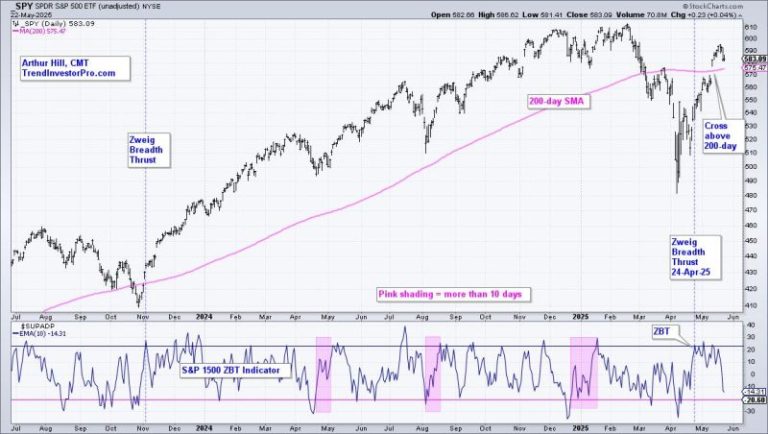
Bullish signal alert! Over 50% of S&P 500 stocks are now above their 200-day moving average.

In this video, Dave explains this key market breadth indicator and what it means for stock market trends. He shows how moving average breadth has reached a bullish milestone, what this means based on historical signals over the past 15 years, and how it compares to the Zweig Breadth Thrust. He also introduces the stoplight market phase technique—a simple but effective method using StockCharts tools to assess market conditions in real time.

This video originally premiered on May 13, 2025. Watch on StockCharts’ dedicated David Keller page!

Previously recorded videos from Dave are available at this link.