
Author

admin

Browsing

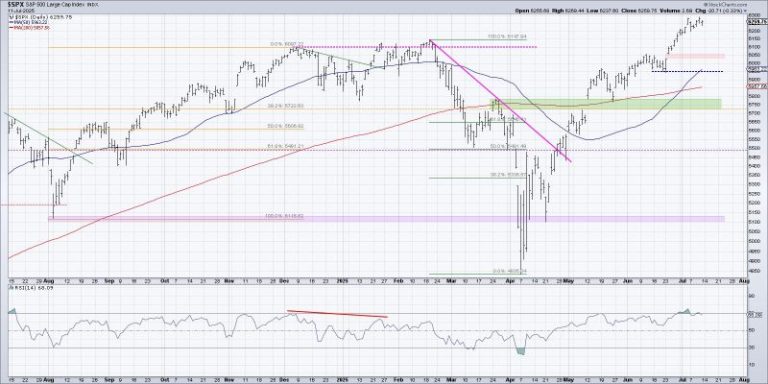
Below is the EB Weekly Market Report that I sent out earlier to our EarningsBeats.com members. This will give you an idea of the depth of our weekly report, which is a very small piece of our regular service offerings. We called both the stock market top in February and stock market bottom in April, and encouraged EB members to lower risk at the time of the former and increase risk at the time of the latter.

There is no better time to experience our service for yourself as we’re currently running a FLASH SALE that offers a 20% discount on annual memberships. The timing to join couldn’t be better as I’ll be providing my Q3 outlook to all EB annual members at 5:30pm ET today. A recording will be provided for those who cannot attend the session live. So if you sign up later today or tomorrow or the next day, we’ll make sure you get a time-stamped copy of the recording.

In the meantime, enjoy this complimentary copy of this week’s report….

ChartLists/Spreadsheets Updated

The following ChartLists/Spreadsheets were updated over the weekend:

  • Strong Earnings (SECL)
  • Strong Future Earnings (SFECL)
  • Strong AD (SADCL)
  • Raised Guidance (RGCL)
  • Bullish Trifecta (BTCL)
  • Short Squeeze (SSCL)
  • Leading Stocks (LSCL)
  • Manipulation Spreadsheet*

*We continued to add more stocks to our Manipulation Spreadsheet and you’ll see that a few have tabs, but do not have data yet. Those 3 are still “under construction”. I also added a “Summary” tab where I’ve begun to sort the individual stocks in order based on a proprietary relative AD ranking system. Don’t ask me what it means yet, because it’s still very much a work in progress as well. I’m looking at the intraday relative performance of individual stocks vs. the benchmark S&P 500. So positive percentages represent better intraday AD performance than the S&P 500, while negative percentages represent the opposite. One thing I’ll be watching is to see if stronger relative AD lines precede relative strength in stocks on a forward-looking basis. It certainly did in the case of both Netflix (NFLX) and Microsoft (MSFT) from several weeks ago when I pointed out what appeared to me to be significant accumulation in March/April when the stock market bottomed. Both NFLX and MSFT have soared since that time. I’ll keep everyone posted on the progress of my research over the next many weeks and months.

Weekly Market Recap

Major Indices

Sectors

Top 10 Industries Last Week

Bottom 10 Industries Last Week

Top 10 Stocks – S&P 500/NASDAQ 100

Bottom 10 Stocks – S&P 500/NASDAQ 100

Big Picture

If you’re a long-term investor, stepping back and looking at the stock market using this 100-year chart enables you to avoid pulling unnecessary sell triggers, because of the media, permabears, negative nellie’s, and all the “news” out there. The above chart never once flashed anything remotely signaling a sell signal and now, here we are, back at all-time highs. Simply put, it filters out all the noise that we hear on a day-to-day basis and keeps our wits about us.

Sustainability Ratios

Here’s the latest look at our key intraday ratios as we follow where the money is traveling on an INTRADAY basis (ignoring gaps):

QQQ:SPY

Absolute price action on both the S&P 500 and NASDAQ 100 has now seen all-time high breakouts, which alone is quite bullish. We want to see aggressive vs. defensive (or growth vs. value) ratios moving higher to indicate sustainability of any S&P 500 advance. In my view, we’re seeing that. But the intraday QQQ:SPY ratio continues to hesitate. A breakout in this intraday relative ratio would most definitely add to the current bullish market environment.

IWM:QQQ

I’m seeing signs of an impending rate cut by the Fed. However, if I’m being completely honest, one signal that we should see is outperformance in small caps and a rising IWM:QQQ ratio. That hasn’t happened – at least not yet. If a rate cut starts to become clearer, I would absolutely expect to see much more relative strength in small caps. Keep an eye out for that.

XLY:XLP

I pay very close attention to the XLY:XLP ratio and, more specifically, this INTRADAY XLY:XLP ratio. This chart helped me feel confident in calling a market top back in January/February. If you recall, that’s when we said it was waaaaay too risky to be long the U.S. stock market. By the time we had bottomed in April, the blue-shaded area highlighted the fact that the XLY vs. XLP ratio had already begun to SOAR! That’s why, on Friday, April 11th, I said I was ALL IN on the long side again.

These signals are golden and, when used in conjunction with all of our other signals, can provide us extremely helpful clues about stock market direction. If these ratios begin to turn lower in a big way, then yes we’ll need to grow more cautious. However, right now, they couldn’t be any more bullish. Expect higher prices ahead.

Sentiment

5-day SMA ($CPCE)

Sentiment indicators are contrarian indicators. When they show extreme bullishness, we need to be a bit cautious and when they show extreme pessimism, it could be time to become much more aggressive. Major market bottoms are carved out when pessimism is at its absolute highest level.

The S&P 500 had struggled a bit once 5-day SMA readings of the CPCE fell to the .55 area, a sign of market complacency and a possible short-term top. We saw a bit of a pullback in June, which many times is all we get during a secular bull market advance. My sustainability ratios are supporting a higher move by stocks and I know from history that overbought conditions can remain overbought. I also know that sentiment does a much better job of calling bottoms than it does calling tops. That’s why I will not overreact every time this 5-day moving average of the CPCE falls back below .55. During Q4 2024, we saw plenty of 5-day SMA readings below .55 and, while the S&P 500 was choppy, bullishness prevailed throughout. So just please always keep in mind that these 5-day SMA readings are our “speed boat” sentiment indicator that changes quite frequently. When it lines up with other bearish or topping signals, we should take note. But reacting to every subtle move in this chart is a big mistake, in my opinion.

253-day SMA ($CPCE)

This longer-term 253-day SMA of the CPCE is our “ocean-liner” signal, unlike our speedboat indicator. This one usually provides us a very solid long-term signal as the overall market environment moves from one of pessimism to complacency and vice versa. Look at the above chart. When the 253-day SMA is moving lower like it is now, it accompanies our most bullish S&P 500 moves. It makes perfect common sense as well. Once this 253-day SMA moves to extremely high levels and begins to roll over, the bears have already sold. We typically have nowhere to go on our major indices, except higher once sentiment becomes so bearish. The opposite holds true when the 253-day SMA reaches extreme complacency and starts to turn higher. We saw that to start 2022, which, at the time, I stated was my biggest concern as we started 2022. If you recall, I said to look for a 20-25% cyclical bear market over a 3-6 month period on the first Saturday in January 2022. The above chart was my biggest reason for calling for such a big selloff ahead of the decline.

These charts matter.

Long-Term Trade Setup

Since beginning this Weekly Market Report in September 2023, I’ve discussed the long-term trade candidates below that I really like. Generally, these stocks have excellent long-term track records, and many pay nice dividends that mostly grow every year. Only in specific cases (exceptions) would I consider a long-term entry into a stock that has a poor or limited long-term track record and/or pays no dividends. Below is a quick recap of how these stocks looked one week ago:

  • JPM – challenging all-time high
  • BA – substantial improvement, would like to see 185-190 support hold
  • FFIV – very bullish action above its 20-month SMA
  • MA – very steady and bullish long-term performer
  • GS – trending higher above 20-month EMA
  • FDX – trying to clear falling 20-week EMA
  • AAPL – monthly RSI at 50, which has been an excellent time to buy AAPL over the past two decades
  • CHRW – 85-90 is solid longer-term support
  • JBHT – would like to see 120-125 support hold
  • STX – long-term breakout in play, excellent trade
  • HSY – breaking above 175 would be intermediate-term bullish
  • DIS – now testing key price resistance in 120-125 range
  • MSCI – monthly RSI hanging near 50, solid entry
  • SBUX – moved back above 50-week EMA, short-term bullish
  • KRE – long-term uptrend remains in play
  • ED – has been a solid income-producer and investment since the financial crisis low in 2009
  • AJG – few stocks have been steadier to the upside over the past decade
  • NSC – continues to sideways consolidate in very bullish fashion
  • RHI – trending down with potential sight set on 30
  • ADM – looks to be reversing higher off long-term price support near 43
  • BG – 65-70 price support held, now looking to clear 50-week SMA to the upside
  • CVS – excellent support at 45 or just below, just failed on bounce at 50-month SMA at 72
  • IPG – monthly RSI now at 37 and also testing 4-year price support near 22.50
  • HRL – long-term price support at 25 and stock now showing positive divergence on monthly chart – bullish
  • DE – one of the better 2025 momentum stocks on this list

Keep in mind that our Weekly Market Reports favor those who are more interested in the long-term market picture. Therefore, the list of stocks above are stocks that we believe are safer (but nothing is ever 100% safe) to own with the long-term in mind. Nearly everything else we do at EarningsBeats.com favors short-term momentum trading, so I wanted to explain what we’re doing with this list and why it’s different.

Also, please keep in mind that I’m not a Registered Investment Advisor (and neither is EarningsBeats.com nor any of its employees) and am only providing (mostly) what I believe to be solid dividend-paying stocks for the long term. Companies periodically go through adjustments, new competition, restructuring, management changes, etc. that can have detrimental long-term impacts. Neither the stock price nor the dividend is ever guaranteed. I simply point out interesting stock candidates for longer-term investors. Do your due diligence and please consult with your financial advisor before making any purchases or sales of securities.

Looking Ahead

Upcoming Earnings

Very few companies will report quarterly results until mid-April. The following list of companies is NOT a list of all companies scheduled to report quarterly earnings, however, just key reports, so please be sure to check for earnings dates of any companies that you own. Any company in BOLD represents a stock in one of our portfolios and the amount in parenthesis represents the market capitalization of each company listed:

  • Monday: None
  • Tuesday: STZ ($29 billion)
  • Wednesday: None
  • Thursday: None
  • Friday: None

Key Economic Reports

  • Monday: June Chicago PMI
  • Tuesday: June PMI manufacturing, June ISM manufacturing, May construction spending, May JOLTS
  • Wednesday: June ADP employment report
  • Thursday: Initial jobless claims, June nonfarm payrolls, unemployment rate & average hourly earnings, May factory orders, June ISM services
  • Friday: None – stock market closed in observance of Independence Day

Historical Data

I’m a true stock market historian. I am absolutely PASSIONATE about studying stock market history to provide us more clues about likely stock market direction and potential sectors/industries/stocks to trade. While I don’t use history as a primary indicator, I’m always very aware of it as a secondary indicator. I love it when history lines up with my technical signals, providing me with much more confidence to make particular trades.

Below you’ll find the next two weeks of historical data and tendencies across the three key indices that I follow most closely:

S&P 500 (since 1950)

  • Jun 30: +34.34%
  • Jul 1: +72.77%
  • Jul 2: +16.76%
  • Jul 3: +77.19%
  • Jul 4: +0.00% (market closed – holiday)
  • Jul 5: +39.40%
  • Jul 6: +22.32%
  • Jul 7: +17.62%
  • Jul 8: -16.29%
  • Jul 9: +76.54%
  • Jul 10: -16.59%
  • Jul 11: +13.23%
  • Jul 12: +36.89%
  • Jul 13: -5.67%

NASDAQ (since 1971)

  • Jun 30: +73.30%
  • Jul 1: +63.18%
  • Jul 2: -47.43%
  • Jul 3: +46.02%
  • Jul 4: +0.00% (market closed – holiday)
  • Jul 5: +7.04%
  • Jul 6: -10.79%
  • Jul 7: +60.19%
  • Jul 8: -10.10%
  • Jul 9: +86.44%
  • Jul 10: -27.94%
  • Jul 11: +11.18%
  • Jul 12: +128.28%
  • Jul 13: +61.52%

Russell 2000 (since 1987)

  • Jun 30: +99.14%
  • Jul 1: +30.53%
  • Jul 2: -113.05%
  • Jul 3: +44.57%
  • Jul 4: +0.00% (market closed – holiday)
  • Jul 5: -4.89%
  • Jul 6: -76.61%
  • Jul 7: +43.95%
  • Jul 8: +37.24%
  • Jul 9: +31.88%
  • Jul 10: -17.39%
  • Jul 11: +29.75%
  • Jul 12: +89.15%
  • Jul 13: +63.13%

The S&P 500 data dates back to 1950, while the NASDAQ and Russell 2000 information date back to 1971 and 1987, respectively.

Final Thoughts

All-time highs are always a time for me to say “I told you so” to the bears, since I’ve been a firm believer that we remain in a secular bull market advance – one in which we should EXPECT to see higher prices and all-time highs. This latest rally is being fully supported by risk-on areas of the market, which will almost certainly lead for more and more all-time highs down the road.

Here are several things I’m watching this week:

  • Jobs. The ADP employment report will be out on Wednesday and the more-closely-watched nonfarm payrolls will be released on Thursday this week since the stock market is closed on Friday. ANY sign of weakness in these reports will begin to put mounting pressure on the Fed to cut rates in late July at their next meeting.
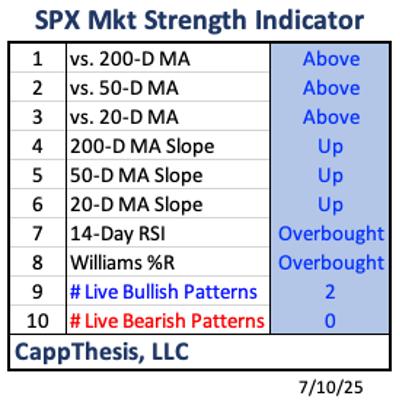
  • Technical Price Action. Any time we’re setting new all-time highs, I start off with a bullish mindset. I only turn bearish if I’m inundated with warning signals. Currently, I see few of those.
  • History. We can now turn our attention to upcoming earnings season and, historically, that’s a bullish thing. Pre-earnings season runs to the upside are common and, if you scroll up and check out historical returns for days over the next couple weeks, you’ll see that July normally performs well – especially the first half of the month.
  • 10-Year Treasury Yield ($TNX). The 10-year treasury yield has been in decline for 3 straight weeks, falling from 4.52% on June 9th to 4.24% just a few minutes ago. The money rotating into bonds is a very strong signal that inflation is NOT a problem. It’s also a signal that the Fed “should be” considering a rate cut at its next meeting.
  • Breakouts. We’ve seen big breakouts in key areas like semiconductors ($DJUSSC), software ($DJUSSW), and investment services ($DJUSSB), but there will be plenty more. Travel & tourism ($DJUSTT) joined the party on Thursday. Banks ($DJUSBK) are on the verge of a breakout. The way I look at it? The more the merrier!

Happy trading!

Tom

Here’s a quick recap of the crypto landscape for Monday (June 30) as of 9:00 p.m. UTC.

Get the latest insights on Bitcoin, Ethereum and altcoins, along with a round-up of key cryptocurrency market news.

Bitcoin and Ethereum price update

Bitcoin (BTC) is priced at US$107,538, up 0.2 percent in the last 24 hours. The day’s range for the cryptocurrency brought a low of US$106,831 and a high of US$107,802 at the opening bell.

Bitcoin price performance, June 27, 2025.

Chart via TradingView.

Ethereum (ETH) closed at US$2,510.38, up by 3.1 percent over the past 24 hours and its highest valuation of the day. Its lowest valuation on Monday was US$2,443.56.

Altcoin price update

  • Solana (SOL) was priced at US$156.95, up by 4.1 percent over 24 hours. Its highest valuation as of Monday was US$158.34, and its lowest was US$150.53.
  • XRP was trading for US$2.29, up by 5.5 percent in 24 hours and its highest valuation on Monday. The cryptocurrency’s lowest valuation was US$2.17.
  • Sui (SUI) is trading at US$2.82, showing an increaseof 0.5 percent over the past 24 hours. Its lowest valuation was US$2.75, and its highest valuation was US$2.83.
  • Cardano (ADA) is priced at US$0.5829, up by 4.8 percent in the last 24 hours and its highest valuation of the day. Its lowest valuation on Monday was US$0.5589.

Today’s crypto news to know

REX to launch Solana staking ETF this week

The REX-Osprey Solana and Staking ETF is set to launch on Wednesday (July 2), as confirmed by issuer REX Shares on Monday. Analysts had predicted this news was imminent just days before its release.

This fund, the first US-staked cryptocurrency ETF, will enable investors to hold Solana and generate yield through staking, potentially fostering wider institutional adoption of cryptocurrency.

REX’s launch comes after thoughtful consideration by the US Securities and Exchange Commission. The commission had previously asserted that the company’s unique C-Corp business structure could be in conflict with Rule 6c-11 under the Investment Company Act of 1940, which governs how ETFs operate and are regulated. REX updated its prospectus with positive feedback, securing regulatory approval for the fund.

OSL soars after buying Canadian crypto firm Banxa

OSL Group (HKEX:0863), a Hong Kong-listed digital asset platform, saw its shares spike 10 percent after announcing it had acquired Canadian crypto payments firm Banxa. The acquisition supports OSL’s ambitious global expansion strategy, which includes applying for stablecoin licenses as new regulatory frameworks emerge.

Finance Chief Ivan Wong explained that acquiring Banxa would enhance OSL’s cross-border payments capabilities and boost its role in the growing stablecoin market.

Hong Kong’s stablecoin bill, set to take effect on August 1, is a major catalyst for this expansion, with Chinese giants already showing interest. OSL is already licensed in Australia, with deals in Japan, Europe and Indonesia soon to close. The company aims to be a key stablecoin issuer in Asia and beyond.

Metaplanet strengthens Bitcoin treasury with fresh bond issuance

Tokyo-based Metaplanet (OTCQX:MTPLF,TSE:3350) has added another 1,005 BTC to its corporate treasury, pushing its total holdings to 13,350 BTC. To further build its crypto war chest, the company announced a zero-interest bond issuance worth US$208 million, designed to finance additional Bitcoin purchases.

Metaplanet is well known for its aggressive Bitcoin strategy, which has made it one of the world’s largest corporate holders of the cryptocurrency. Just last week, the hotel and investment firm raised US$515 million through an equity issuance to support its Bitcoin ambitions.

At current market prices around, Metaplanet’s Bitcoin stash is worth well over US$1.4 billion.

The Blockchain Group expands Bitcoin holdings and capital pool

Paris-based the Blockchain Group has further strengthened its Bitcoin treasury with the purchase of 60 BTC for around 5.5 million euros, boosting its holdings to 1,788 BTC.

The firm also raised about 600,000 euros by exercising warrants, allowing it to buy an additional 6 BTC.

Blockstream CEO Adam Back invested in the firm’s share offering, subscribing to over 2.1 million new shares, while French asset manager TOBAM contributed nearly 143,000 euros, supporting the purchase of 13 more BTC.

The company conducted an “ATM-type” capital increase with TOBAM, raising 4.1 million euros to fund 41 BTC.

Altogether, the Blockchain Group has secured a BTC yield of roughly 1,270 percent so far this year, with gains amounting to about 46.7 million euros.

Backed Finance launches tokenized stock product

Backed Finance, a company focused on bridging traditional financial assets like stocks and ETFs onto blockchain through tokenization, announced the launch of its tokenized stocks product, xStocks, on Monday.

60 stocks are now accessible on Bybit, Kraken and several Solana DeFi protocols, providing users with exposure to traditional stocks through blockchain infrastructure.

‘xStocks represent a monumental leap forward in democratizing access to financial markets,’ said Adam Levi, co-founder of Backed, in a press release. ‘By bringing familiar assets onto the blockchain with unprecedented accessibility, we are not just bridging traditional finance and DeFi; we are building the foundational blocks for a truly open, efficient, and inclusive global financial system where everyone can participate in wealth creation.’

Chainlink rolls out Automated Compliance Engine

Chainlink announced an early access rollout of its Automated Compliance Engine on Monday.

Built on the Chainlink Runtime Environment and launched in collaboration with Apex Group, GLEIF and ERC-3643 Association, the system automates the process of checking and enforcing financial rules for both traditional and blockchain-based financial activities, making it easier for established financial institutions to use new blockchain technologies in a compliant and safe way.

Topnotch Crypto launches adaptive yield contracts

Topnotch Crypto has launched its new adaptive yield contracts, which the company says are aimed at helping crypto investors maintain returns despite ongoing market volatility.

The contracts use proprietary predictive yield-switching artificial intelligence to automatically rotate customer funds between cloud mining and staking, depending on which is more profitable in real time.

The company’s strategy analyzes a range of on-chain data, from network congestion to staking rates, to continuously optimize yields. Unlike many passive strategies, the adaptive yield approach gives investors exposure to multiple cryptocurrencies to spread out risk. Another highlight is Topnotch’s use of geothermal and solar energy, which helps keep costs down while supporting sustainability goals.

Securities Disclosure: I, Giann Liguid, hold no direct investment interest in any company mentioned in this article.


Securities Disclosure: I, Meagen Seatter, hold no direct investment interest in any company mentioned in this article.
This post appeared first on investingnews.com

Google on Monday announced a partnership with Commonwealth Fusion Systems, or CFS, a private company spun off from the Massachusetts Institute of Technology, which marks the tech giants first commercial commitment to fusion.

The company unveiled plans to buy 200 megawatts of clean fusion power from what CFS describes as the world’s first grid-scale fusion power plant, known as ARC, based in Chesterfield County, Virginia.

ARC is expected to come online and generate 400 megawatts of clean, zero-carbon power in the early 2030s, which is enough energy to power large industrial sites or roughly 150,000 homes, according to CFS. The agreement also gives Google the option to purchase power from additional ARC plants.

Google, which has invested in CFS since 2021, said it also increased its stake in the Devens, Massachusetts-based company.

Google and CFS did not disclose the financial terms.

“We’re excited to make this longer-term bet on a technology with transformative potential to meet the world’s energy demand, and support CFS in their effort to reach their scientific and engineering milestones needed to get there,” Michael Terrell, head of advanced energy at Google, said in a statement.

Fusion is a process that takes light atomic nuclei and heats them to over 100 million degrees Celsius. At these temperatures, the fuel becomes a plasma, which eventually causes the nuclei to fuse and release significant amounts of energy. The energy is then captured to create carbon-free electricity.

CFS is one of many firms racing to achieve commercial-scale fusion energy and Google has invested in others. Earlier this month, Google announced continued funding for TAE Technologies, a California-based fusion energy company.

This post appeared first on NBC NEWS

Home Depot said Monday that it is buying GMS, a building-products distributor, for about $4.3 billion as the retailer moves to draw more sales from contractors and other home professionals.

Shares of Home Depot were roughly flat in early trading Monday. GMS shares jumped more than 11%.

As part of the deal, the Home Depot-owned subsidiary SRS Distribution will buy all outstanding shares of GMS for $110 per share, which adds up to about $4.3 billion and amounts to total enterprise value including net debt of about $5.5 billion, the company said.

Home Depot said it expects the acquisition to be completed by early 2026.

Home Depot’s announcement also concludes a potential bidding war between the big-box retailer and billionaire Brad Jacobs. Jacobs’ building-products distributor QXO had offered about $5 billion in cash to acquire GMS and said it would press forward with a hostile takeover if the company’s management rejected the proposal.

As Home Depot chases growth, it’s gone after a steadier and more lucrative piece of the home improvement business: electricians, roofers, home renovators and other professionals who tackle large projects year-round and need a lot of supplies. Home Depot said it’s speeding along that strategy with the GMS deal.

Home Depot bought SRS Distribution — the subsidiary that’s acquiring GMS — last year for $18.25 billion, in the largest acquisition in its history. Texas-based SRS sells supplies to professionals in the landscaping, roofing and pool businesses and it has bought up many other smaller suppliers as it’s grown.

Home Depot’s focus on selling to professionals is well-timed. Sales from do-it-yourself customers have slowed as higher mortgage rates have decreased housing turnover and dampened homeowners’ demand for larger projects because of higher borrowing costs.

The company said it expects total sales to grow by 2.8% for the full fiscal year and comparable sales, which take out the impact of one-time factors like store openings and calendar differences, to rise about 1%.

This post appeared first on NBC NEWS

Home Depot said Monday that it is buying GMS, a building-products distributor, for about $4.3 billion as the retailer moves to draw more sales from contractors and other home professionals.

Shares of Home Depot were roughly flat in early trading Monday. GMS shares jumped more than 11%.

As part of the deal, the Home Depot-owned subsidiary SRS Distribution will buy all outstanding shares of GMS for $110 per share, which adds up to about $4.3 billion and amounts to total enterprise value including net debt of about $5.5 billion, the company said.

Home Depot said it expects the acquisition to be completed by early 2026.

Home Depot’s announcement also concludes a potential bidding war between the big-box retailer and billionaire Brad Jacobs. Jacobs’ building-products distributor QXO had offered about $5 billion in cash to acquire GMS and said it would press forward with a hostile takeover if the company’s management rejected the proposal.

As Home Depot chases growth, it’s gone after a steadier and more lucrative piece of the home improvement business: electricians, roofers, home renovators and other professionals who tackle large projects year-round and need a lot of supplies. Home Depot said it’s speeding along that strategy with the GMS deal.

Home Depot bought SRS Distribution — the subsidiary that’s acquiring GMS — last year for $18.25 billion, in the largest acquisition in its history. Texas-based SRS sells supplies to professionals in the landscaping, roofing and pool businesses and it has bought up many other smaller suppliers as it’s grown.

Home Depot’s focus on selling to professionals is well-timed. Sales from do-it-yourself customers have slowed as higher mortgage rates have decreased housing turnover and dampened homeowners’ demand for larger projects because of higher borrowing costs.

The company said it expects total sales to grow by 2.8% for the full fiscal year and comparable sales, which take out the impact of one-time factors like store openings and calendar differences, to rise about 1%.

This post appeared first on NBC NEWS

It’s a bittersweet day for Windows users.

Microsoft is scrapping its iconic “blue screen of death,” known for appearing during unexpected restarts on Windows computers. The company revealed a new black iteration in a blog post on Thursday, saying that it is “streamlining the unexpected restart experience.”

The new black unexpected restart screen is slated to launch this summer on Windows 11 24H2 devices, the company said. Microsoft touted the updates as an “easier” and “faster” way to recover from restarts.

The software giant’s blue screen of death dates back to the early 1990s, according to longtime Microsoft developer Raymond Chen.

Travelers walk past screens after a major disruption in Microsoft’s cloud services caused widespread flight cancellations and delays at T3 IGI Airport in New Delhi, India, on July 19.Vipin Kumar / Hindustan Times via Getty Images file

Microsoft also said it plans to update the user interface to match the Windows 11 design and cut downtime during restarts to two seconds for the majority of users.

“This change is part of a larger continued effort to reduce disruption in the event of an unexpected restart,” Microsoft wrote.

The iconic blue screen was seemingly everywhere in July 2024 after a faulty update from CrowdStrike crashed computer systems around the world.

This post appeared first on NBC NEWS

Investor Insight

With a strategic foothold in Portugal and a commodity focus on tungsten – a metal deemed critical by both NATO and US defense agencies – Allied Critical Minerals is advancing two past-producing projects toward near-term production. Backed by a $4.6 million financing, offtake interest from major buyers, and a leadership team with proven capital markets and operational success, ACM is well-positioned to become the largest tungsten producer outside of China.

Overview

Allied Critical Minerals (CSE:ACM,FSE:0VJ0) is advancing two highly strategic, past-producing tungsten projects – Borralha and Vila Verde – located in northern Portugal. These brownfield assets present a compelling combination of near-term production potential and district-scale exploration upside, positioning the company to become the largest tungsten producer outside of China. With 100 percent ownership of both projects and supportive local communities, ACM is well-placed to contribute to the critically needed supply of this strategic metal to Western markets.

Tungsten is essential for defense systems, electric vehicles, semiconductors and artificial intelligence (AI), yet current global supply is dominated by China and Russia, accounting for about 90 percent of production. ACM’s projects are aligned with national security strategies in the US and EU, seeking secure and stable sources of tungsten supply. The company has already signed a letter of intent with Global Tungsten & Powders, a major Pennsylvania-based end-user with ties to the US military and is actively engaging with other global refineries.

To capitalize on these market dynamics, ACM closed a $4.6 million financing to fund an aggressive value creation plan. This includes an ongoing drill program at Borralha aimed at expanding its existing NI 43-101 resource, and the construction of a pilot processing facility at Vila Verde, targeted to begin in Q4 2025 and become operational by 2026. The pilot plant will process tailings and alluvial material from existing deposits, with an estimated annual output of ~250 tons tungsten trioxide (WO₃) and projected revenues of $4 million to $5 million, supporting near-term cash flow with minimal dilution.

ACM differentiates itself from competitors such as American Tungsten and Fireweed through its permitting progress, advanced technical groundwork and strong leadership. CEO Roy Bonnell brings a proven track record of successful exits and rapid value creation, having been instrumental in the success of both Founders Metals (TSXV:FDR) and Thesis Gold (TSXV:TAU) — two of the TSX Venture’s top-performing issuers in recent years.

Company Highlights

  • Strategic Focus on Critical Metals: Allied Critical Minerals is developing two tungsten projects – Borralha and Vila Verde – in mining-friendly northern Portugal, targeting near-term production and long-term scale.
  • Advanced Brownfield Assets: Both projects are historic producers with significant infrastructure, community support and technical momentum. Borralha produced tungsten from 1904 to 1986, and holds a newly updated NI 43-101 compliant resource.
  • Pilot Plant Launch in 2026: A pilot plant at Vila Verde is slated for construction in Q4 2025 with 150,000 tpa throughput capacity, expandable to 300,000 tpa. Target output of ~250 tons WO₃ annually is expected to generate $4 million to $5 million in revenue, funded through non-dilutive financing.
  • Offtake and Government Support: Allied has signed an LOI with Global Tungsten & Powders and is in discussions with additional refineries. Expressions of interest from US and EU defense-linked buyers are ongoing.
  • High Impact Drill Campaign: A fully funded 5,000 meter drill program is currently underway at Borralha, with assays expected to expand resources and define the high-grade Santa Helena Breccia zone.
  • Differentiated from Peers: Allied is one of only a few public companies in the Western world with near-term tungsten production potential, outpacing peers such as American Tungsten and Fireweed, in both timeline and resource readiness.

Key Projects

Borralha Tungsten Project

The Borralha project is ACM’s flagship development-stage asset, located approximately 100 km northeast of Porto in northern Portugal. A brownfield project with a rich production history dating back to 1904, Borralha produced over 10,280 tons of wolframite concentrate at an average grade of 66 percent WO₃, until operations ceased in 1986. Today, the project is advancing rapidly, supported by a Mining Rights Concession License and a newly updated NI 43-101 compliant resource estimate effective July 31, 2024. The estimate defines indicated resources of 4.98 million tons (Mt) at an average grade of 0.22 percent WO₃, 762 grams per ton (g/t) copper, and 4.8 g/t silver, and inferred resources of 7.01 Mt at 0.20 percent WO₃, 642 g/t copper, and 4.4 g/t silver. The project area hosts significant polymetallic enrichment, with tin and copper frequently associated with the tungsten mineralization, adding potential for by-product credits.

The primary zone of interest, the Santa Helena Breccia (SHB), is a subvertical to sub-horizontal breccia pipe-style tungsten system. Historical and recent drilling confirms broad, continuous mineralization with highlight intercepts including 106 m at 0.21 percent WO₃, 114 m at 0.23 percent WO₃, 108 m at 0.22 percent WO₃, and a high-grade zone of 10 m at 1.75 percent WO₃.

The SHB zone accounts for over 70 percent of known mineralization, but only about half of the zone has been drill-tested to date. The current drill campaign is targeting both lateral extensions and higher-grade core zones within the breccia body.

Geologically, the deposit is hosted in metasedimentary rocks intruded by late-Variscan granites, with mineralization occurring predominantly as wolframite associated with quartz-cassiterite veins and breccia infill. Breccia pipe mining techniques – similar to open-pit quarry operations – are anticipated for early-stage exploitation.

The project is currently undergoing an environmental impact assessment under review by Portuguese authorities. The mining license includes provisions for up to 150,000 tons per annum of bulk sampling ahead of full-scale operations, which will be governed by a future feasibility study. The low-cost drill environment (~$235/meter) and excellent infrastructure – including road, power, water and proximity to a skilled workforce – make Borralha a technically robust and strategically significant asset for ACM.

Vila Verde Tungsten-Tin Project

Located approximately 45 km southeast of Borralha, the Vila Verde project is ACM’s pilot production and near-term cash flow opportunity. Historically, this area hosted the Vale das Gatas Mine, which was one of Portugal’s largest tungsten producers prior to its closure in 1986. The project covers a significantly larger land area than Borralha and includes multiple mineralized zones, notably Cumieira and Porqueira. A historical resource estimate from 2020 defined 7.3 Mt of mineralized material above a 0.05 percent WO₃ cutoff, including 4.0 Mt at 0.14 percent WO₃ in the Cumieira zone and 3.3 Mt at 0.10 percent WO₃ in Porqueira. While historical in nature, these figures are supported by 17 diamond drill holes totaling 2,103 metres, which revealed a 2.1 km x 1.0 km mineralized footprint at Cumieira and a 1.0 km x 500 m footprint at Porqueira.

Vila Verde Pilot Plan

Vila Verde is advancing toward the construction of a 150,000-ton-per-annum pilot plant, scheduled to begin construction in Q4 2025 and be operational in 2026. Tailings and alluvial material from the Justes deposit will be used as the initial feedstock, with an average WO₃ grade of ~0.21 percent anticipated. Plant design includes standard crushing and grinding circuits followed by gravimetric and magnetic separation to produce a high-grade wolframite concentrate. Engineering work by GMR Consultores and MinePro Solutions supports an annual output of approximately 250 tons of WO₃ under current parameters. The total estimated CAPEX for the pilot plant is CA$7.9 million, with a proposed expansion to 300,000 tpa requiring an additional CA$2.9 million, both targeted for non-dilutive funding sources.

Permitting is progressing efficiently, with the mineral license being converted from exploration to experimental mining status. This permits early-stage production while full-scale licensing is pursued. The project benefits from pre-existing quarry infrastructure, strong community support, and short timelines to cash flow. A signed LOI with Global Tungsten & Powders in Pennsylvania provides an initial offtake channel, and additional negotiations with global refiners are ongoing. Vila Verde is central to ACM’s short-term revenue plan and is designed to serve as a testbed for scalable production across its broader tungsten portfolio.

Management Team

Roy Bonnell – CEO and Director

Roy Bonnell is a seasoned executive with over 30 years in capital markets, venture finance and natural resources. Bonnell holds an LLB from Western University, an MSc from the London School of Economics, and an MBA from McGill University. He brings deep leadership and financing experience and previously served as a board member for Founders Metals and Thesis Gold – two of the TSXV’s top performers.

João Barros – President and COO

With over 20 years of mining sector experience in Portugal, João Barros specializes in exploration management, environmental impact assessments and feasibility studies. He has held leadership roles at Ascendant Resources and Redcorp, and is a member of the Portuguese Engineers Association.

Sean O’Neill – Non-Executive Chairman

Sean O’Neill is head of securities at Boughton Law with 20+ years in corporate and securities law, including advising mining firms globally. He holds degrees in Chemical Engineering and Law, an MBA, and is a registered professional engineer (P.Eng).

Michael Galego – Director

Michael Galego is the CEO of Apolo Capital Advisory and CLO of LNG Energy, with extensive experience in M&A and corporate strategy. Notably, he advised on the sale of Woulfe Mining (tungsten asset) to Almonty Industries. He is a Lexpert Top 40 Under 40 awardee and member of the TSX Venture Advisory Committee.

Colin Padget – Director

CEO of Founders Metals, Colin Padget brings operational exploration experience across South America. He holds a Masters in Geology and a Bachelor in Business Administration.

Andrew Lee – Director and Corporate Secretary

Former Managing Director of York Harbour Metals, Andrew Lee has 15 years of global exploration experience across gold and phosphate projects in Ecuador and West Africa.

Sean Choi – CFO

A CPA with nearly 20 years in mining finance, Sean Choi has held CFO roles at York Harbour Metals, Ecuador Gold & Copper, and Northern Sun Mining. He holds a degree from the Western University.

This post appeared first on investingnews.com

(TheNewswire)

Vancouver, BC TheNewswire June 30, 2025 – Element79 Gold Corp. (CSE: ELEM | FSE: 7YS0 | OTC: ELMGF) (‘Element79’ or the ‘Company’) announces its forward corporate guidance for the remainder of 2025, outlines recent strategic developments regarding its Lucero Project in Peru, and reaffirms its operational focus on its advanced-stage projects in Nevada, USA.

Force Majeure Declared on Lucero Project

The Company formally invoked the force majeure clause under its agreement with Condor Resources Inc. with respect to the Lucero Project due to a combination of social, regulatory, and political barriers which have effectively prevented the Company from lawfully executing planned exploration and development activities, despite holding full mineral rights.

A force majeure event refers to unforeseen circumstances beyond a party’s control—such as acts of government, social unrest, or natural disasters—that prevent contractual obligations from being fulfilled. In the case of Lucero, the following factors have contributed to the declaration:

  • Evolving and inconsistent Peruvian federal policies on small-scale mining formalization, creating uncertainty in legal enforceability and timelines.

  • Political instability and leadership vacuums , with current municipal governance in Chachas in transition and the outgoing mayor largely absent from the community.

  • Legacy community mistrust and unmet promises from prior owners, complicating local engagement efforts.

  • Ongoing unauthorized artisanal mining by community members operating outside legal frameworks and without formalized agreements.

Element79 has spent two and a half years of extensive, evolving efforts to foster community relationships and negotiate access agreements in good faith, and the Company believes in developing a win-win solution with the Chachas community for the restart of the past-producing Lucero mine, the tailings and development of a regional processing plant, and exploring the geological assets inside the Lucero concessions.  The Company and its contracted financial consultants remain staunchly optimistic to fund future development at Lucero as agreements for surface rights agreements are reached.  In the short-term, internal reports and formal feedback from its social engagement team (GAE Peru) and regional mining authorities (DREM Arequipa) suggest that no material progress toward surface rights agreements is likely for the remainder of 2025.

Path Toward Resolution and Reworking Terms with Condor Resources

Over the next 12 months, Element79 will:

  • Continue monitoring regulatory developments, particularly the anticipated implementation of MAPE legislation , which may clarify formalization mechanisms between artisanal miners and mineral right holders.

  • Maintain social outreach campaigns in Chachas through the Company’s social engagement team, GAE Peru, preparing the groundwork for ongoing engagement pre- and post-municipal elections in early 2026

  • Continue ongoing dialogue with Condor Resources to explore restructuring the terms of the original Lucero agreement, with the goal of establishing a more reasonable, flexible and mutually beneficial framework as on-the-ground conditions allow for meaningful work to resume at Lucero.

Strategic Focus Shift to Nevada Projects

In line with this operational pivot, Element79 is reaffirming its near-term focus on its U.S.-based assets:

  • The Company will retain and advance development at the Elephant Project in Nevada. A technical report to formally organize historical work under the 43-101 framework, upcoming work plan and exploration campaign are currently being finalized and will be publicly disclosed shortly.

  • The acquisition of the Gold Mountain Project , a drill-ready asset also located in Nevada, is expected to close as soon as possible, pending administrative timelines surrounding Canada Day and U.S. Independence Day holidays. A comprehensive development plan will be issued thereafter.

Corporate Outlook

As Element79 aligns its capital and human resources to near-term executable projects, the Company remains committed to:

  • Unlocking shareholder value through strategic asset optimization.

  • De-risking its project portfolio by prioritizing jurisdictions with clear permitting paths.

  • Continuing stakeholder engagement to support long-term success at Lucero when conditions become viable.

  • Changes to the board of directors and management to reflect the evolving business model

About Element79 Gold Corp.

Element79 Gold Corp. is a mining company focused on the exploration and development of high-grade gold and silver assets. Its principal asset is the past-producing Lucero Project in Arequipa, Peru, where it aims to resume operations through both conventional mining and tailings reprocessing. In the United States, the Company holds interests in multiple projects along Nevada’s Battle Mountain Trend.  Additionally, Element79 Gold has completed the transfer of its Dale Property in Ontario to its wholly owned subsidiary, Synergy Metals Corp., and is progressing through the Plan of Arrangement spin-out process.

For further information, please visit: www.element79.gold

On Behalf of the Board of Directors

James C. Tworek

Chief Executive Officer, Director

Element79 Gold Corp.

jt@element79.gold

Cautionary Note Regarding Forward Looking Statements

This press release contains forward-looking statements within the meaning of applicable securities laws. The use of any of the words ‘anticipate,’ ‘plan,’ ‘continue,’ ‘expect,’ ‘estimate,’ ‘objective,’ ‘may,’ ‘will,’ ‘project,’ ‘should,’ ‘predict,’ ‘potential’ and similar expressions are intended to identify forward-looking statements. In particular, this press release contains forward-looking statements concerning the Company’s exploration plans, development plans and the Force Majeure Event. Although the Company believes that the expectations and assumptions on which the forward-looking statements are based are reasonable, undue reliance should not be placed on these statements because the Company cannot provide assurance that they will prove correct. Forward-looking statements involve inherent risks and uncertainties, and actual results may differ materially from those anticipated. Factors that could cause actual results to differ include conditions in the duration of the Force Majeure Event, and receipt of regulatory and shareholder approvals. These forward-looking statements are made as of the date of this press release, and, except as required by law, the Company disclaims any intent or obligation to update publicly any forward-looking statements.

Neither the Canadian Securities Exchange nor the Market Regulator (as that term is defined in the policies of the Canadian Securities Exchange) accepts responsibility for the adequacy or accuracy of this release.

Copyright (c) 2025 TheNewswire – All rights reserved.

News Provided by TheNewsWire via QuoteMedia

This post appeared first on investingnews.com