Author

admin

Browsing

After a relatively quiet week for the S&P 500, we’re seeing some interesting shifts in sector dynamics. Let’s dive into the latest rankings, RRG analysis, and what it means for our portfolio strategy.

Sector Shifts and RRG Insights: Materials on the Move

The big news this week is the ascent of the Materials sector, which has muscled its way into the top five at the expense of the Utilities sector.

The rest of the top five remained steady, but we’re seeing some movement in the lower ranks as well. Consumer Discretionary made a notable jump from #9 to #7, pushing Consumer Staples and Real Estate down a notch each. Energy and Health Care continue to bring up the rear at #10 and #11, respectively.

  1. (1) Technology – (XLK)
  2. (2) Industrials – (XLI)
  3. (3) Communication Services – (XLC)
  4. (4) Financials – (XLF)
  5. (6) Materials – (XLB)*
  6. (5) Utilities – (XLU)*
  7. (9) Consumer Discretionary – (XLY)*
  8. (7) Consumer Staples – (XLP)*
  9. (8) Real-Estate – (XLRE)*
  10. (10) Energy – (XLE)
  11. (11) Healthcare – (XLV)

Weekly RRG

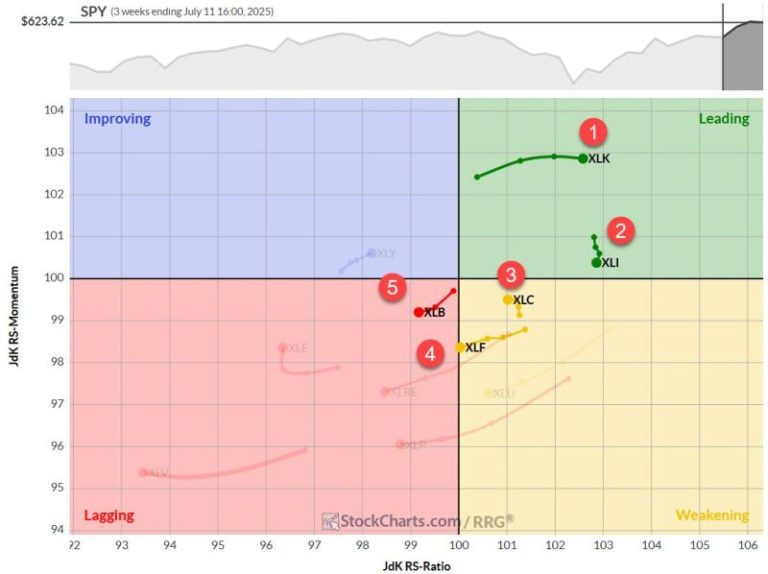
The weekly Relative Rotation Graph (RRG) gives us a broader perspective on sector trends. Technology continues to dominate, firmly entrenched in the leading quadrant, no surprises there. Industrials is showing stability with a short tail in the leading quadrant, indicating a consistent relative uptrend.

Communication Services, however, is raising some eyebrows. It’s lurking in the weakening quadrant with a short tail, suggesting a stable relative uptrend but with negative momentum. Financials are teetering on the edge of the lagging quadrant, a move that demands attention. Materials, despite its rise in the rankings, is actually in the lagging quadrant on the weekly RRG. You will see why it made its way into the top 5 on the daily RRG.

Daily RRG

On the daily RRG, we get a more nuanced picture of short-term sector movements:

  • Materials (XLB) is the star of the show, crossing into the leading quadrant and standing alone in that coveted space.
  • Financials (XLF) is showing weakness, rolling over and heading back towards the lagging quadrant — confirming what we saw on the weekly chart.
  • Communication Services is on the verge of crossing into the lagging quadrant, a sign that is not great for its current #3 ranking.
  • Industrials is flexing its muscles, approaching the leading quadrant with a positive heading.
  • Technology, while rotating into the weakening quadrant, still has ample room to bounce back into leading territory.

Technology

The tech train continues to roll, breaking through resistance around 240 and maintaining its upward trajectory in both price and relative strength. The RS line is pushing higher after a clean breakout from its falling trend, a bullish sign for the sector leader.

Industrials

XLI is following through nicely on both price and relative strength charts. The raw RS line has established a new higher low, dragging the RS ratio higher. In my opinion, this sector looks rock-solid.

Communication Services

Here’s where things get dicey. XLC is clinging to its breakout above 105, but last week’s decline is testing that former resistance as new support. The raw RS line breaking below rising support is a warning sign that this sector could be in for a bumpy ride.

Financials

Similar to Communications Services, Financials has retreated to test old resistance as support. The raw RS line looks even worse here, having broken out of its rising channel weeks ago. Both RRG lines are flirting with the 100 level; a further push into the lagging quadrant seems likely.

Materials

XLB is showing some muscle, breaking out of its falling channel and taking out recent highs. The raw RS line is pushing against falling resistance — if it can break through, we could see a significant turnaround in the RRG lines, confirming the sector’s newfound strength.

Portfolio Performance

Now, for the part that might sting a bit, the portfolio drawdown is ongoing. It’s something trend followers need to learn to live with. Currently, the portfolio is down about 2% for the year, while the S&P 500 is up over 6%. That puts us roughly 8% behind the benchmark YTD.

It’s not a comfortable position, but it’s part of the game. Trend-following strategies often lag in choppy or rapidly changing markets. The key is to stay disciplined and trust in the long-term efficacy of our approach.

#StayAlert and have a great week, Julius


Q2 confirmed that the artificial intelligence (AI) boom is entering a new phase in the physical world.

As the industry evolves, attention is being directed to strengthening underlying infrastructure while advancing areas like embodied AI, a subsector that MarketsandMarkets projects will grow at a CAGR of 39 percent globally by 2030.

Also during Q2, a geopolitical tech rivalry exacerbated shifting macroeconomic conditions.

While the race for compute, energy, hardware and supply chain dominance intensified, talk of tariff policies reigniting inflation or contributing to stagflation created brief periods of contraction.

Concerns also grew around AI-driven job displacement, amplified by Anthropic CEO Dario Amodei’s ominous warning that AI could eliminate up to half of all entry-level white-collar jobs within the next five years.

On a more positive note, the S&P 500 (INDEXSP:.INX) and Nasdaq Composite (INDEXNASDAQ:.IXIC) both ended Q2 up by 0.5 percent, closing the first half of 2025 at all-time highs with gains of 5.5 percent.

That said, investor enthusiasm for AI is showing early signs of recalibration.

Big Tech delivered generally robust Q2 earnings despite initial volatility in April, but posted only modest year-to-date gains, suggesting near-term caution around richly valued growth names. Meanwhile, quantum computing, which NVIDIA (NASDAQ:NVDA) CEO Jensen Huang said was decades away just six months ago, made measurable progress in Q2, drawing attention from both deep-tech investors and national governments.

McKinsey’s annual Quantum Technology Monitor projects that quantum computing, communication and sensing could generate up to US$97 billion in global revenue by 2035, with quantum computing leading the way.

Not surprisingly, AI companies performed well. Thirty-eight AI stocks chosen by Morningstar — including Palantir Technologies (NASDAQ:PLTR), Palo Alto Networks (NASDAQ:PANW), Synopsys (NASDAQ:SNPS) and Micron Technology (NASDAQ:MU) — closed 27.3 percent higher, outpacing the Morningstar US Technology Index, which gained 22 percent.

Ultimately, the quarter underscored a strategic pivot for major tech players, prioritizing vast infrastructure investments alongside aggressive AI monetization efforts to capitalize on this transformative era.

AI results impact major tech players

In public markets, AI-related equities continued to attract attention.

NVIDIA posted another blockbuster quarter, with its market cap on the cusp of $US4 trillion at the end of June. Its performance was driven largely by demand for Blackwell architecture.

Alphabet (NASDAQ:GOOGL), facing a possible Chrome divestiture, reported an increase in AI-related ad revenue and highlighted growing adoption of its Gemini model suite. Amazon (NASDAQ:AMZN) reported a 23 percent annual increase in net sales from its Amazon Web Services segment, beating earnings estimates by 17.78 percent.

Meta Platforms’ (NASDAQ:META) Reality Labs division reported a $US4.2 billion operating loss; however, interest in embodied AI applications for the metaverse and augmented reality continue to be the company’s long-term play, with CEO Mark Zuckerberg poaching the industry’s top talent to assemble the Meta Superintelligence Lab. On July 7, Reuters reported that the company had added Apple’s (NASDAQ:AAPL) Ruoming Pang as its latest recruit.

Microsoft’s (NASDAQ:MSFT) OpenAI partnership faced issues after OpenAI bought Windsurf, an AI coding firm. Disputes arose over Microsoft’s access to WindSurf’s IP and its stake in a restructured OpenAI.

Q2 was also marked by a shift to AI in hardware, robotics and edge applications.

Chipmakers Advanced Micro Devices (NASDAQ:AMD) and Google introduced specialized AI accelerators, a potential challenge to NVIDIA’s nearly three year run as the dominant provider.

Notable developments in robotics included Google Cloud and Samsung Electronics’ (KRX:005930) partnership, integrating Google Cloud’s advanced generative AI technology into Samsung’s new home AI companion robot, Ballie.

Data center operators like Amazon Web Services and Google Cloud also increased their infrastructure investments in the US as part of an effort to reduce reliance on foreign markets and secure long-term AI compute capacity.

Companies began testing or rolling out new AI agent capabilities, empowered by the Model Context Protocol from Anthropic. Major tech players, along with payment giants Visa (NYSE:V), Mastercard (NYSE:MA), Stripe, Block (NYSE:SQ) and PayPal (NASDAQ:PYPL), began adopting the Model Context Protocol to integrate seamless payment functionality directly into AI chatbots, moving beyond simple browse to full commerce.

Microsoft enhanced its GitHub Copilot offering with new coding agents capable of autonomous actions, while a handful of companies, including Dataiku, Databricks and Atlassian (NASDAQ:TEAM), introduced tools designed to build, deploy and manage autonomous systems for real-world enterprise applications.

On the quantum computing side, a paper published by researcher Craig Gidney for Google’s Quantum AI division suggests that a quantum computer could break a highly secure 2048 bit encryption, like the kind used for online banking, much faster than previously thought, requiring fewer than a million qubits.

Quantum computing firms later saw their shares spike following bullish comments from NVIDIA’s Huang at his company’s Paris GTC conference. Before Huang’s comments, IBM (NYSE:IBM) announced its development of the world’s first large-scale, error-free quantum computer, set to launch by 2029.

AI trends to watch in Q3

Q2 confirmed the AI cycle is evolving beyond text-based chatbots to hardware, embodiment and commercial uses.

While the Magnificent Seven still largely drove returns in Q2, there’s an expectation that earnings growth will broaden out to other sectors. Picton Investments’ 2025 mid-year update suggests that foundational model growth is encountering headwinds, with competition challenging the need for extensive capital expenditure.

Graph indicating that investor enthusiasm for AI stocks has recently ‘lost altitude.’

Graph via Picton Investments.

However, the firm also suggests that this shift is redirecting the spotlight to real-world AI applications, leading to an expected acceleration of industrial adoption and the creation of new companies.

At this year’s Web Summit conference in May, panelists emphasized the critical role of strategic early stage investments when it comes to navigating the evolving AI landscape and identifying new opportunities.

“Our take is (that) AI is going to upend a lot of technology businesses. In the specific sense, I am of increasingly high conviction that authoring software is going to be more or less free, and that’s going to shake up the topology of the software business market (in terms of) what makes sense and what’s investable,” said Brett Gibson, managing partner at Initialized Capital, during a panel discussion on where AI investment is headed next.

He added that customizable software will ultimately allow for tailored solutions for virtually any need.

In H2, quantum computing could continue its shift from pure research into early stage commercialization.

Updates may come from firms like IonQ (NYSE:IONQ), which recently raised US$1 billion to expand quantum networking, as well as Quantinuum and PsiQuantum, which may reach technical milestones.

Meanwhile, D-Wave (NYSE:QBTS) is pivoting toward hybrid commercial models, which may offer continued proof of revenue from quantum optimization-as-a-service.

However, the outcome of ongoing trade negotiations between the US and the rest of the world could impact chip capacity and rare earths supply chains, constraining the growth of AI hardware stocks.

The Trump administration’s imposition of 25 percent tariffs on Japan and South Korea may pose a threat to semiconductor capacity and rare earths equipment imports critical for AI hardware.

“Both countries have been close partners on economic security matters and have a lot to offer the United States on priority matters like shipbuilding, semiconductors, critical minerals and energy cooperation,” Asia Society Policy Institute vice president Wendy Cutler said in response to the hikes.

Investor takeaway

The second quarter of the year confirmed an evolution in the AI landscape as the industry moves beyond theoretical discussions to real-world applications and critical infrastructure development.

While geopolitical tensions and concerns about job displacement may continue to present challenges, this pivot could set the stage for continued innovation and adaptation as the industry navigates both opportunities and complexities.

Securities Disclosure: I, Meagen Seatter, hold no direct investment interest in any company mentioned in this article.

This post appeared first on investingnews.com
After soaring to all-time highs during the first quarter of 2025, how could gold follow up during Q2?

By setting new price records, of course.

Tariff threats, financial uncertainty and geopolitical tensions all fueled the yellow metal’s price rise during the second quarter of the year, which saw gold reach the US$3,500 per ounce mark for the first time.

While central banks continued to make gold purchases during the period, so too did retail investors, who shied away from US treasuries in favor of a more tangible safe-haven asset class.

What happened to the gold price in Q2?

Gold had an impressive run during the first quarter of the year, steadily rising from US$2,658.04 on January 2 to US$3,138.24 on April 2, leaving investors to wonder how much more gas was available for Q2.

Gold price, April 1 to July 10, 2025.

Chart via Trading Economics.

The price of gold started the second quarter on a downswing, falling below the US$3,000 mark by April 8, but quickly found momentum and soared to its quarterly high of US$3,434.40 on April 21.

It broke through the US$3,500 threshold briefly during the day’s trading session.

However, the gains were temporary, and gold once again fell; by May 1, it had dropped to US$3,237.30.

The metal saw a slight rebound to US$3,400.70 before the May meeting of the US Federal Reserve, but it came under pressure after that and had fallen to US$3,185 by May 14.

The end of May saw more tailwinds for the gold price, pushing it first to US$3,358 by May 23, then to US$3,381.70 by June 2. By the middle of the month, it was back to trading above US$3,400. Since that time, the precious metal has remained mainly above the US$3,300 level, closing the quarter at US$3,303.30 on June 30.

Tariff uncertainty helps boost gold price

The biggest story from the first quarter has carried over into the second quarter: tariffs.

Since the start of his second term in the Oval Office, US President Donald Trump has applied the threat of tariffs like a cudgel in trade talks with other countries. His long-held belief is that other nations, even longtime allies, are benefiting from trade with the US, while the US itself is facing detrimental effects.

During the first quarter of the year, the Trump administration levied tariff threats against Canada and Mexico. While most of his promised import fees were dialed back at the eleventh hour, a 25 percent tax was still applied to imports of Canadian steel and aluminum, as well as non-CUSMA-compliant automobiles and parts.

On April 2, Trump announced a broader set of tariffs on nearly every country in the world, regardless of trade status with the US. Dubbed “Liberation Day” by Trump, the executive order applied a baseline 10 percent fee to all imports from most countries to the US, plus significant reciprocal measures against countries with the largest trade deficits.

The new measures, set to be implemented on April 9, created panic among investors, causing a global market meltdown. Fear also spread to US debt holders, such as Japan and Canada, which began to sell US treasuries, pushing up the 10 year bond yield. Spooked investors rapidly flocked to gold, pushing the price to record highs above US$3,400.

“The bond market understands that Washington is so broken and the debt situation is so bad,’ he explained. ‘It varies in degrees compared to other countries, but everybody’s in the same boat. That’s why gold all of a sudden … gold is the safe haven now, even more than treasuries. And I don’t think a lot of people every thought they’d see that again.’

Ultimately, the stock market turmoil and the shift in bond market sentiment brought about a quick reversal from Trump, who paused his tariff plans for 90 days. Although the gold price showed signs of easing as market participants calmed, the metal remained high through the end of the quarter as uncertainty remained near the surface.

The pause was set to expire on July 9, but the White House announced a last-minute extension delaying the implementation of the tariffs on all but 14 countries, including Japan, South Korea and South Africa.

However, there are still underlying concerns.

The US-China trade war, which raged through much of the first half of the year, was put on hold on May 12 after tariffs between the two largest economies reached their peak, adding headwinds to the gold price. Up to that point, the US had levied a 145 percent import tax on Chinese goods while China had applied a 125 percent tax on US imports.

Although tensions have stabilized since the pause, on July 7, China warned the US against reigniting conflicts. China also said it would retaliate against any country that makes deals with the US to China’s detriment.

Geopolitical tensions erupt in the Middle East

Financial uncertainty was a key driver of the gold price through the second quarter as investors sought to diversify their portfolios amid a chaotic investment landscape, but it wasn’t the only factor.

Geopolitical tensions also played a significant role, particularly in the Middle East.

With the Israel-Gaza conflict now past 18 months, the larger fear was that it would spill into a broader regional war.

Those fears were stoked in late May, when there was speculation that Israel was preparing to attack nuclear facilities in Iran. The news helped pull gold out of monthly lows as more investors sought the safety of the metal.

Ultimately, the speculation was true — on June 12, Israel launched attacks against key nuclear sites in Iran, causing Iran to launch counterattacks against targets in Israel and providing further tailwinds for the gold price.

What’s driving demand for gold?

Other support for the gold price came from continued purchases from central banks.

According to World Gold Council data, central banks bought 244 metric tons of gold in Q1. The amount was 24 percent higher than the five year quarterly average, but 9 percent lower than the average from the last three years.

The largest first quarter gold buyers were the National Bank of Poland, which added 49 metric tons of the metal to its holdings, increasing its total to 497 metric tons. This was followed by the People’s Bank of China, which purchased 13 metric tons, bringing its reported gold reserves to 2,292 metric tons

In another report, the World Gold Council indicates that despite high prices, central banks continued to buy gold in May, albeit at a slightly reduced pace, with a net 20 metric tons entering their reserves.

But it’s not just central banks that are picking up gold.

“In the past, there has been relatively little involvement, even to now, from western retail investors in this move. This has been overwhelmingly led by central banks and large funds,” Temple said.

However, he noted a shift in buying on the back of wider interest, pointing to gold’s popularity at Costco Wholesale (NASDAQ:COST), although he noted, ‘So far, this hasn’t moved the needle significantly.’

Temple added, “Traditionally the big needle mover when you’ve got these larger swings in markets and market sentiment has come from investors who are buying exchange-traded funds (ETFs) and buying the larger gold stocks, and then ultimately working their way down the food chain and buying the better exploration stories. We finally started in recent months to see some of that where it’s deserved. There have been some really nice moves.’

This idea is echoed in the World Gold Council’s June ETF report, which indicates that ETF flows ended the first half of 2025 with the highest semiannual inflows since the first half of 2020.

The North American movement led the way, with more than US$4.8 billion entering the market in June, bringing the total for the first half of the year to US$21 billion. This was followed by US$2 billion in inflows in Europe, with its first half total reaching US$6 billion. Asian markets added US$610 million with a first-half record of US$11 billion.

Gold price forecast for 2025

The expectation is that the factors that drove the gold price in H1 are unlikely to go away soon.

Trump continues to kick the tariff question down the road. And although a ceasefire has been called between Israel and Iran, tensions in the region are still high. The conflict between Russia and Ukraine is ongoing, with Russia escalating attacks at the start of July, to the point of invoking Trump’s ire.

“We were thinking that by the time you got into June, July, August, not only would you have some seasonal weakness, but you’d also have a situation where financial markets might have calmed down and taken a less pessimistic outlook to the economy, simply because the initial shock of Trump policies was in there and had been digested. What we’re seeing is a prolongation of that shock period.’

Financial uncertainty and conflicts were a theme echoed by Kandoshko.

She pointed to the July 9 — now August 1 — deadline for tariffs as a potential inflection point.

“This could spark another rally in gold prices if trade tensions escalate. I have a feeling that the existing tariffs will gradually push prices up, which might lead the Fed to hold off on cutting rates. In the grand scheme of things, higher inflation is likely to boost gold demand, especially from central banks,” Kandoshko said.

She also believes a weak US dollar will likely be a boon for gold, making it more attractive to overseas buyers.

Securities Disclosure: I, Dean Belder, hold no direct investment interest in any company mentioned in this article.

This post appeared first on investingnews.com
Adrian Day, president of Adrian Day Asset Management, shares his latest thoughts on gold.

He also discusses the opportunity in gold stocks, saying that while as a group they’re up 55 percent in last year, valuation metrics are lower than they were two years ago.

Securities Disclosure: I, Charlotte McLeod, hold no direct investment interest in any company mentioned in this article.

This post appeared first on investingnews.com

Has silver’s moment finally arrived?

Precious metals analyst Ted Butler believes the answer is ‘yes.’

‘I think this is the moment, because we broke through technically what was a really important level — that US$35, US$36 (per ounce) level,’ he said. He sees a clear path for silver to outperform gold.

Securities Disclosure: I, Charlotte McLeod, hold no direct investment interest in any company mentioned in this article.

This post appeared first on investingnews.com
Mani Alkhafaji, vice president of corporate of development and investor relations at First Majestic Silver (TSX:AG,NYSE:AG) discusses silver’s recent price rise.

He notes that the gold-silver mining ratio is at seven to one, while the price ratio is at 90 to one.

‘That tells us silver needs to play catch up to collapse that ratio,’ he said.

Securities Disclosure: I, Charlotte McLeod, hold no direct investment interest in any company mentioned in this article.

This post appeared first on investingnews.com

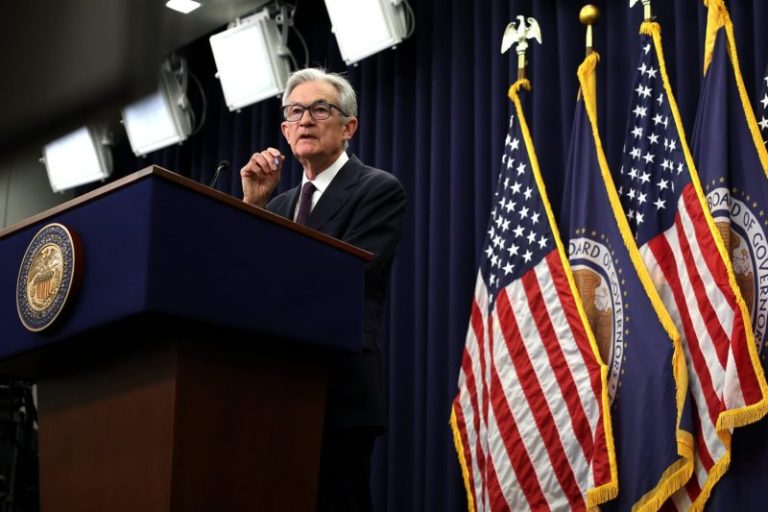
The Federal Reserve has brought in its inspector general to review a building expansion that has drawn fire from the White House, according to a source familiar with the issue.

Fed Chair Jerome Powell asked for the review, following blistering criticism of the project, initially pegged at $2.5 billion but hit by cost overruns that have brought accusations from President Donald Trump and other administration officials of “fundamental mismanagement.”

“The idea that the Fed could print money and then spend $2.5 billion on a building without real congressional oversight, it didn’t occur to the people that framed the Federal Reserve Act,” Kevin Hassett, director of the National Economic Council, said Monday on CNBC’s “Squawk Box.” “We’ve got a real problem of oversight and excess spending.”

The inspector general serves the Fed and the Consumer Financial Protection Bureau and is responsible for looking for fraud, waste and abuse. Powell’s request was reported first by Axios.

In a letter posted to social media last week, Russell Vought, head of the Office of Management and Budget, also slammed the project, which involves two of the Fed’s three Washington, D.C., buildings including its main headquarters known as the Eccles Building.

Vought, during a CNBC interview Friday, likened the building to the Palace of Versailles in France and charged that Powell was guilty of “fiscal mismanagement” at the Fed.

For its part, the central bank has posted a detailed frequently asked questions page on its site, highlighting key details and explaining why some of the specifications were changed or “scaled back or eliminated” at least in part due to higher-than-expected construction costs.

“The project also remediates safety issues by removing hazardous materials such as asbestos and lead and will bring the buildings up to modern code,” the page explains. “While periodic work has been done to keep the buildings occupiable, neither building has seen a comprehensive renovation since they were constructed.”

The Fed is not a taxpayer-funded institution and is therefore not under the OMB’s supervision. It has worked with the National Capital Planning Commission in Washington on the project, but also noted on the FAQ page that it “does not regard any of those changes as warranting further review.”

In separate comments, former Fed Governor Kevin Warsh, speaking Sunday on Fox News, called the renovation costs “outrageous” and said it was more evidence the central bank “has lost its way.” Warsh is considered a strong contender to succeed Powell when the latter’s term as chair expires in May 2026.

This post appeared first on NBC NEWS

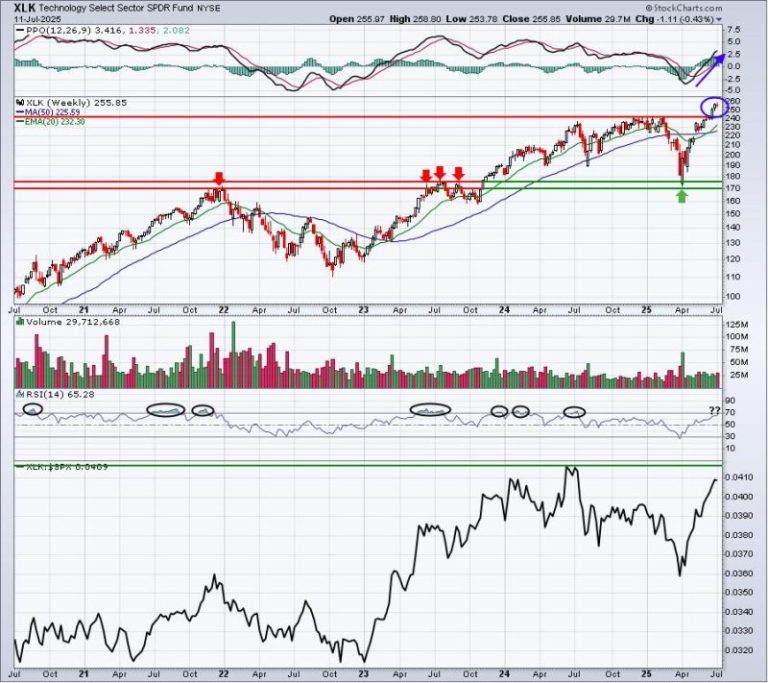
I remain very bullish and U.S. stocks have run hard to the upside off the April low with growth stocks leading the way. I expect growth stocks to remain strong throughout the summer months, as they historically do, but we need to recognize that they’ve already seen tremendous upside. Could technology (XLK) names, in particular, use a period of consolidation? Well, if we look at a 5-year weekly chart, the XLK really isn’t that overbought just yet:

The weekly PPO has crossed its centerline and is gaining bullish momentum. The recent price breakout suggests to me that we likely have further to run. And if you look at the weekly RSI, you’ll note that we’ve seen the weekly RSI move well into the 70s and even close to 80 before witnessing a market top or pause. Outside a bit of profit taking, I really don’t see the likelihood of a big selloff here. Keep in mind that the XLK represents 31% of the S&P 500. If the XLK doesn’t slow down, it’s very unlikely that we’ll see any type of meaningful decline in the S&P 500 either.

Growth vs. Value

Growth stocks have historically performed well over the summer months. One way to visualize this is to compare large-cap growth (IWF) to large-cap value (IWD) using a seasonality chart. Check this out:

The average monthly outperformance since 2013 is reflected at the bottom of each month’s column. If you add those numbers for May through August, you get +5.4%. If you add those numbers for the other 8 months combined, you get +0.6%. Clearly, large-cap growth has the tendency to outperform value from May through August. We’re in the growth “sweet spot” right now.

So Should We Lower Our Market Expectations?

I say absolutely not. Yes, we’ve run substantially higher off that April low, but I see more left in the tank. Will we see profit taking from time to time and could we see a period of consolidation? Sure. But I still believe that remaining on the sidelines is a big mistake as plenty of market upside remains. In fact, I see another somewhat forgotten asset class that’s poised to scorch 50% higher or more, possibly over the next 6 months. I’m investing in this area now, as I believe it’s in the early stages of a significant rally, and believe it would be prudent for you to take a look as well. For more information, simply CLICK HERE, provide your name and email address, and I’ll send you a video that explains exactly why I’m favoring this group right now!

Happy trading!

Tom

Here’s a quick recap of the crypto landscape for Friday (July 11) as of 9:00 p.m. UTC.

Get the latest insights on Bitcoin, Ethereum and altcoins, along with a round-up of key cryptocurrency market news.

Bitcoin and Ethereum price update

Bitcoin (BTC) was priced at US$118,036 at the end of the trading day, its highest valuation on Friday and a 4.1 percent increase in the last 24 hours. Earlier on Friday, Bitcoin saw a low of US$116,847.

Bitcoin price performance, July 11, 2025.

Chart via TradingView.

Bitcoin’s surge to a new all-time high of US$118,000 confirms a breakout above key resistance levels.

Glassnode confirms a US$4.4 billion increase in realized cap, indicating real capital inflows rather than just speculative trading. Based on data from the MVRV oscillator over the past four years, market analyst Axel Adler Jr. suggests that Bitcoin could reach approximately US$130,900 when the MVRV ratio hits 2.75, a level historically linked to profit taking and distribution. This would mark a 17 percent increase from current prices.

Some analysts have upside targets as high as US$150,000 in the weeks ahead.

The popular cryptocurrency’s rise came as investors cheered bipartisan US Senate passage of the GENIUS Act — a bill that would establish regulatory guardrails for stablecoins. The act would codify requirements for fiat-pegged stablecoins, offering investor protections while legitimizing the sector in the eyes of institutional capital.

Optimism was also supported by a softer US dollar and the Trump administration’s crypto-friendliness.

Bitcoin exchange-traded funds tracking Bitcoin have posted record volumes, drawing billions in net inflows.

Ethereum (ETH) was priced at US$3,001.99, up by 6.6 percent over the past 24 hours and just shy of an earlier peak of US$3,003.01. Its lowest valuation on Friday was US$2,593.05. ETH’s recent breakout is supported by bullish indicators suggesting a potential rally to US$3,400 if it can overcome resistance levels.

Altcoin price update

  • Solana (SOL) was priced at US$164.25, up by 3.1 percent over 24 hours. Its lowest valuation on Friday was US$162.25, and its highest was US$167.55.
  • XRP was trading for US$2.85, up 13.9 percent in the past 24 hours. The cryptocurrency’s lowest valuation was US$2.69 as the markets opened, and its highest was US$2.91.
  • Sui (SUI) is trading at US$3.51, up by 2.7 percent over the past 24 hours. Its lowest valuation was US$3.45, and its highest was US$3.56.
  • Cardano (ADA) is priced at US$0.7419, up by 13.7 percent in the last 24 hours. Its lowest valuation on Friday was US$0.7281, and its highest was US$0.7721.

Today’s crypto news to know

Ties between Trump coin and Binance under scrutiny

According to a Friday Bloomberg report citing three people familiar with the matter, cryptocurrency exchange Binance helped write the code behind USD1, the stablecoin issued by World Liberty Financial.

World Liberty Financial is one of the crypto businesses tied to US President Donald Trump and his family.

The report cites Abu Dhabi-based investment firm MGX’s announcement of a US$2 billion investment in Binance on March 12 using a then-unnamed stablecoin. Later, in May, co-founder Eric Trump said that the company would settle the investment using USD1, which was minted on the BNB chain on March 24.

The report found that 90 percent of the USD1 coins used in that transaction were still in Binance’s wallets as of Friday, where they are potentially generating tens of millions of dollars in interest for Trump and his family.

The report comes with three stablecoin bills poised for Congressional hearings and votes next week. Members of Congress have been divided over certain aspects of the legislation, with Trump’s financial ties to the industry a topic of scrutiny across the political spectrum and among various stakeholders in the financial and crypto communities.

Changpeng Zhao, former CEO of Binance, served four months in federal prison after pleading guilty to one felony count of violating anti-money laundering laws as part of a settlement with US authorities in 2023.

In May, Zhao said he was seeking a presidential pardon from Trump. In response to the new report, Zhao denied Binance’s involvement with World Liberty Financial, as well as the purchase of any World Liberty Financial coins.

Trump-linked $WLFI token gets US$100 million buy from anonymous entity

A little-known group called Aqua 1 Foundation became the largest public investor in World Liberty Financial’s crypto token $WLFI, buying US$100 million worth of the token in late June.

According to Reuters, though the foundation says it is based in the United Arab Emirates, public records offer no clarity on the group’s financial backers or its supposed founder Dave Lee.

The token purchase directly benefits the Trump family, which reportedly receives 75 percent of all $WLFI proceeds; the family’s estimated crypto earnings have now topped US$500 million.

While Aqua 1 said in a brief statement it was backed by ‘mission-aligned partners,’ it declined to offer transparency on its structure, citing privacy. US ethics experts have raised concerns over potential conflicts of interest, despite the White House stating Trump’s assets are in a trust managed by his children.

World Liberty and Trump Media & Technology Group (NASDAQ:DJT) did not respond to press inquiries.

HIVE Digital shares pop on new milestone

Hive Digital Technologies (TSXV:HIVE,NASDAQ:HIVE) opened higher on Friday after the company announced a milestone hashrate of 12 exahashes per second (EH/s), effectively doubling its output since the beginning of the year.

The company anticipates further scaling its operations to achieve 18 EH/s.

This increase in hashrate is already generating over US$250 million in annualized revenue for HIVE Digital. Projections indicate this figure could rise to US$400 million once the 18 EH/s hashrate is achieved.

“We’re building high-performance campuses at hyper speed, turning Paraguay into a global hub for sustainable Bitcoin mining data centers and laying the groundwork for the AI data center era now soaring,” said Frank Holmes, co-founder and executive chair of HIVE, in a press release.

HIVE’s rapidly expanding operations in Paraguay, a region strategically chosen for its abundant and affordable hydroelectric power, are a major driver of its growth and a focal point for the company’s future.

Beyond the technological advancements and production increases, the company is also committed to making a difference in the local communities. “We’re not just building data centers — we’re creating economic opportunity, delivering social impact by lighting the streets of Valenzuela at night and installing air conditioning in local grade schools, and developing digital infrastructure on a scale few thought possible,” said Gabriel Lamas, HIVE’s country president.

EU regulator warns crypto firms over misleading investors

The European Securities and Markets Authority (ESMA) warned crypto platforms against blurring the distinction between regulated and unregulated products under MiCA, the EU’s new crypto framework.

ESMA said many crypto firms are offering both compliant and non-compliant services on the same platform, creating investor confusion and undermining MiCA’s consumer protections. Under MiCA, only firms licensed as crypto asset service providers are allowed to market specific financial products across the EU.

However, direct investments in commodities or crypto lending still fall outside the scope of those protections. ESMA also criticized some firms for using their regulated status as a marketing tactic to legitimize riskier services.

Securities Disclosure: I, Giann Liguid, hold no direct investment interest in any company mentioned in this article.

Securities Disclosure: I, Meagen Seatter, hold no direct investment interest in any company mentioned in this article.

This post appeared first on investingnews.com

The US Department of Defense (DoD) will become the largest shareholder in MP Materials (NYSE:MP) after agreeing to purchase US$400 million worth of preferred stock in the company.

MP Materials is known for owning and operating the only US rare earths mine.

The rare earths producer said the proceeds from the investment will fund the expansion of its processing capabilities at the Mountain Pass mine in California and support the construction of a second magnet manufacturing facility in the US.

The materials mined and processed by MP Materials are critical to the production of permanent magnets used in military systems, including the F-35 fighter jet, drones, and submarines.

The US has depended heavily on foreign imports for these materials — primarily from China, which accounted for about 70 percent of rare earth imports in 2023, according to the US Geological Survey.

In a press release issued on Thursday (July 10), MP Materials described the agreement as a ‘transformational public-private partnership.’ The company also said the deal will ‘dramatically accelerate the build-out of an end-to-end US rare earth magnet supply chain and reduce foreign dependency.’

The investment gives the Pentagon newly created preferred stock convertible into common shares, along with a 10-year warrant to buy additional stock at US$30.03 per share. If fully converted and exercised, the DoD would own 15 percent of MP Materials, based on current share counts as of Wednesday (July 9). That would exceed the 8.61 percent stake held by CEO James Litinsky and the 8.27 percent stake held by BlackRock Fund Advisors.

Litinsky emphasized that the deal does not equate to government control of the company. “This is not a nationalization,” he told CNBC. “We remain a thriving public company. We now have a great new partner in our economically largest shareholder, DoD, but we still control our company. We control our destiny. We’re shareholder driven.”

MP’s new magnet facility, called 10X, will increase the company’s magnet manufacturing capacity to 10,000 metric tons annually once it begins commissioning in 2028. The exact location of the facility has not yet been disclosed.

The Pentagon has committed to purchasing 100 percent of the magnets produced at the 10X facility for 10 years.

Additionally, the DoD will guarantee a minimum price of US$110 per kilogram for MP’s neodymium-praseodymium oxide, a key material for magnet production.

If market prices fall below that level, the Pentagon will pay the difference quarterly. In return, once the new facility is operational, the government will receive 30 percent of any upside above US$110 per kilogram.

To further support the buildout, MP Materials expects to receive a US$150 million loan from the Pentagon within 30 days to expand its heavy rare earth separation capabilities at Mountain Pass, the only active rare earth mine in the US.

It is also commissioning a magnetics facility in Texas, known as Independence, to bolster its downstream processing capabilities.

As the only domestic miner with vertically integrated capabilities and a clear path to rare earth magnet production at scale, MP Materials now sits at the center of the Biden-to-Trump era effort to bring critical minerals supply chains back to American soil.

Securities Disclosure: I, Giann Liguid, hold no direct investment interest in any company mentioned in this article.

This post appeared first on investingnews.com