Author

admin

Browsing

Adrian Day, president of Adrian Day Asset Management, shares his latest thoughts on gold.

He also discusses the opportunity in gold stocks, saying that while as a group they’re up 55 percent in last year, valuation metrics are lower than they were two years ago.

Securities Disclosure: I, Charlotte McLeod, hold no direct investment interest in any company mentioned in this article.

This post appeared first on investingnews.com

Has silver’s moment finally arrived?

Precious metals analyst Ted Butler believes the answer is ‘yes.’

‘I think this is the moment, because we broke through technically what was a really important level — that US$35, US$36 (per ounce) level,’ he said. He sees a clear path for silver to outperform gold.

Securities Disclosure: I, Charlotte McLeod, hold no direct investment interest in any company mentioned in this article.

This post appeared first on investingnews.com

Mani Alkhafaji, vice president of corporate of development and investor relations at First Majestic Silver (TSX:AG,NYSE:AG) discusses silver’s recent price rise.

He notes that the gold-silver mining ratio is at seven to one, while the price ratio is at 90 to one.

‘That tells us silver needs to play catch up to collapse that ratio,’ he said.

Securities Disclosure: I, Charlotte McLeod, hold no direct investment interest in any company mentioned in this article.

This post appeared first on investingnews.com

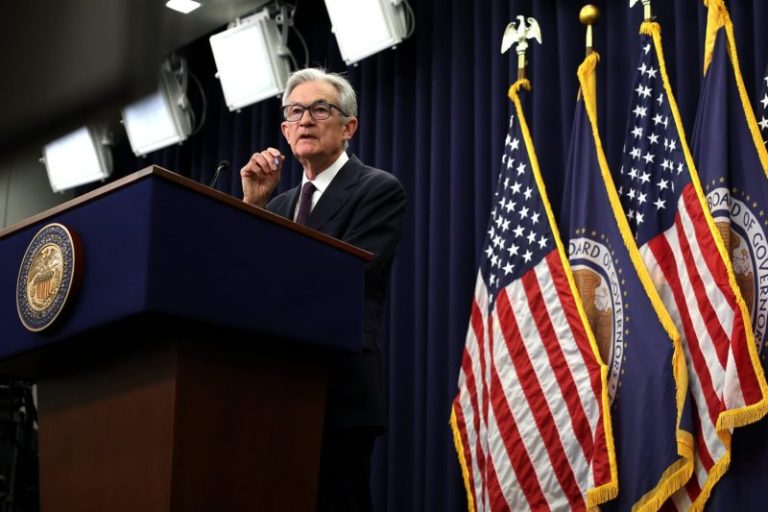
The Federal Reserve has brought in its inspector general to review a building expansion that has drawn fire from the White House, according to a source familiar with the issue.

Fed Chair Jerome Powell asked for the review, following blistering criticism of the project, initially pegged at $2.5 billion but hit by cost overruns that have brought accusations from President Donald Trump and other administration officials of “fundamental mismanagement.”

“The idea that the Fed could print money and then spend $2.5 billion on a building without real congressional oversight, it didn’t occur to the people that framed the Federal Reserve Act,” Kevin Hassett, director of the National Economic Council, said Monday on CNBC’s “Squawk Box.” “We’ve got a real problem of oversight and excess spending.”

The inspector general serves the Fed and the Consumer Financial Protection Bureau and is responsible for looking for fraud, waste and abuse. Powell’s request was reported first by Axios.

In a letter posted to social media last week, Russell Vought, head of the Office of Management and Budget, also slammed the project, which involves two of the Fed’s three Washington, D.C., buildings including its main headquarters known as the Eccles Building.

Vought, during a CNBC interview Friday, likened the building to the Palace of Versailles in France and charged that Powell was guilty of “fiscal mismanagement” at the Fed.

For its part, the central bank has posted a detailed frequently asked questions page on its site, highlighting key details and explaining why some of the specifications were changed or “scaled back or eliminated” at least in part due to higher-than-expected construction costs.

“The project also remediates safety issues by removing hazardous materials such as asbestos and lead and will bring the buildings up to modern code,” the page explains. “While periodic work has been done to keep the buildings occupiable, neither building has seen a comprehensive renovation since they were constructed.”

The Fed is not a taxpayer-funded institution and is therefore not under the OMB’s supervision. It has worked with the National Capital Planning Commission in Washington on the project, but also noted on the FAQ page that it “does not regard any of those changes as warranting further review.”

In separate comments, former Fed Governor Kevin Warsh, speaking Sunday on Fox News, called the renovation costs “outrageous” and said it was more evidence the central bank “has lost its way.” Warsh is considered a strong contender to succeed Powell when the latter’s term as chair expires in May 2026.

This post appeared first on NBC NEWS

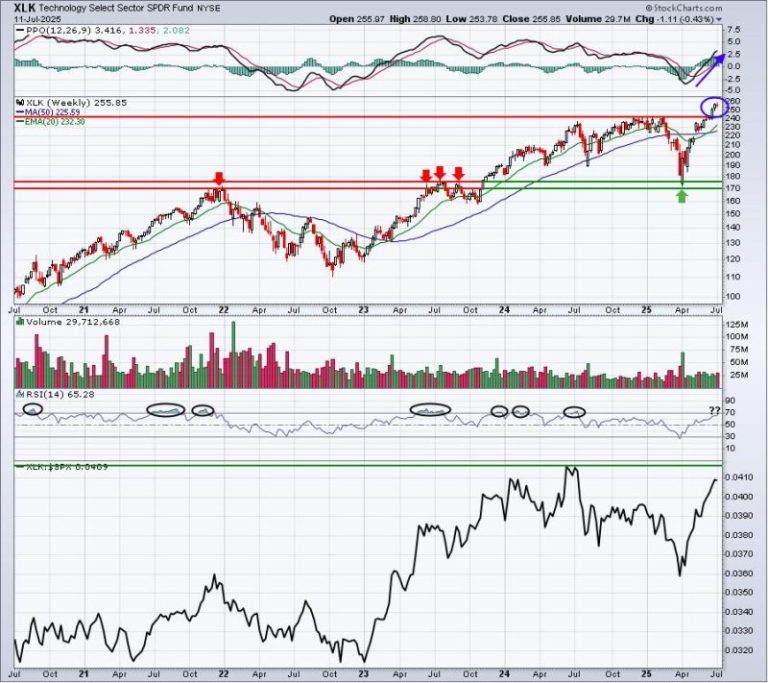
I remain very bullish and U.S. stocks have run hard to the upside off the April low with growth stocks leading the way. I expect growth stocks to remain strong throughout the summer months, as they historically do, but we need to recognize that they’ve already seen tremendous upside. Could technology (XLK) names, in particular, use a period of consolidation? Well, if we look at a 5-year weekly chart, the XLK really isn’t that overbought just yet:

The weekly PPO has crossed its centerline and is gaining bullish momentum. The recent price breakout suggests to me that we likely have further to run. And if you look at the weekly RSI, you’ll note that we’ve seen the weekly RSI move well into the 70s and even close to 80 before witnessing a market top or pause. Outside a bit of profit taking, I really don’t see the likelihood of a big selloff here. Keep in mind that the XLK represents 31% of the S&P 500. If the XLK doesn’t slow down, it’s very unlikely that we’ll see any type of meaningful decline in the S&P 500 either.

Growth vs. Value

Growth stocks have historically performed well over the summer months. One way to visualize this is to compare large-cap growth (IWF) to large-cap value (IWD) using a seasonality chart. Check this out:

The average monthly outperformance since 2013 is reflected at the bottom of each month’s column. If you add those numbers for May through August, you get +5.4%. If you add those numbers for the other 8 months combined, you get +0.6%. Clearly, large-cap growth has the tendency to outperform value from May through August. We’re in the growth “sweet spot” right now.

So Should We Lower Our Market Expectations?

I say absolutely not. Yes, we’ve run substantially higher off that April low, but I see more left in the tank. Will we see profit taking from time to time and could we see a period of consolidation? Sure. But I still believe that remaining on the sidelines is a big mistake as plenty of market upside remains. In fact, I see another somewhat forgotten asset class that’s poised to scorch 50% higher or more, possibly over the next 6 months. I’m investing in this area now, as I believe it’s in the early stages of a significant rally, and believe it would be prudent for you to take a look as well. For more information, simply CLICK HERE, provide your name and email address, and I’ll send you a video that explains exactly why I’m favoring this group right now!

Happy trading!

Tom


(TheNewswire)


TORONTO, ON TheNewswire – July 14 2025 –Silver Crown Royalties Inc. (‘Silver Crown’, ‘SCRi’, the ‘Corporation’, or the ‘Company’) (Cboe:SCRI,OTC:SLCRF; OTCQX:SLCRF; FRA:QS0) is pleased to announce that the Company has successfully closed the final tranche (‘Final Tranche’) of its non-brokered offering of units (‘Units’) that was previously announced on May 20, 2025 (the ‘Offering’) and issued 132,693 Units at a price of C$6.50 per Unit, for gross proceeds of approximately C$862,505.50.


  Each Unit consists of one common share (‘Common Share’) and one Common Share purchase warrant (‘Warrant’), with each Warrant exercisable to acquire one additional Common Share at an exercise price of C$13.00 for a period of three years from the closing date. A total of 235,531Units were issued in accordance with the Offering for cumulative gross proceeds of C$1,530,951.50.  


  The proceeds from the Final Tranche will be used to fund the Company’s silver royalty acquisition on the Igor 4 project in Peru, as well as general and administrative expenses. All securities issued are subject to a statutory hold period of four months plus one day from the date of issuance, in accordance with applicable securities legislation. The closing was subject to customary conditions, including the approval of Cboe Canada Inc.  


  ABOUT Silver Crown Royalties INC.  


  Founded by industry veterans, Silver Crown Royalties (   Cboe:   SCRI |   OTCQX:   SLCRF |   BF:   QS0   ) is a publicly traded, silver royalty company. Silver Crown (SCRi) currently has four silver royalties of which three are revenue-generating. Its business model presents investors with precious metals exposure that allows for a natural hedge against currency devaluation while minimizing the negative impact of cost inflation associated with production. SCRi endeavors to minimize the economic impact on mining projects while maximizing returns for shareholders.   For further information, please contact:  


  Silver Crown Royalties Inc.  


  Peter Bures, Chairman and CEO  


  Telephone: (416) 481-1744  


  Email:   pbures@silvercrownroyalties.com  


  FORWARD-LOOKING STATEMENTS  


  This release contains certain ‘forward looking statements’ and certain ‘forward-looking information’ as defined under applicable Canadian and U.S. securities laws. Forward-looking statements and information can generally be identified by the use of forward-looking terminology such as ‘may’, ‘will’, ‘should’, ‘expect’, ‘intend’, ‘estimate’, ‘anticipate’, ‘believe’, ‘continue’, ‘plans’ or similar terminology. The forward-looking information contained herein is provided for the purpose of assisting readers in understanding management’s current expectations and plans relating to the future. Readers are cautioned that such information may not be appropriate for other purposes. Forward-looking statements and information include, but are not limited to, SCRi anticipates that Elk Gold will pay this residual amount owing on or before March 31, 2025. Forward-looking statements and information are based on forecasts of future results, estimates of amounts not yet determinable and assumptions that, while believed by management to be reasonable, are inherently subject to significant business, economic and competitive uncertainties and contingencies. Forward-looking information is subject to known and unknown risks, uncertainties and other factors that may cause the actual actions, events or results to be materially different from those expressed or implied by such forward-looking information, including but not limited to: the impact of general business and economic conditions; the absence of control over mining operations from which SCRi will purchase gold and other metals or from which it will receive royalty payments and risks related to those mining operations, including risks related to international operations, government and environmental regulation, delays in mine construction and operations, actual results of mining and current exploration activities, conclusions of economic evaluations and changes in project parameters as plans continue to be refined; accidents, equipment breakdowns, title matters, labor disputes or other unanticipated difficulties or interruptions in operations; SCRi’s ability to enter into definitive agreements and close proposed royalty transactions; the inherent uncertainties related to the valuations ascribed by SCRi to its royalty interests; problems inherent to the marketability of gold and other metals; the inherent uncertainty of production and cost estimates and the potential for unexpected costs and expenses; industry conditions, including fluctuations in the price of the primary commodities mined at such operations, fluctuations in foreign exchange rates and fluctuations in interest rates; government entities interpreting existing tax legislation or enacting new tax legislation in a way which adversely affects SCRi; stock market volatility; regulatory restrictions; liability, competition, the potential impact of epidemics, pandemics or other public health crises on SCRi’s business, operations and financial condition, loss of key employees. SCRi has attempted to identify important factors that could cause actual results to differ materially from those contained in forward-looking statements, there may be other factors that cause results not to be as anticipated, estimated or intended. There can be no assurance that such statements will prove to be accurate, as actual results and future events could differ materially from those anticipated in such statements. Accordingly, readers are advised not to place undue reliance on forward-looking statements or information. SCRi undertakes no obligation to update forward-looking information except as required by applicable law. Such forward-looking information represents management’s best judgment based on information currently available.  


  This document does not constitute an offer to sell, or a solicitation of an offer to buy, securities of the Company in Canada, the United States   or any other jurisdiction. Any such offer to sell or solicitation of an offer to buy the securities described herein will be made only pursuant to subscription documentation between the Company and prospective purchasers. Any such offering will be made in reliance upon exemptions from the prospectus and registration requirements under applicable securities laws, pursuant to a subscription agreement to be entered into by the Company and prospective investors. There can be no assurance that forward-looking statements will prove to be accurate, as actual results and future events could differ materially from those anticipated in such statements. Accordingly, the reader is cautioned not to place undue reliance on forward-looking statements.  


  CBOE CANADA DOES NOT ACCEPT RESPONSIBILITY FOR THE ADEQUACY OR ACCURACY OF THIS NEWS RELEASE.  


Copyright (c) 2025 TheNewswire – All rights reserved.


News Provided by TheNewsWire via QuoteMedia

This post appeared first on investingnews.com

Here’s a quick recap of the crypto landscape for Friday (July 11) as of 9:00 p.m. UTC.

Get the latest insights on Bitcoin, Ethereum and altcoins, along with a round-up of key cryptocurrency market news.

Bitcoin and Ethereum price update

Bitcoin (BTC) was priced at US$118,036 at the end of the trading day, its highest valuation on Friday and a 4.1 percent increase in the last 24 hours. Earlier on Friday, Bitcoin saw a low of US$116,847.

Bitcoin price performance, July 11, 2025.

Chart via TradingView.

Bitcoin’s surge to a new all-time high of US$118,000 confirms a breakout above key resistance levels.

Glassnode confirms a US$4.4 billion increase in realized cap, indicating real capital inflows rather than just speculative trading. Based on data from the MVRV oscillator over the past four years, market analyst Axel Adler Jr. suggests that Bitcoin could reach approximately US$130,900 when the MVRV ratio hits 2.75, a level historically linked to profit taking and distribution. This would mark a 17 percent increase from current prices.

Some analysts have upside targets as high as US$150,000 in the weeks ahead.

The popular cryptocurrency’s rise came as investors cheered bipartisan US Senate passage of the GENIUS Act — a bill that would establish regulatory guardrails for stablecoins. The act would codify requirements for fiat-pegged stablecoins, offering investor protections while legitimizing the sector in the eyes of institutional capital.

Optimism was also supported by a softer US dollar and the Trump administration’s crypto-friendliness.

Bitcoin exchange-traded funds tracking Bitcoin have posted record volumes, drawing billions in net inflows.

Ethereum (ETH) was priced at US$3,001.99, up by 6.6 percent over the past 24 hours and just shy of an earlier peak of US$3,003.01. Its lowest valuation on Friday was US$2,593.05. ETH’s recent breakout is supported by bullish indicators suggesting a potential rally to US$3,400 if it can overcome resistance levels.

Altcoin price update

  • Solana (SOL) was priced at US$164.25, up by 3.1 percent over 24 hours. Its lowest valuation on Friday was US$162.25, and its highest was US$167.55.
  • XRP was trading for US$2.85, up 13.9 percent in the past 24 hours. The cryptocurrency’s lowest valuation was US$2.69 as the markets opened, and its highest was US$2.91.
  • Sui (SUI) is trading at US$3.51, up by 2.7 percent over the past 24 hours. Its lowest valuation was US$3.45, and its highest was US$3.56.
  • Cardano (ADA) is priced at US$0.7419, up by 13.7 percent in the last 24 hours. Its lowest valuation on Friday was US$0.7281, and its highest was US$0.7721.

Today’s crypto news to know

Ties between Trump coin and Binance under scrutiny

According to a Friday Bloomberg report citing three people familiar with the matter, cryptocurrency exchange Binance helped write the code behind USD1, the stablecoin issued by World Liberty Financial.

World Liberty Financial is one of the crypto businesses tied to US President Donald Trump and his family.

The report cites Abu Dhabi-based investment firm MGX’s announcement of a US$2 billion investment in Binance on March 12 using a then-unnamed stablecoin. Later, in May, co-founder Eric Trump said that the company would settle the investment using USD1, which was minted on the BNB chain on March 24.

The report found that 90 percent of the USD1 coins used in that transaction were still in Binance’s wallets as of Friday, where they are potentially generating tens of millions of dollars in interest for Trump and his family.

The report comes with three stablecoin bills poised for Congressional hearings and votes next week. Members of Congress have been divided over certain aspects of the legislation, with Trump’s financial ties to the industry a topic of scrutiny across the political spectrum and among various stakeholders in the financial and crypto communities.

Changpeng Zhao, former CEO of Binance, served four months in federal prison after pleading guilty to one felony count of violating anti-money laundering laws as part of a settlement with US authorities in 2023.

In May, Zhao said he was seeking a presidential pardon from Trump. In response to the new report, Zhao denied Binance’s involvement with World Liberty Financial, as well as the purchase of any World Liberty Financial coins.

Trump-linked $WLFI token gets US$100 million buy from anonymous entity

A little-known group called Aqua 1 Foundation became the largest public investor in World Liberty Financial’s crypto token $WLFI, buying US$100 million worth of the token in late June.

According to Reuters, though the foundation says it is based in the United Arab Emirates, public records offer no clarity on the group’s financial backers or its supposed founder Dave Lee.

The token purchase directly benefits the Trump family, which reportedly receives 75 percent of all $WLFI proceeds; the family’s estimated crypto earnings have now topped US$500 million.

While Aqua 1 said in a brief statement it was backed by ‘mission-aligned partners,’ it declined to offer transparency on its structure, citing privacy. US ethics experts have raised concerns over potential conflicts of interest, despite the White House stating Trump’s assets are in a trust managed by his children.

World Liberty and Trump Media & Technology Group (NASDAQ:DJT) did not respond to press inquiries.

HIVE Digital shares pop on new milestone

Hive Digital Technologies (TSXV:HIVE,NASDAQ:HIVE) opened higher on Friday after the company announced a milestone hashrate of 12 exahashes per second (EH/s), effectively doubling its output since the beginning of the year.

The company anticipates further scaling its operations to achieve 18 EH/s.

This increase in hashrate is already generating over US$250 million in annualized revenue for HIVE Digital. Projections indicate this figure could rise to US$400 million once the 18 EH/s hashrate is achieved.

“We’re building high-performance campuses at hyper speed, turning Paraguay into a global hub for sustainable Bitcoin mining data centers and laying the groundwork for the AI data center era now soaring,” said Frank Holmes, co-founder and executive chair of HIVE, in a press release.

HIVE’s rapidly expanding operations in Paraguay, a region strategically chosen for its abundant and affordable hydroelectric power, are a major driver of its growth and a focal point for the company’s future.

Beyond the technological advancements and production increases, the company is also committed to making a difference in the local communities. “We’re not just building data centers — we’re creating economic opportunity, delivering social impact by lighting the streets of Valenzuela at night and installing air conditioning in local grade schools, and developing digital infrastructure on a scale few thought possible,” said Gabriel Lamas, HIVE’s country president.

EU regulator warns crypto firms over misleading investors

The European Securities and Markets Authority (ESMA) warned crypto platforms against blurring the distinction between regulated and unregulated products under MiCA, the EU’s new crypto framework.

ESMA said many crypto firms are offering both compliant and non-compliant services on the same platform, creating investor confusion and undermining MiCA’s consumer protections. Under MiCA, only firms licensed as crypto asset service providers are allowed to market specific financial products across the EU.

However, direct investments in commodities or crypto lending still fall outside the scope of those protections. ESMA also criticized some firms for using their regulated status as a marketing tactic to legitimize riskier services.

Securities Disclosure: I, Giann Liguid, hold no direct investment interest in any company mentioned in this article.

Securities Disclosure: I, Meagen Seatter, hold no direct investment interest in any company mentioned in this article.

This post appeared first on investingnews.com

The US Department of Defense (DoD) will become the largest shareholder in MP Materials (NYSE:MP) after agreeing to purchase US$400 million worth of preferred stock in the company.

MP Materials is known for owning and operating the only US rare earths mine.

The rare earths producer said the proceeds from the investment will fund the expansion of its processing capabilities at the Mountain Pass mine in California and support the construction of a second magnet manufacturing facility in the US.

The materials mined and processed by MP Materials are critical to the production of permanent magnets used in military systems, including the F-35 fighter jet, drones, and submarines.

The US has depended heavily on foreign imports for these materials — primarily from China, which accounted for about 70 percent of rare earth imports in 2023, according to the US Geological Survey.

In a press release issued on Thursday (July 10), MP Materials described the agreement as a ‘transformational public-private partnership.’ The company also said the deal will ‘dramatically accelerate the build-out of an end-to-end US rare earth magnet supply chain and reduce foreign dependency.’

The investment gives the Pentagon newly created preferred stock convertible into common shares, along with a 10-year warrant to buy additional stock at US$30.03 per share. If fully converted and exercised, the DoD would own 15 percent of MP Materials, based on current share counts as of Wednesday (July 9). That would exceed the 8.61 percent stake held by CEO James Litinsky and the 8.27 percent stake held by BlackRock Fund Advisors.

Litinsky emphasized that the deal does not equate to government control of the company. “This is not a nationalization,” he told CNBC. “We remain a thriving public company. We now have a great new partner in our economically largest shareholder, DoD, but we still control our company. We control our destiny. We’re shareholder driven.”

MP’s new magnet facility, called 10X, will increase the company’s magnet manufacturing capacity to 10,000 metric tons annually once it begins commissioning in 2028. The exact location of the facility has not yet been disclosed.

The Pentagon has committed to purchasing 100 percent of the magnets produced at the 10X facility for 10 years.

Additionally, the DoD will guarantee a minimum price of US$110 per kilogram for MP’s neodymium-praseodymium oxide, a key material for magnet production.

If market prices fall below that level, the Pentagon will pay the difference quarterly. In return, once the new facility is operational, the government will receive 30 percent of any upside above US$110 per kilogram.

To further support the buildout, MP Materials expects to receive a US$150 million loan from the Pentagon within 30 days to expand its heavy rare earth separation capabilities at Mountain Pass, the only active rare earth mine in the US.

It is also commissioning a magnetics facility in Texas, known as Independence, to bolster its downstream processing capabilities.

As the only domestic miner with vertically integrated capabilities and a clear path to rare earth magnet production at scale, MP Materials now sits at the center of the Biden-to-Trump era effort to bring critical minerals supply chains back to American soil.

Securities Disclosure: I, Giann Liguid, hold no direct investment interest in any company mentioned in this article.

This post appeared first on investingnews.com

Here’s a quick recap of the crypto landscape for Wednesday (July 9) as of 9:00 p.m. UTC.

Get the latest insights on Bitcoin, Ethereum and altcoins, along with a round-up of key cryptocurrency market news.

Bitcoin and Ethereum price update

Bitcoin’s (BTC) price peaked at US$111,744 as the market wrapped, a 2.7 percent increase in the last 24 hours. The day’s range for the cryptocurrency also brought a low of US$108,644.

Crypto analyst TradingShot believes Bitcoin may not experience another rally this cycle, despite projections exceeding US$160,000. This assessment is based on Bitcoin’s historical four year patterns.

According to TradingShot, Bitcoin has not broken out of its current upward channel to trigger the explosive rallies seen in 2017 and 2021. If the four year cycle holds, time is running out for such a breakout.

Ethereum (ETH) is priced at US$2,772.50, up by 6.3 percent over the past 24 hours. On Wednesday, the cryptocurrency hit a low of US$2,635.74 before rallying to finish the day at its peak, mirroring a broader market trend.

Altcoin price update

Bitcoin price performance, July 9, 2025.

Chart via TradingView.

  • Solana (SOL) was priced at US$157.12, up by 3.7 percent over 24 hours. Its lowest valuation as of Wednesday was US$153.45.
  • XRP was trading for US$2.42, up 4.5 percent in the past 24 hours. The cryptocurrency’s lowest valuation was US$2.36
  • Sui (SUI) was trading at US$3.05, up by 4.9 percent over the past 24 hours. Its lowest valuation was US$2.93.
  • Cardano (ADA) is priced at US$0.6217, up by 5.6 percent in the last 24 hours. Its lowest valuation as of Wednesday was US$0.6027

Today’s crypto news to know

US Senate committee gathers for hearing on digital assets

The US Senate Banking Committee held a hearing on Wednesday dubbed ‘From Wall Street to Web3’ to discuss proposed legislation regarding digital assets, including the Clarity Act.

Massachusetts Democrat Elizabeth Warren, a longtime crypto critic, said she is in favor of laws regulating digital assets that strengthen the financial system in the US, but criticized aspects of the Clarity Act that she said would allow non-crypto companies to “put their stocks on the blockchain,’ evading US Securities and Exchange Commission guidelines.

“That is a serious problem for our country,” she warned.

Ahead of the hearing, Warren sent a statement to analytical publication the Block, accusing Republicans of enabling “industry handouts” to crypto lobbyists. Other vocal critics of the bill include New York Attorney General Letitia James and the ranking member of the House Financial Services Committee Maxine Waters.

Both she and Warren have questioned the ethics of US President Donald Trump’s business ties to the industry. At the hearing, former chief White House ethics lawyer Richard Painter, who was invited to speak by Warren, said:

“We cannot have the people who are in charge of passing legislation and enforcing legislation, implementing legislation, have conflicts of interest with their official responsibilities. You should be divesting from crypto if you’re going to be regulating crypto.”

Lawmakers are now facing a September 30 deadline to define cryptocurrencies, address Trump’s crypto interests and finalize industry rules.

RLUSD gains traction via Transak integration and BNY Mellon custody

Transak, a Web3 onboarding infrastructure provider allowing users to buy and sell digital assets using traditional payment methods, officially integrated Ripple’s US-dollar pegged stablecoin, RLUSD.

The move expands the token’s reach to 8.3 million additional users across 64 countries.

“Transak has always strived to make finance truly accessible and that includes bringing on assets like RLUSD that balance blockchain ethos with compliance requirements,” said Sami Start, CEO and co-founder of Transak.

“With this integration, users gain access to one of the most thoughtfully designed stablecoins in the market, now available through a seamless and trusted fiat-to-crypto experience.”

The news was announced the same day Ripple chose Bank of New York Mellon to custody its USD reserves. This move by a traditional financial giant lends significant institutional credibility to Ripple’s stablecoin, which was built as an enterprise-grade stablecoin to improve the efficiency of cross-border transactions.

“As primary custodian for RLUSD, we’re proud to support the growth of digital assets by providing a differentiated platform, designed to meet the evolving needs of institutions in the digital assets ecosystem,” said Emily Portney, global head of asset servicing at Bank of New York Mellon.

South Korea to reclassify crypto businesses as venture companies

South Korea’s Ministry of SMEs and Startups announced Wednesday that it will lift current restrictions preventing crypto-related businesses from qualifying as venture companies. Firms in the virtual asset sector are currently restricted in their eligibility for various tax breaks and financial support due to crypto regulations implemented last year.

However, the minister said that the proposed amendment reflects “a shift in perception” regarding the industry.

“It is expected that the virtual asset business operators based on new technologies with innovation and business viability will be newly recognized as venture companies, and existing venture companies will also be able to promote virtual asset-related businesses,” the statement explains, “which will lead to the activation and expansion of the venture ecosystem and promote the fostering of the virtual asset industry.”

This change will be supported by the establishment of “legal and institutional safeguards” designed to protect users. Public comments on the proposal will be accepted by the ministry until August 18.

Tether reveals it holds US$8 billion in gold in private Swiss vault

Tether, the issuer behind the world’s largest stablecoin, USDT, has disclosed it holds nearly 80 metric tons of gold worth US$8 billion in a private Swiss vault, according to a Bloomberg report.

The company, which manages over US$159 billion in circulating stablecoins, says most of the gold is directly owned by Tether, making it one of the world’s largest private gold holders outside of sovereign institutions.

CEO Paolo Ardoino confirmed the gold is stored in a highly secure location in Switzerland, though he declined to disclose the exact facility for safety reasons.

The firm also operates a gold-backed token called XAUT, with each coin redeemable for one ounce of physical gold.

Tether’s increasing exposure to gold comes amid rising demand for safe-haven assets and ongoing concerns about US debt sustainability. However, new regulations in the US and EU may force the company to divest gold from USDT’s reserves if it seeks formal approval in those markets.

Trump Media files for Crypto Blue Chip ETF

Trump Media & Technology Group (NASDAQ:DJT) has filed to launch its third crypto-focused exchange-traded fund (ETF) under the Truth Social brand. Called the “Crypto Blue Chip ETF,’ the fund will aim to allocate 70 percent to Bitcoin, 15 percent to Ether and the remainder to Solana, Cronos and XRP.

This marks the latest move by the Trump-affiliated media company to expand its crypto investment footprint following two prior filings focused more narrowly on Bitcoin and Ether.

The ETF is set to trade on NYSE Arca, and is being developed in partnership with Crypto.com.

The company had earlier disclosed plans to raise US$2.5 billion to directly acquire Bitcoin. While Trump Media shares rose nearly 3 percent on the day of the announcement, it remains down over 40 percent year-to-date.

Sequans soars 43 percent on Bitcoin treasury strategy

Chipmaker Sequans Communications (NYSE:SQNS) saw its share price jump 43 percent after announcing a major pivot to a Bitcoin-based treasury reserve strategy. The firm raised US$384 million through equity and debt instruments to begin acquiring Bitcoin as a long-term corporate asset, emphasizing Bitcoin’s scarcity and independence from central banks as reasons behind the move and its potential to strengthen the company’s financial footing.

More than 40 institutional investors backed the fundraising, including convertible debentures and warrants that could bring in another US$57 million. The company plans to allocate future cash flows toward Bitcoin purchases.

Securities Disclosure: I, Giann Liguid, hold no direct investment interest in any company mentioned in this article.

Securities Disclosure: I, Meagen Seatter, hold no direct investment interest in any company mentioned in this article.

This post appeared first on investingnews.com

LONDON/NEW YORK, July 11 (Reuters) – Suppliers to Walmart WMT.N have delayed or put on hold some orders from garment manufacturers in Bangladesh, according to three factory owners and correspondence from a supplier seen by Reuters, as U.S. President Donald Trump’s threat of a 35% tariff on the textile hub disrupts business.

Bangladesh is the third-largest exporter of apparel to the United States, and it relies on the garment sector for 80% of its export earnings and 10% of its GDP. The factory owners all said they expected orders to fall if the August 1 tariffs go into effect, as they are unable to absorb that 35% rate.

Iqbal Hossain, managing director of garment manufacturer Patriot Eco Apparel Ltd, told Reuters an order for nearly 1 million swim shorts for Walmart was put on hold on Thursday due to the tariff threat.

“As we discussed please hold all below Spring season orders we are discussing here due to heavy Tariff % imposed for USA imports,” Faruk Saikat, assistant merchandising manager at Classic Fashion, wrote in an email to Hossain and others seen by Reuters. Classic Fashion is a supplier and buying agent that places orders for retailers.

“As per our management instruction we are holding Bangladesh production for time being and IN case Tariff issues settled then we will continue as we planned here.”

The hold was not decided by Walmart, Saikat told Reuters, but by Classic Fashion itself.

Walmart did not respond to a request for comment.

Bangladesh is currently in talks with the United States in Washington to try to negotiate a lower tariff. Trump in recent days has revived threats of higher levies on numerous nations.

“If the 35% tariff remains for Bangladesh, that will be very tough to sustain, honestly speaking, and there will not be as many orders as we have now,” said Mohiuddin Rubel, managing director at jeans manufacturer Denim Expert Ltd in Dhaka.

Rubel, whose company produces jeans for H&M HMb.ST and other retailers, said he expects clients will ask him to absorb part of the tariff, but added this would not be possible financially. Manufacturers have already absorbed part of the blanket 10% tariff imposed by the U.S. on April 2.

“Only probably the big, big companies can a little bit sustain (tariffs) but not the small and medium companies,” he said.

Retailers have front-loaded orders since Trump returned to the White House, anticipating higher tariffs. Jeans maker Levi’s LEVI.N, which imports from Bangladesh, said on Thursday it has 60% of the inventory it needs for the rest of 2025.

U.S. clothing imports from Bangladesh totaled $3.38 billion in the first five months of 2025, up 21% from the year-earlier period, according to U.S. International Trade Commission data.

Another Dhaka-based garment factory owner said an importer with whom he was negotiating a spring 2026 order of trousers for Walmart asked him on Thursday to wait a week before the order would be confirmed due to the tariff risk.

Hossain said he may look for more orders from European clients to make up for lost orders if the U.S. 35% tariff gets implemented, even if he has to cut prices to stimulate demand.

(Reuters reporting by Helen Reid in London and Siddharth Cavale in New York; Editing by David Gaffen and Matthew Lewis)

This post appeared first on NBC NEWS